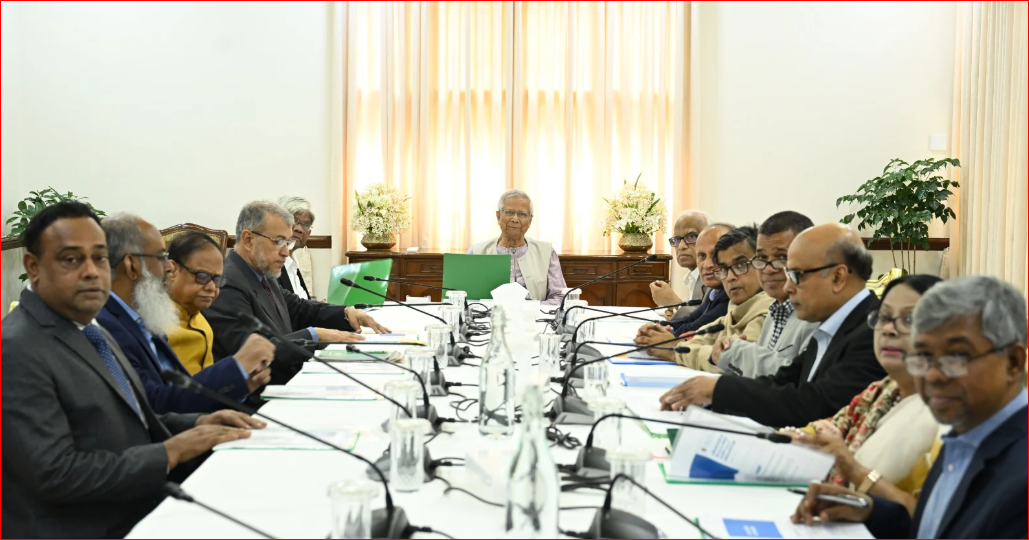
A high-level meeting on the country’s overall economic progress and budget expenditure was held at the State Guest House Jamuna in the city on Monday.
Chief Adviser Professor Muhammad Yunus chaired the meeting attended by, among others, Finance Adviser Dr Salehuddin Ahmed, Planning Adviser Wahiduddin Mahmud and Bangladesh Bank Governor Ahsan H Mansur.
The meeting discussed a range of key economic issues, including inflation, wage growth, agricultural production, financial and external sector, current account, remittance, imports and letters of credit.
Inflation:
The meeting was informed that as a 12-month average, overall inflation in the country fell below 9 percent for the first time in November 2025 since June 2023.
It may be noted that on a point-to-point basis, inflation crossed 9 percent in March 2023, reaching 9.33 percent. However, overall inflation (point-to-point) had already declined below 9 percent in June 2025 and further decreased to 8.29 percent in November 2025.
It is expected that due to the government’s contractionary monetary policy and austerity measures, inflation will fall below 7 percent by June 2026.
Wage Growth:
The meeting was informed that in recent years, the gap between inflation and wage growth rates has been very wide, resulting in a decline in real income of the people. However, in recent months of the current fiscal year, this gap has narrowed significantly.
In November 2025, point-to-point inflation and wage growth stood at 8.29 percent and 8.04 percent respectively, compared to averages of 9.02 percent and 7.04 percent in FY 2022–23.
As a result, although real income had declined considerably in previous years due to high inflation, a gradual recovery is expected in the current fiscal year.
Agricultural Production:
The meeting was also informed that due to appropriate incentives and management in the agricultural sector, Boro production was good in the last fiscal year. As no major natural disasters have occurred so far, a good harvest of Aman is also expected this year.
Consequently, it is anticipated that the government’s food grain procurement target will be achieved in the current fiscal year. As of December 15, 2025, Aman production has reached 160.95 lakh metric tons. Once harvesting of the remaining crops is completed, production is expected to exceed the target.
Although Aus production was slightly below the target, total production increased by 7.20 percent compared to FY 2024–25.
Overall imbalances among various economic indicators have already moved toward a balanced position.
Financial and External Sector:
As of December, 18 2025, gross foreign exchange reserves stood at US$ 32.57 billion, compared to around US$ 25 billion in August 2024.
With exchange rate stability, increased remittance inflows and a significant rise in interest rates recently in the financial sector, foreign exchange reserves are expected to increase further in the coming days.