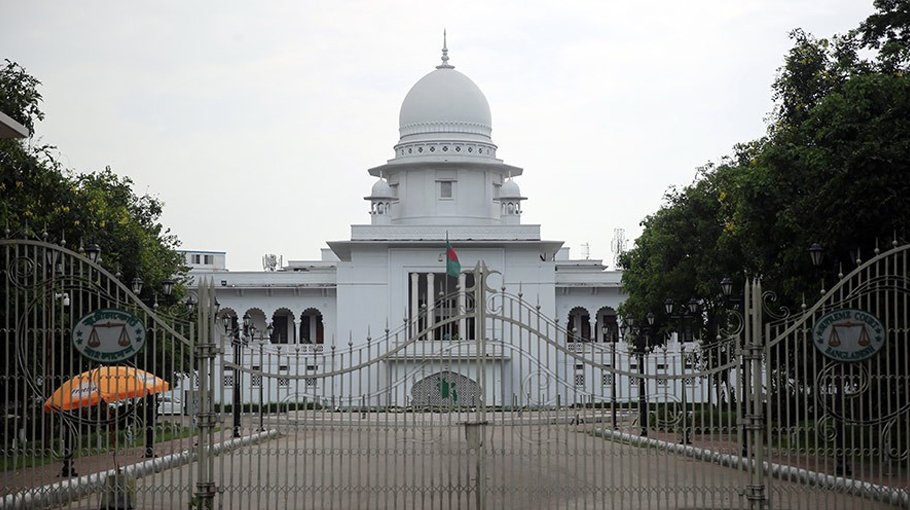
The High Court has raised questions about the legality of the existing provision of the death penalty in the absence of a clear policy framework in light of Bangladesh’s commitments under international law.
The HC bench of Justice Mustafa Zaman Islam and Justice Md Abdullah issued the rule on Tuesday (January 30), asking why policy guidelines on the matter have not been developed yet.
The rule came in response to a writ petition filed challenging the death penalty because Bangladesh is a signatory to an international law
banning it. The Secretary of the Law and Justice Division of the Law Ministry, the Secretary of the Legislative and Parliamentary Affairs Division of the ministry, and the registrar general of the Supreme Court have been asked to respond to the rule.
The writ petition was filed on December 7, challenging the existing provision of the death penalty.
Advocate Ishrat Hassan filed the writ petition. She took part in the hearing in the court, while Deputy Attorney General Tushar Kanti Roy and Assistant Attorney General Salim Azad represented the state.
Advocate Ishrat Hassan cited the abolition of the death penalty in 112 countries and argued that it be declared unconstitutional in Bangladesh.
Many developed countries, along with neighbouring countries like Bhutan and Nepal, have abolished capital punishment, said the lawyer. She also said that Bangladesh was a signatory to an international law banning the death penalty.
The death penalty was discouraged in the “UN Convention on Human Rights-1948”, “International Convention on Civil and Political Rights-1966” and “Convention against Torture-1984”.
As Bangladesh is a signatory member country of the laws, hence there is an obligation to prohibit the death penalty.
The writ petition further contends that the provisions for capital punishment under Bangladesh’s Penal Code contradict Articles 32 and 35 of the country’s Constitution.