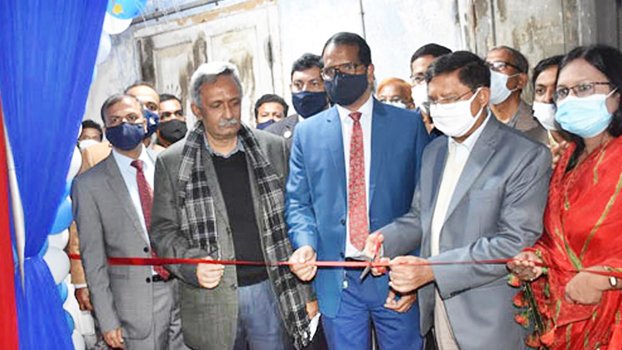
Textiles and Jute Minister Golam Dastagir Gazi (Bir Protik) said the government has taken move to bring more power looms of the factory in operation to restore the lost glory of traditional Rajshahi Silk.
“We are pledged to revive the lost glory of silk,” he said adding that when all the 63 looms will go into operation 2.87 lakh meters silk clothes will be produced every year.
Minister made the remarks while he was formally reopened the Rajshahi Silk Factory as part of the government’s efforts of revitalizing the traditional silk sector in phases.
He said BSDB has adopted a Taka 32-crore project for boosting silk
production and mulberry farming.
The minister further said closure of the mill was very much unfortunate for people of the area. People of the city are struggling for a long demanding reopening of the mill. Besides, he said many people of the region will be employed here after reopening the mill.
Simultaneously, a model factory will be set up adjacent to BSRTI here as an exhibit so that people visiting here from outside could get a real picture of Rajshahi silk.
He reopened operational activities of 19 looms of the state-owned factory to mark the Mijib Borsha, birth centenary of Father of the Nation Bangabandhu Sheikh Mujibur Rahman, on Sunday afternoon as chief guest.
Fazley Hossain Badsha, MP, Advocate Adiba Anjum Mita, MP, Secretary to the cTextiles and Jute Ministry Lokeman Hossain Mian and Chairman of Bangladesh
Handloom Board Shah Alam were present on the occasion. Six of the looms were reopened in 2017 for the first time locally after around 16 years of closure in 2002.
The minister also went round different sections of the silk factory and Bangladesh Sericulture Research and Training Institute (BSRTI) to see for himself their activities.
Minister Dastagir Gazi asked the BSDB and BSRTI officials and others concerned to put in their best efforts to make the state level silk sector
profitable for the sake of protecting its existence. He said there is no way but to down the cost of production to make the sector profitable. It is very essential to take the sector forward through facing all existing challenges.
“We have to build the silk sector as a model to inspire and promote the private sector,” he added.
According to the sources concerned, the factory was commissioned on 15.5 bighas of land in the city’s Seroil area in 1961.
In 1996, the then Awami League government modernised the factory through adding modern machines at a cost of around Taka 10 crore and restarted it partially subsequently.
But, the then BNP-led four-party alliance government declared the factory lay off in the name of continuous loss on November 30, 2002.