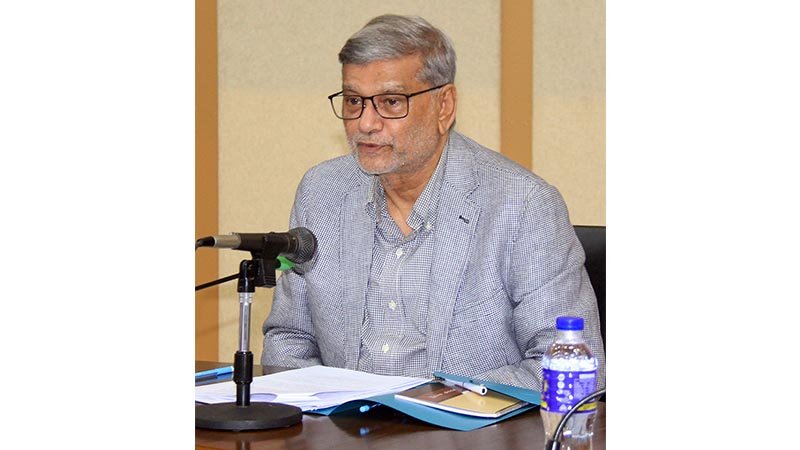
The government will go tough on project directors, contractors and concerned persons engaged in different development programmes if they continue neglecting their duties. “It is very unfortunate, most of the project directors and contractors are not available at their respective work places. It is not acceptable. Such trends should stop. If they continue to do so they will face the music,” Planning Minister MA Mannan came up with this warning at the public- private stakeholder committee’s 13th meeting at National economic Council (NEC)bhaban conference room at planning commission campus at Agargaon in the city on Thursday.
Project directors and contractors of ongoing development programmes will have to be accountable and transparent at their respective workplaces across the country, experts said. Implementation of most of the ongoing project works are being delayed due to negligence of project directors and contractors, making the overall development scenario frustrating.
The Minister said, “If the project directors and contractors are not accountable and transparent, the whole process to implement the ongoing projects will face serious setback.” As the project directors and contractors are not accountable and transparent in their works, they are not available at the respective work places. If such trend of negligence in performing responsibilities continues, project implementation will suffer, the panning minister said.
He further said that, monitoring of accountabilities of concerned stakeholders should be ensured for proper implementation. Implementation Monitoring and Evaluation Division (IME Division) Abul Mansur Md. Faizullah said that, in the last fiscal year Asian Development Project (ADP) allocated 1 lakh 76 crore dollar. It will add additional 25 thousands crore taka to this project.
He further remarked that, in Bangladesh no project finishes in time. As a result, government loses both time and labor. In the introduction to DIMAPPP, Bangladesh makes substantial investment in annual development program (ADP) each year. It is estimated that the annual expenditure on public procurement, amounting to over 16 billion us dollars, is more than 75 percent of ADB of the national budget.
The government has been making sustained efforts over the years to bring about a positive change in public procurement environment. The central procurement technical unit (CPTU) of the implementation monitoring and evaluation division (IMED) ministry of planning, has implemented a serious of reforms including digitization of public procurement towards that end.
The country now has good foundation of public procurement system that includes a well-functioning nodal agency-the central procurement unit-to regulate public procurement laws with rules and associated document.To ensure reforms accomplish more tasks, the CPTU has been implementing a new project titled,“Digitizing implementation monitoring and public procurement project” since July 2017.
The project, supported by the World Bank, aims to improve public procurement performance and enhance capacity for implementation monitoring of development program/project. DIMAPPP has four components restructuring CPTU and institutionalizing-GP, enhancing digitization of public procurement, professionalizing procurement and citizen engagement (CE) and (IV) digitizing project implementation monitoring.
The BRCK institute of government and development (BIGD) is assigned as aconsultant to lead the design and implementation of the citizen engagement sub- component of DIMPPP. Under this component, BIGD is supposed to carry out three major activities including, public-private stakeholder committee (PPSC) dialogue, and, site- specific citizen monitoring(SSCE) at the local level and coordination, technical and advisory support to the CPTU.
The PPSC led by the minister for planning comprises 34 relevant representatives from the public and the privet sector, BIGD was a consultant under the public procurement reform project (PPRP II) and II (extension phase) under which it successfully organized 12 PPsc meetings. It also developed and implemented a citizen engagement strategy which was piloted quite successfully in 4 upazilals of 2 districts.