The government has paid tribute to Bangladeshi peacekeepers serving under the United Nations, recognising their sacrifices and contributions to global peace and security.
Foreign Affairs State Minister Shama Obaed Islam on Monday praised the role of Bangladeshi peacekeepers, saying their dedication and sacrifices are often not fully appreciated at home despite earning international recognition.
"They continue to work under difficult and dangerous conditions out of love for Bangladesh and a commitment to upholding the country’s honour," she said.
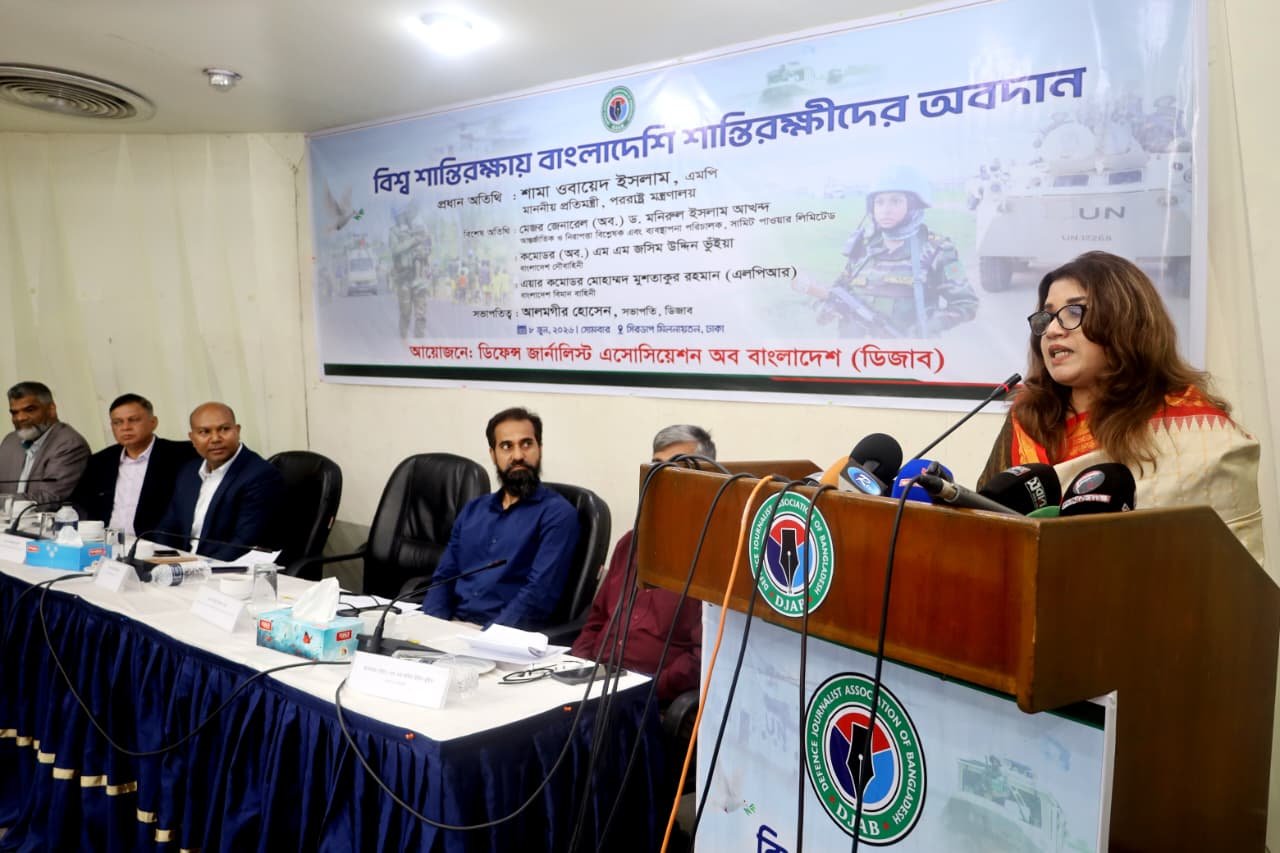
The state minister made the remarks while addressing a seminar titled "Contribution of Bangladeshi Peacekeepers to World Peace" at the CIRDAP auditorium in Dhaka. The event was organised by the Defense Journalist Association of Bangladesh (DJAB).
Speaking as the chief guest, Shama Obaed said she had witnessed firsthand the respect and appreciation Bangladeshi peacekeepers receive in various African countries.
"When attending conferences in Africa, I realised that many of us in Bangladesh do not fully understand the significance of their achievements. They risk their lives every day in the service of peace," she said.
Paying tribute to the families of peacekeepers, she said their sacrifices often go unnoticed.
"I also want to honour their families. They send their fathers, husbands and brothers abroad without knowing whether they will return safely. They make these sacrifices out of patriotism and love for Bangladesh," she added.
The state minister said she personally salutes the peacekeepers and extends the government's appreciation for their service.
She also assured continued support from the Ministry of Foreign Affairs, saying peacekeepers would receive assistance whenever needed.
The seminar was chaired by DJAB President Alamgir Hossain. It was moderated by the organisation's General Secretary Tarikul Islam Masum.
Among the special guests were Major General (retd) Dr Monirul Islam Akhand, international relations and security analyst and managing director of Summit Power Limited; Commodore (retd) MM Jasim Uddin Bhuiyan of the Bangladesh Navy; and Air Commodore Mohammad Mushtakur Rahman (LPR) of the Bangladesh Air Force.
The speakers said Bangladesh's success in UN peacekeeping operations reflects not only military professionalism but also the country's humanitarian values, discipline and leadership.
They highlighted Bangladesh's contributions to the reconstruction of Sierra Leone, the deployment of the first all-female Muslim police unit in Haiti, healthcare and infrastructure development initiatives in Africa, and the recent award of the prestigious Dag Hammarskjöld Medal as examples of international recognition earned by Bangladeshi peacekeepers.
DJAB President Alamgir Hossain said there is a common misconception that peacekeepers earn large amounts of money during overseas deployments.
"The reality is that a significant portion of the financial benefits is received by the government," he said.
Sharing his experience of visiting peacekeeping mission areas, he noted that many peacekeepers sacrifice important moments of their personal lives while serving abroad.
"Many cannot hold their newborn children for the first time and are forced to see them only through video calls. Some are unable to return home even when close family members pass away," he said.
He added that Bangladeshi peacekeepers perform their duties under constant risk while safeguarding both global peace and the country's reputation.
The keynote paper was presented by Md Tawohidul Haque, associate professor at the Institute of Social Welfare and Research of the University of Dhaka and a crime and society expert.
He said Bangladesh began its peacekeeping journey in 1988 with just 15 military observers but has since become one of the world's leading contributors to UN peacekeeping missions.
According to him, more than 206,000 Bangladeshi peacekeepers have served in over 63 missions across 43 countries.
Currently, 4,212 members of the Bangladesh Armed Forces and police are deployed in various UN peacekeeping operations worldwide.
Dr Haque said 175 Bangladeshi peacekeepers have made the ultimate sacrifice in the service of international peace and security.
Former DJAB presidents Abul Khair and Mamunur Rashid, senior journalist Masud Karim, university academics and researchers also addressed the seminar.
The speakers emphasised the need for continued policy support and stronger international cooperation to sustain Bangladesh's leadership in peacekeeping operations.
They also noted that Bangladesh continues to play a significant role in advancing this year's UN peacekeeping theme, "Invest in Peace", through the professionalism, sacrifice and humanitarian contributions of its peacekeepers.
The seminar concluded with a tribute to Bangladeshi peacekeepers who lost their lives in the line of duty and a call to promote awareness of their contributions among younger generations.
Representatives from several diplomatic missions in Dhaka, including Mahadi Al Hasnat, Press Specialist at the Public Affairs Section of the US Embassy in Dhaka, were also present.