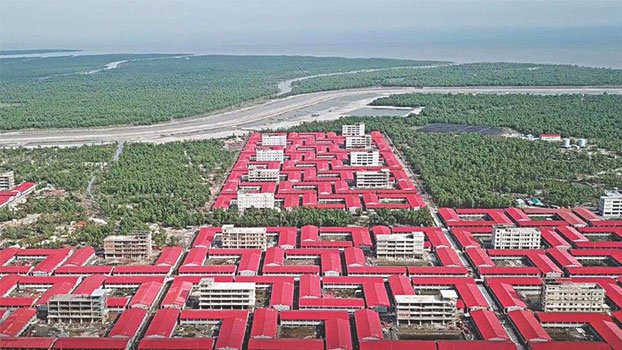
Bangladesh is planning to commence “initial transfer” of Rohingyas after the monsoon season to give the Myanmar nationals taking shelter in Cox’s Bazar a better place for living.
The government also welcomes any third country resettlement as an alternative to Bhashan Char relocation.
Foreign Secretary Masud Bin Momen on Monday on the eve of the three years of the latest exodus began on August 25 in 2017 said they would arrange a go-and-see visit for the relatives of the already sheltered Rohingyas and other representatives to Bhashan Char soon.
Some 306 Rohingyas rescued in the Bay of Bengal have been sheltered in the Island. They were living in the river island even during the massive cyclone Amphan.
“If they (after go-and-see visit) find the place better than the cramped camps in Cox’s bazar, we expect to commence initial transfer of Rohingyas there after the Monsoon season,” the foreign secretary said. He was speaking at a webinar organised by the Center for Peace Studies (CPS) of the South Asian Institute of Policy and Governance (SIPG) at the North South University in Dhaka.
The US ambassador in Dhaka and the Canadian High Commissioner were also present, among others.
The international community has been preventing the government to relocate some Rohingyas to the Bhashan Char citing safety and security concerns.
The mighty cyclone Amphan has attested to the durability of the island and quality of the structures built.
“Detractors should now stop their propaganda on Bhasanchar and examine how to relieve pressure off from the highly congested Cox’s Bazar area where locals are outnumbered at a ratio of 2:1,” the foreign secretary said.
“Third country resettlement (TCR) as an alternative to Bhashan Char relocation is a welcome thought,” he said.
“Given the past experience of TCR globally in recent years, this cannot be a serious option, other than some countries getting the satisfaction of offering something new.
“If a group of countries can jointly offer to take over half a million Rohingyas in a time span of 1-2 years, we may consider examining it.”
The foreign secretary highlighted the hazards of the crowded camps in Cox’s Bazar including crimes in and around the camps.
Involvement of Rohingyas in various crimes- human trafficking, drug, murder, abduction for ransom, sex trade, rape, thefts and robbery are higher than the host communities.
Radicalization of youth cannot be ruled out altogether in a situation of despair and hopelessness, the foreign secretary said.
In recent times quite a few Rohingyas have died in internal clashes.
Rohingyas have traditionally been used as carriers of methamphetamine, popularly known as Yaba.
Despite all efforts, Yabas are being smuggled to other parts of Bangladesh. Criminal activities tended to increase in the nighttime and these insecurities are spreading beyond the camps.
“As such, Bangladesh had no option but to consider the erection of a barbed-wire security fence around the camps to curb criminal activities in the area,” he said.
“These are not for their isolation, but for their good and security of locals. It must be mentioned here that access to humanitarian actors remains unhindered.”
“In order to reduce all these risks, Bangladesh has invested hundreds of millions of dollars on infrastructural development of the island to accommodate a maximum of 100,000 persons.
“It has provisions for 120 clusters. Each cluster can house 768 persons in 12 houses. A total of 1440 houses and 120 shelter stations have been built,” he said about the Bhasan Char.
“We have undertaken efforts to make the Island ready for habitation,” he said.
a. Arranged adequate health, sanitary facility and vaccination, with referral system for complicated health conditions.
b. Created temporary works and livelihood options (salt-tolerant paddy, horticulture, fisheries, poultry and animal husbandry.
c. Arranged primary-nonformal and formal-education which can be extended to secondary education. Vocational education and skill development facilities may be established in due course.
The foreign secretary said UN teams are expected to visit Bhashan Char & Prepare UN System’s assistance response.
“We may also arrange visits of human rights groups and select media to appreciate the facilities created.”