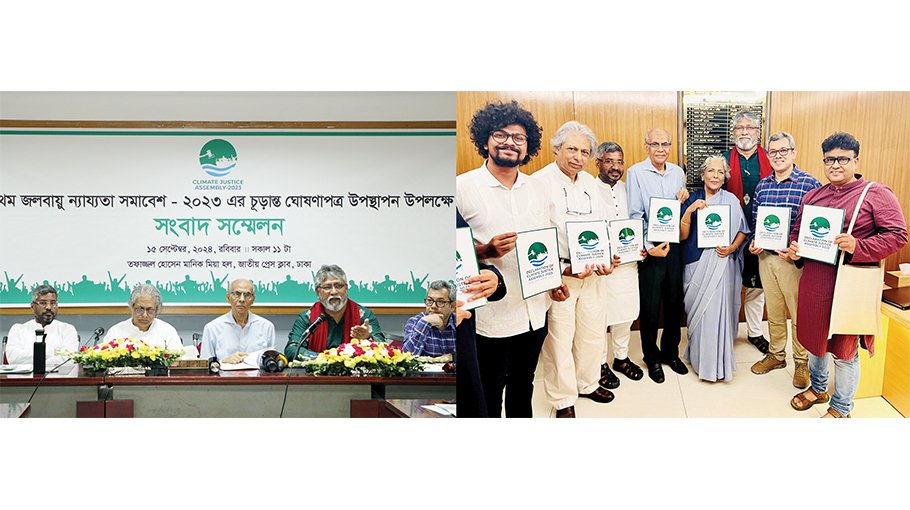
Green activists on Sunday (September 15) said that the transboundary river countries should work for equal share of the rivers. The government of Bangladesh has to play a vital role in this regard.
They said this at a press conference organised to present the final declaration of ‘Climate Justice Assembly-2023’ at National Press Club in Dhaka.
Dr Mujibur Rahman Hawlader, former chairman of the National River Conservation Commission (NRCC); was present at the event as the chief guest with MS Siddique, advisor (private) of the Bangladesh Competition Commission and co-convener of the Climate Justice Assembly; in the chair.
Sharif Jamil, member secretary of the organising committee of Climate Justice Assembly 2023; presented the final declaration at the press conference. Professor Dr Ahmad Kamruzzaman Majumder, chairman of the Atmospheric Pollution Study Center (CAPS); Md Shamsuddoha, chief executive of Center for Participatory Research and Development; Monir Hossain Chowdhury, executive director of Environmental Research and Development Alternative (ERDA); Noor Alam Sheikh, coordinator of Sundarban Rokkyai Amara; Sohanur Rahman, executive coordinator of YouthNet for Climate Justice; Rowman Smita of Global Thinkers Society; Dr Mustafizur Rahman; Nikhil Chandra Bhadra; Faisal Ahmed; Md. Jahangir Alam, and Aman Ullah Parag also attended the press conference, among others.
At the end of the press conference, a seven-member delegation handed over the copy of the final declaration to Syeda Rizwana Hasan, adviser for the Ministry of Environment, Forest and Climate Change; and Sharmen S. Murshid, adviser for the Ministry of Social Welfare and Women Affairs at their offices in Bangladesh Secretariat.
In the speech at the press conference, Dr Mujibur Rahman Hawlader said, “We are responsible for the Matarbari coal power project. Why did we take this decision against the public interest? Buildings and factories occupying river must be evacuated. They should be brought under the law.”
In the presidential speech, MS Siddiqui said that the government must play an active role to ensure equal right of transboundary rivers.
The final declaration identified thematic issues based on the analysis of the harmful effects of climate change and put forward proposals based on them.
In the final declaration, Sharif Jamil said that the campaign organized in response to the urgent demand of the people has made an important contribution to the progress of a larger movement for climate justice in Bangladesh.
He mentioned that as part of the main objectives of the country’s Integrated Energy and Power Master Plan (IEPMP), the development of renewable energy and the phase-out of existing coal and gas-based power projects should be planned, as well as the use of false solutions or unproven technologies should be avoided and public-oriented, to develop environmentally friendly, ecologically balanced and climate-resilient policies and strategies requires mutually productive dialogue and partnership between relevant government agencies, institutions and communities.
He demanded that the Strategic Environmental Assessment (SEA) completed in the South-West region should be redone with scientific and local community involvement and the Strategic Environmental Assessment (SEA) initiative in the South-East region should be carried out with transparency and accountability.
In his speech, Professor Dr Ahmad Kamruzzaman said that developed countries are emitting most of the carbon. “We, the eastern countries are suffering. We are not justified. So we have to raise our voice to end discrimination,” he said.
Md. Shamsuddoha said, “We are trying to create a climate justice narrative. We are constantly affected by climate change. We need to create a National Narrative of Climate Justice.”
“We have seen that the affected people are not getting their solution,” said Sohanur Rahman
Jahangir Alam said, “Our internal development process should not damage people’s livelihood.”
Nikhil Chandra Bhadra said that the government is taking positive steps. “We expect the government to take quick and effective steps to solve the climate crisis,” he added.
Raoman Smita said, “We must make research-based claims for climate justice. Care should be taken to ensure that climate fund money reaches the affected people.”
Amanullah Parag said, “Our policies have nothing to do with the common people and the marginal people. They must be included in the next NDC.”