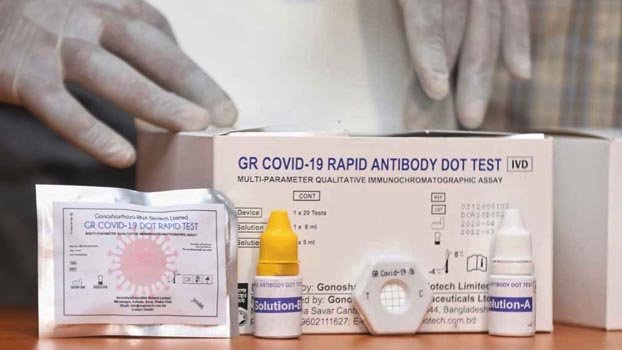
The third-party evaluation of the much-talked-about Gonoshasthaya Kendra kit for coronavirus has found that it is not suitable for finding Covid-19 in patients with symptoms.
The Bangabandhu Sheikh Mujib Medical University (BSMMU) which was requested by the drug administration to conduct the evaluation found that the kit is not effective for patients who have symptoms.
“It could only detect 11 percent to 40 percent of patients who showed symptoms in the first two weeks.”
They also found that this kit can detect antibodies but cannot separately detect IgM (which is created at the beginning of the infection) and IgG (which is created in the later phase of the infection).
BSMMU Vice-chancellor Prof Kanak Kanti Barua disclosed the findings on Wednesday.
Gonoshasthaya on March 17 announced that they had developed a testing kit (G-Rapid Dot Blot) that could examine samples to detect Covid-19 within 15 minutes.
The issue drew huge media attention as the Gonoshasthaya team held a press briefing and claimed the success without any validation by the third party.
They also asked the government to use it.
The Directorate General of Drug Administration (DGDA) has asked them to follow the rules.
On April 29, following Gonoshasthaya’s appeal, the drug administration appointed BSMMU as the Contract Research Organisation (CRO) to conduct a scientific evaluation on the testing kit.
The BSMMU formed a six member research team led by Prof of virology Dr Shahina Tabassum.
On May 13, they started the research titled "Evaluation of GRCovid-19 Rapid Antibody Dot Test and GR Covid-19 Rapid Antigen Dot Test for detection of Sars-Cov-2".
They completed the research within a month through 509 blood testing samples, and it took another week to complete statistical evaluation.
The BSMMU team made few recommendations also.
The drug administration will make the final decision.
Earlier, on May 12, Gonoshasthaya gave 200 antibody testing kits to the BSMMU research team.
Initially, the aim was to carry out research based on blood tests, but on May 19 Gonoshasthaya requested them to test saliva instead.
The research team applied to IRB, BSMMU and on May 23, they granted the revised proposal.
Later, Gonoshasthaya again requested the BSMMU research team to temporarily stop the antigen test and continue research on the antibody test kit only.
BSMMU says these changes by Gonoshasthaya delayed the research.
The research team did not take any remuneration for the month-long research. And they disclosed that they do not have any involvement or interest with Gonoshasthaya.