Although Dhaka always remains at the top of the list of air pollution even in the world, its adjoining district Gazipur has recently surpassed the capital.
According to a study done last year, now Gazipur district has the highest polluted air in Bangladesh, while Dhaka and Narayanganj grabbed the second and third positions. However, Madaripur has the lowest among 64 districts in the country.
The air pollution levels in the districts and some other districts and cities in the country have reached an extreme level due to uncontrolled discharge of dust from construction projects, smoke from vehicles and brick kilns, road digging, renovation work, thousands of small and large industrial plants, and incineration of garbage.
The Center for Atmospheric Pollution Studies (CAPS) of Stamford University Bangladesh collected the data and findings through a countrywide survey from January 6 to April 6 in 2021. It was later reviewed in a scientific manner. An 81-member research team from CAPS carried out the study.
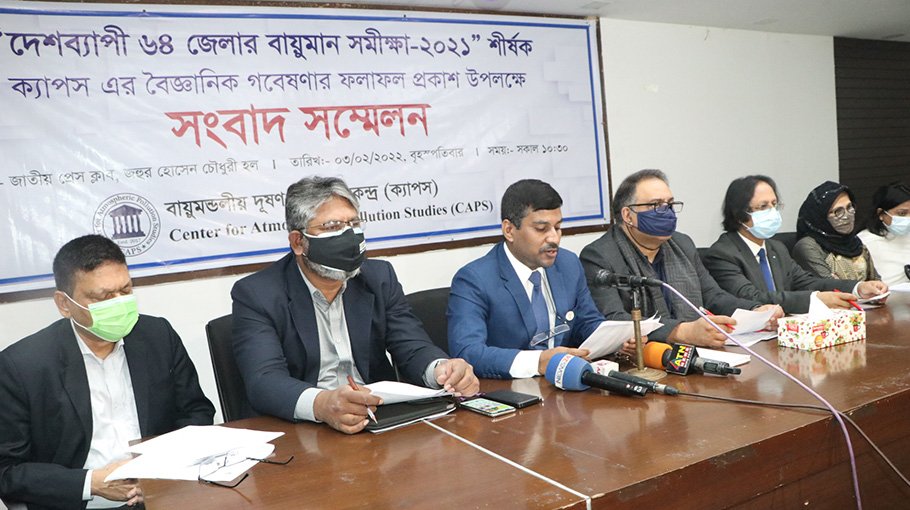
Prof Ahmad Kamruzzaman Majumder, founder and Chairman of CAPS who led the research team, revealed the study report titled ‘Air Pollution Survey-2021 in 64 Districts’ at a press conference at the National Press Club in Dhaka on Thursday (February 3).
Some recommendations were made in the study to control air pollution. These include covering construction sites, covering construction raw materials while transporting, planting more trees, ensuring vehicles are fit to run on roads, conserving water bodies and raising awareness about pollution.
Prof Mohammad Ali Naqi, the Vice-Chancellor of Stamford University Bangladesh, presided over the event, while Prof Dr Mohammad Jasim Uddin of Dhaka University, Sharif Jamil, general secretary of Bangladesh Poribesh Andolon (BAPA), Dr Lenin Chowdhury, joint general secretary of Poribesh Bachao Andolon (POBA), Kazi Sarwar Imtiaz Hashmi, a former additional director general of Department of Environment (DoE), Abdullah Al Nayeem of Stamford University, Dr Rashida Begum and Advocate Marufa Gulshan Ara also attended the press conference and spoke there.
The CAPS study shows that Gazipur had the highest level of air pollution at 263.51 micrograms per cubic meter in 2021. Its adjoining districts Dhaka and Narayanganj were in second and third positions with an air volume of 252.93 and 222.45 micrograms respectively.
Prof Ahmad Kamruzzaman Majumder, also head of the environmental science department and dean of science faculty at Stamford University Bangladesh, said that air volumes in Gazipur, Dhaka, Narayanganj and some other districts and cities in Bangladesh are considered ‘very unhealthy’.
The expert on air and sound pollution also said that air pollution causes the highest number of deaths among deaths caused by non-communicable diseases globally.
The highest level of air pollution that can be accepted as normal is 65 micrograms per cubic meter. However, air quality of Gazipur, Dhaka and majority of the districts in Bangladesh is above the 65 micrograms, according the study report.
An AQI (air quality index), an index for reporting daily air quality, between 101 and 200 is considered ‘unhealthy’, while 201 and 300 is considered ‘poor’ as well as ‘very unhealthy’, and a reading of 301 to 400 is said to be ‘hazardous’, posing serious health risks to people.
The CAPS study shows that in 2021, the average amount of microscopic particles in 3,163 places in 64 districts was 102.41 micrograms per cubic meter, which is about 1.57 times more than the daily standard (65 micrograms). The air quality of some cities was about 4-5 times higher than the standard in Bangladesh.
In the study, Madaripur’s air quality has been described as good with an air volume of 49.08 micrograms. Madaripur is followed by Patuakhali and Meherpur. The abundance of rivers, reservoirs and greenery are the main reasons behind the good air quality of Madaripur and some other districts. Apart from this, the amount of road repair work in these areas was not mostly seen during the survey.
According to the study, the other districts with excessively air pollution are Habiganj (220.11 micrograms), Noakhali (204.01), Tangail (186.32), Cox’s Bazar (183.41), Chandpur (170.42), Chattogram (165.31), Kishoreganj (165.13), Moulvibazar (154.81), Laxmipur (149.02), Panchagarh (142.31), Mymensingh (138.11), Brahmanbaria (134.72), Feni (128.41), Thakurgaon (125.32) and Jamalpur (121.61).
According to the survey, air quality in 36 districts is moderately polluted. The districts are Jashore (111.12 micrograms), Munshiganj (103.72), Manikganj (101.91), Sherpur (100.42), Netrokona (99.63), Barguna (98.58), Khagrachhari (98.17), Sylhet (97.02), Gopalganj (94.47), Narsingdi (93.65), Gaibandha (93.03), Rangamati (92.07), Chuadanga (90.3), Sunamganj (89.05), Pirojpur (87.93), Bogura (87.02), Cumilla (86.77), Magura (86.01), Lalmonirhat (86.1), and Bandarban (84.04 micrograms).
Other districts on the list are Naogaon, Chapainawabganj, Jhalokati, Bhola, Nilphamari, Shariatpur, Dinajpur, Jhenaidah, Barishal, Satkhira, Faridpur, Bagerhat, Rangpur, Narail, Kushtia and Khulna. The particles in the air of these districts are between 80 and 67 micrograms.
The survey found good air quality in only 10 districts. The particles in the air of these districts are below 65 micrograms per cubic meter. The districts are Kurigram, Natore, Joypurhat, Rajbari, Rajshahi, Pabna, Sirajganj, Meherpur, Patuakhali and Madaripur.