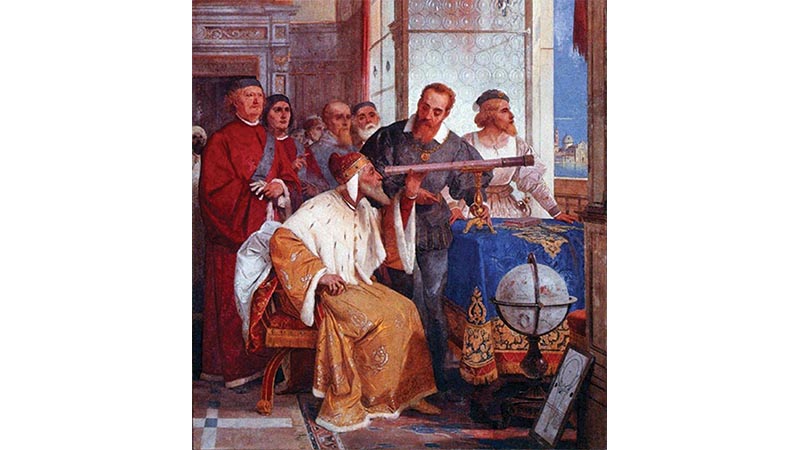
On this day in 1609 Galileo Galilei demonstrated his first telescope to Venetian lawmakers, including Leonardo Donato, the Doge (ruler) of Venice. At the time, Galileo taught geometry, mechanics and astronomy at the University of Padua, which was part of the Venetian republic. A year after the demonstration, he published Starry Messenger, which described his finding - made with his new telescope - that Venus and the moons of Jupiter have phases, like the Moon.
Galileo demonstrated one of his early telescopes, with a magnification of about 8 or 9, to Venetian lawmakers. His telescopes were also a profitable sideline for Galileo, who sold them to merchants who found them useful both at sea and as items of trade. He published his initial telescopic astronomical observations in March 1610 Galileo’s eight-powered telescope, and the more powerful models he soon produced, when pointed skywards gave the fascinating image of the night sky.
The moon was not, as long believed, completely smooth. Another planet, Jupiter, also had moons. Meanwhile Venus showed a range of moon-like phases, something which could not happen if both it and the sun orbited the Earth. Galileo Galilei (15 February 1564– 8 January 1642) was an Italian physicist, mathematician, astronomer, and philosopher, who played a major role in the Scientific Revolution. His achievements include improvements to the telescope and consequent astronomical observations, and support for Copernicanism. Galileo has been called the "father of modern observational astronomy," the "father of modern physics," the "father of science"and "the Father of Modern Science."Stephen Hawking says, "Galileo, perhaps more than any other single person, was responsible for the birth of modern science."
The motion of uniformly accelerated objects, taught in nearly all high school and introductory college physics courses, was studied by Galileo as the subject of kinematics. His contributions to observational astronomy include the telescopic confirmation of the phases of Venus, the discovery of the four largest satellites of Jupiter, named the Galilean moons in his honour, and the observation and analysis of sunspots. Galileo also worked in applied science and technology, improving compass design. —Ancient Pages