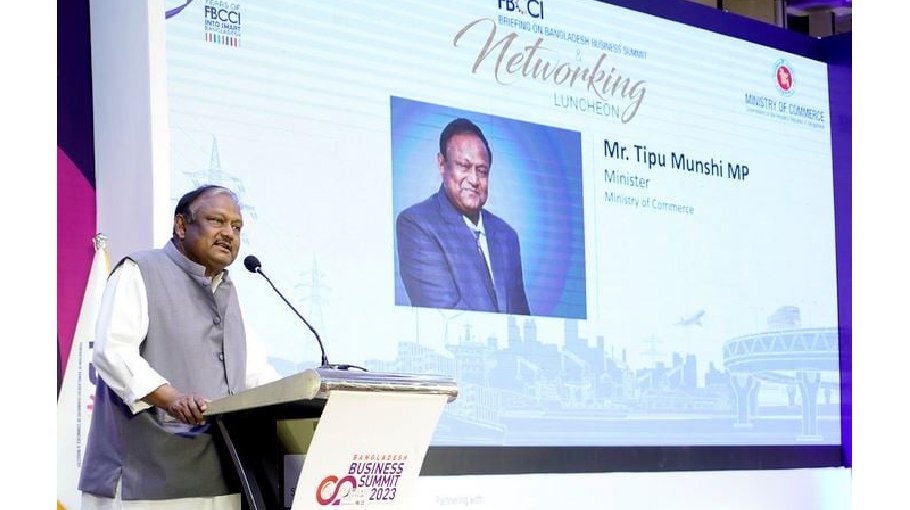
Commerce Minister Tipu Munshi on Thursday said that there is enough manpower at mid-level in the RMG sector from the country and thus foreign manpower at the mid-level in the RMG sector is not required anymore.
"Necessary skilled managers have been created in the country at the mid-level in the RMG sector while they are also doing fine in their works. Although we've been performing such tasks through foreign manpower for long, but now enough manpower have been created in the country. So, there is no need to bank on foreign managers anymore," he said.
The Commerce Minister said this while addressing as chief guest the orientation and certificate award ceremony of the BUFT-EPB PGD Programme for Mid-Level Management to create skilled managers in the RMG sector organized by the BGMEA Institute of Fashion and Technology (BUFT) in association with the Ministry of Commerce held in Turag.
The Export Promotion Bureau (EPB) in collaboration with BUFT has launched the diploma courses for mid-level managers and employees of garment factories to
develop their professional skills.
Tipu said that the BUFT has been working to create skilled manpower in this
sector.
Mentioning that skilled manpower is the main driving force for an industry,
Tipu said that the aim of the government is to minimize dependency on foreign
manpower in the RMG sector.
He said that the home grown manpower would meet the local demand as well as
they would also have to play an important role to the industries.
The Commerce Minister cited that the RMG sector of Bangladesh has been able
to make its position in the 2nd slot of the global RMG industry despite
braving various adversities.
Currently around 82 percent of the country's export receipts come from the
RMG sector, he added.
BGMEA President Faruque Hassan said skills development including reskilling
and upskilling were imperative to sustain industry's competitiveness in the
era of fourth industrial revolution (4IR).
"Rapid advances in technologies led to a rise in demand for the workers and
professionals who were skilled enough to operate advanced machinery and
conduct complex and sophisticated production processes," he said.
While automation in the industry will pose new challenges, Faruque said it
will also increase productivity and competitiveness. "We need to reap the
benefits of industry 4.0 through skills development,"
Faruque said, "As we're preparing for the next growth phase, we have to
enhance our business capabilities using latest technologies that make
production more efficient and faster."
He said though there was a perception that automation would result in loss of
many jobs, new jobs would emerge through the adoption of technologies.
"What we need is market-oriented skills training to turn challenges into
opportunities," the BGMEA President added.
Chairman of BUFT Board of Trustees Md Shafiul Islam, MP, BUFT vice chancellor
Professor Dr S M Mahfuzur Rahman, pro-VC Professor Dr Engr. AyubNabi Khan,
vice chairman of EPB A. H. M. Ahsan, and additional secretary at the Commerce
Ministry Abdur Rahim were present at the program.
Mohammed Nasir, former vice president (Finance) of BGMEA, and BUFT Trustee
Board Member; Moshiul Azam Shajal, former vice president of BGMEA, and BUFT
Trustee Board Member; and Abdullah Hil Rakib, director of BGMEA, and BUFT
Trustee Board Member were also present at the certificate giving ceremony.