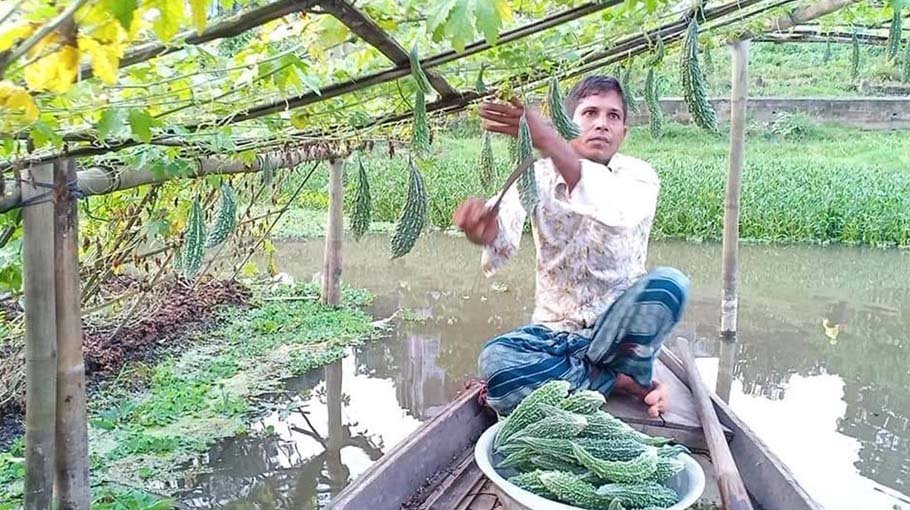
Due to floods, waterlogging and climate change issues, farmers in Kishoreganj district are concentrating on growing vegetables on floating beds. This method of farming is gaining more and more popularity among local farmers as sometimes they cannot produce vegetable seedlings in time for waterlogging.
It is expanding especially in the Haor region. Following this, farmers of Kishoreganj Sadar, Itna, Mithamin, Ashtagram, Nikli, Bajitpur, Tarail, Karimganj and Pakundia upazilas are making vegetable seedbed and cultivating vegetables using that method. This method is becoming popular day by day as it is convenient for farmers to grow vegetables in this way.
When asked about the floating beds visiting on spot recently, the farmers said that due to scarcity of space for seedbeds, no one could make seedbeds in time and they are making seedbeds in this method on the advice of the Department of Agricultural Extension (DAE) to produce seedlings faster and reduce the cost of seedbeds.
Regarding making floating beds, local farmers said that the main material for making these floating beds is water hyacinth that is locally known as Kochuripana. First, a bamboo frame of 10 metre length and 1.25 metre width was formed and placed on the water. Then the frame was surrounded by water hyacinth and arranged in piles. The beds are then covered with 2-3 cm of water hyacinth.
Then vegetables, spice crops or seedbeds can be planted on the beds as required. Later the water hyacinth can be used as cattle feed. In case of making seedbed of Aman paddy, 80 to 100 grams of seeds have to be sown per square meter. In this method additional irrigation is not required, only sprinkling water from time to time is enough. Seedlings prepared in this method can be planted after 12 to 15 days.
Seedlings produced in floating beds can be planted in the cropland like normal seedlings. To ensure proper planting of seedlings of the right age in waterlogged areas and for those farmers who do not have enough space to make seedbeds, this type of floating seedbeds are a reliable alternative for preparing seedlings.
In this method seedlings can be produced at a low cost and within a short time it becomes suitable for planting and that also without using any additional cropland. As the matter is simple and convenient, great interest in doing farming in this method, can be noticed among local farmers
In this regard, Pakundia Upazila Deputy Assistant Agriculture Officer Mohammad Hamimul Haque Sohag said, “Floating beds contain a lot of essential nutrients for plants, so seeds can be sown more densely than in flat lands. Floating bed method allows the crop to grow faster than conventional cultivation and in many cases yields are 3-5 times higher.”
“Different vegetables can also be cultivated in the bed in phases. Later, the decomposed hyacinth of the bed can be mixed with the soil in the crop land as well as at the base of the fruit tree”, he added.
Kishoreganj Agricultural Research Sub-Centre Senior Scientific Officer Mohammad Mohiuddin said, “By making floating beds, the farmer will be able to make a seedbed of transplanted Aman and later cultivate vegetables and grass. This will save the time of the farmer, the crop land can be used in advance. This will increase the profit of the farmer, save cost and produce environment friendly crops. Above all, as a result of climate change, farmers will be able to adapt to adverse environments.”