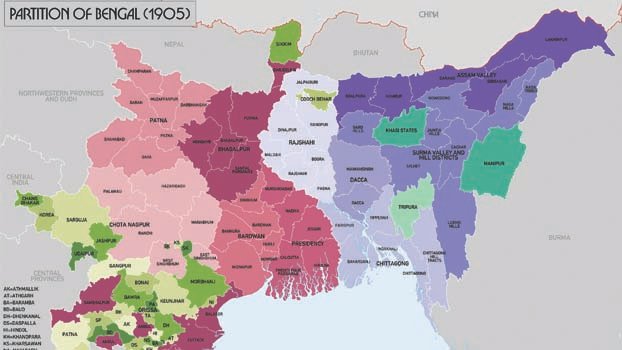
The first partition of Bengal in 1905 brought that province to the brink of open rebellion. The British recognized that Bengal, with some 85 million people, was much too large for a single province and determined that it merited reorganization and intelligent division. The line drawn by Lord Curzon’s government, however, cut through the heart of the Bengali-speaking “nation,” leaving western Bengal’s bhadralok (“respectable people”), the intellectual Hindu leadership of Calcutta, tied to the much less politically active Bihari- and Oriya-speaking Hindus to their north and south.
A new Muslim-majority province of Eastern Bengal and Assam was created with its capital at Dacca (now Dhaka). The leadership of the Congress Party viewed that partition as an attempt to “divide and rule” and as proof of the government’s vindictive antipathy toward the outspoken bhadralok intellectuals, especially since Curzon and his subordinates had ignored countless pleas and petitions signed by tens of thousands of Calcutta’s leading citizens. Mother-goddess-worshipping Bengali Hindus believed that partition was nothing less than the vivisection of their “mother province,” and mass protest rallies before and after Bengal’s division on October 16, 1905, attracted millions of people theretofore untouched by politics of any variety.
The new tide of national sentiment born in Bengal rose to inundate India in every direction, and “Bande Mataram” (“Hail to Thee Mother”) became the Congress’s national anthem, its words taken from Anandamath, a popular Bengali novel by Bankim Chandra Chatterjee, and its music composed by Bengal’s greatest poet, Rabindranath Tagore (1861–1941). As a reaction against the partition, Bengali Hindus launched an effective boycott of British-made goods and dramatized their resolve to live without foreign cloth by igniting huge bonfires of Lancashire-made textiles. Such bonfires, re-creating ancient Vedic sacrificial altars, aroused Hindus in Poona, Madras, and Bombay to light similar political pyres of protest. Instead of wearing foreign-made cloth, Indians vowed to use only domestic (swadeshi) cottons and other clothing made in India. Simple hand-spun and hand-woven saris became high fashion, first in Calcutta and elsewhere in Bengal and then all across India, and displaced the finest Lancashire garments, which were now viewed as hateful imports. The swadeshi movement soon stimulated indigenous enterprise in many fields, from Indian cotton mills to match factories, glassblowing shops, and iron and steel foundries.
Increased demands for national education also swiftly followed partition. Bengali students and professors extended their boycott of British goods to English schools and college classrooms, and politically active Indians began to emulate the so-called “Indian Jesuits”—Vishnu Krishna Chiplunkar (1850–82), Gopal Ganesh Agarkar (1856–95), Tilak, and Gokhale—who were pioneers in the founding of indigenous educational institutions in the Deccan in the 1880s. The movement for national education spread throughout Bengal, as well as to Varanasi (Banaras), where Pandit Madan Mohan Malaviya (1861–1946) founded his private Banaras Hindu University in 1910.
One of the last major demands to be added to the platform of the Congress Party in the wake of Bengal’s first partition was swaraj (self-rule), soon to become the most popular mantra of Indian nationalism. Swaraj was first articulated, in the presidential address of Dadabhai Naoroji, as the Congress’s goal at its Calcutta session in 1906.
-Encyclopaedia Britannica