Despite the vast potential of rooftop solar (rooftop-based solar power) in Bangladesh, progress is mainly stalled due to lack of financing, stakeholders of the sector on Tuesday said at a discussion session.
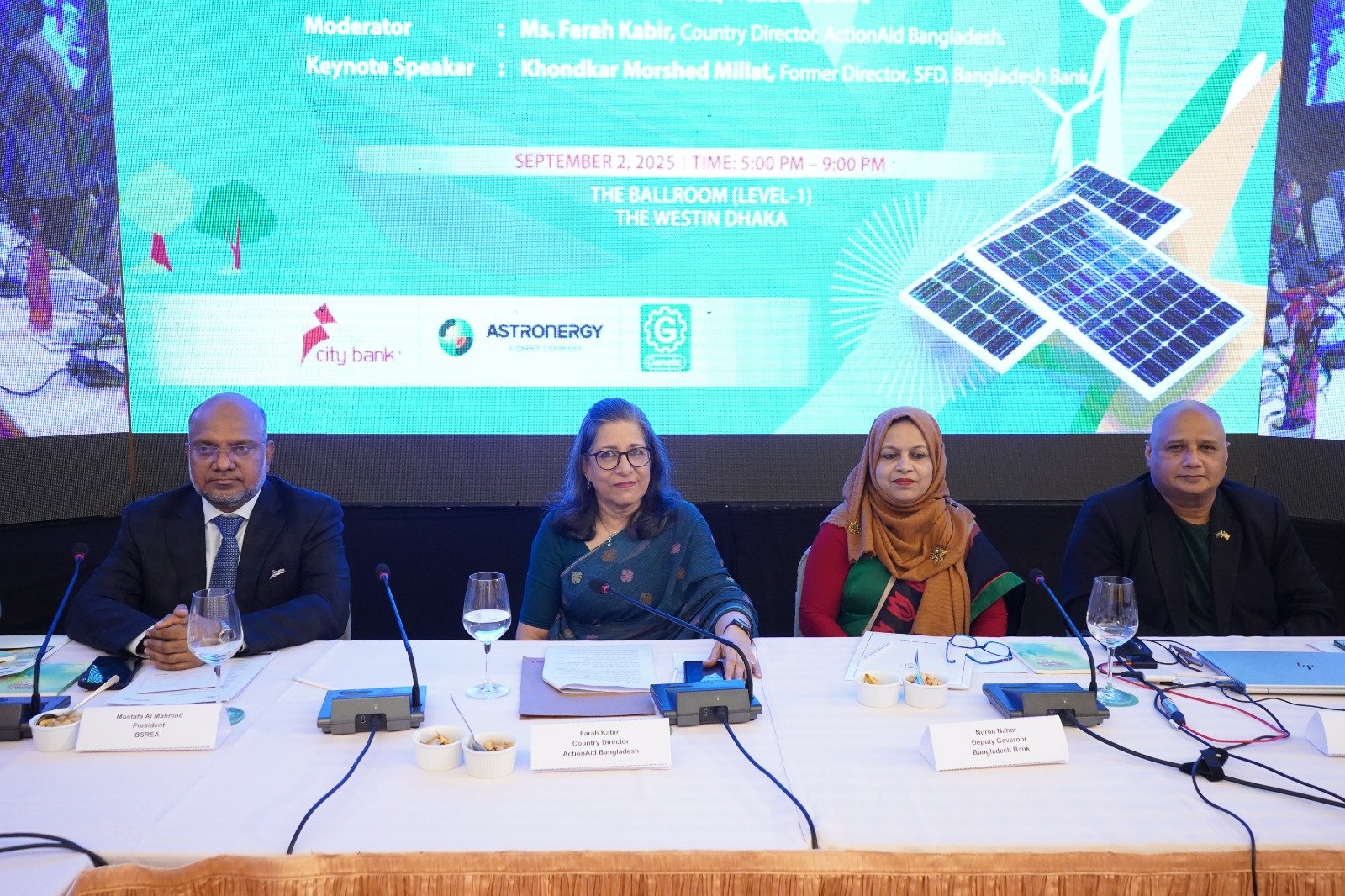
The discussion session titled “Unveiling Solar Rooftop Finance: Towards a Sustainable Energy Future”, was held at a city hotel.
The event was jointly organised by Bangladesh Sustainable and Renewable Energy Association (BSREA) and ActionAid Bangladesh.
Presided over by BSREA President Mostafa Al Mahmud, Bangladesh Bank Deputy Governor Nurun Nahar present was present as the Chief Guest.
 The session was moderated by ActionAid Bangladesh Country Director Farah Kabir and the keynote paper was presented by Khondkar Morshed Millat, former Director (Sustainable Finance Department) of Bangladesh Bank.
Representatives from the Power Division, SREDA, IDCOL, various power distribution companies, commercial banks, non-bank financial institutions (NBFIs), development finance institutions (DFIs), development partners, renewable energy sector leaders, and civil society were also present.
The speakers in their speeches said, although there are currently limited incentives in this sector, they are not yielding immediate effectiveness. Financing and risk management still remain the main obstacles. Due to the absence of aggregation, bundling or risk management tools for small projects, these are not becoming attractive to investors. IDCOL has already demonstrated success in off-grid solar and large projects.
They said, commercial banks and NBFIs can introduce new financial products such as leasing, project financing, ‘pay-as-you-save’ models and green bonds, which will reduce investment risk and ensure sustainable profit. Therefore, if the rooftop solar program is not implemented within the stipulated time, the target of 30 percent renewable energy by 2040 will not be achieved, stakeholders of the sector said.
 BSREA President Mostafa Al Mahmud said, “In the new policy, the target has been set to generate 20 percent of total electricity from renewable sources by 2030 and 30 percent by 2040. Among this, there is a target to install 3,000 MW of rooftop solar by December 2025. But although there is potential in this sector, the big obstacle is financing. Currently only 5.6 percent of electricity is coming from renewable energy, which is much less compared to our neighboring countries.”
He said, “At present there is no alternative to rooftop solar. This is now the most rapidly implementable, sustainable and effective solution. The countless rooftops of our government institutions, hospitals, educational institutions, commercial and industrial factories are waiting to be transformed into clean power plants. Here lies Bangladesh’s opportunity to move forward. Our main problem is not technology, nor is it lack of willpower, the problem is financing.
He further said, in this sector, opportunities for long-term and affordable financing are limited. Many commercial banks are still reluctant to lend to rooftop solar considering it risky. Although there is a net metering facility, the approval process is lengthy, causing time delays, and there are problems in obtaining long-term and affordable loans from commercial banks and NBFIs. If a one-stop service system is introduced at the utility company, the approval process time can be significantly reduced. Due to the absence of aggregation, bundling and risk management tools for small projects, these are still not attractive enough to investors, and if this problem is not solved, project financing will remain limited. That means our rooftop solar potential is still waiting for the right financial ecosystem.”
The BSREA President also said, “Bangladesh Bank has already formulated refinancing schemes, green banking guidelines and sustainable finance policies to encourage green finance, which is commendable. But now it is time to take one step further. Bangladesh Bank can expand refinancing funds, introduce credit guarantees and encourage blended finance models to activate rooftop solar financing. Commercial banks and NBFIs can develop new financial products such as leasing, project financing, pay-as-you-save models and green bonds. This will reduce investment risk and also bring sustainable profit. IDCOL has already shown success in off-grid solar and large projects. Now their expertise needs to be directed towards rooftop solar scale-up, especially in the industrial and residential sectors. If we succeed, rooftop solar will not only reduce our pressure on gas and fuel imports, it will ensure energy security, reduce carbon emissions and create thousands of new green jobs.”
It was stated at the event that to make the national rooftop solar program successful, collective initiative is needed. The Power Division and SREDA need to make policies more transparent, stable and private sector-friendly. Distribution utility companies have to simplify net metering and support grid connectivity. The industrial sector and developers will prepare reliable project lists and implement maintaining standards. And most importantly, development partners will provide support with blended finance, risk guarantees and globally successful models. Rooftop solar finance is the next frontier of renewable energy in Bangladesh. A rooftop solar green finance roadmap needs to be prepared. Green bonds, blended finance and results-based financing models need to be introduced and a Green Finance Taskforce needs to be formed with the coordination of government, banks, private sector and DFIs.