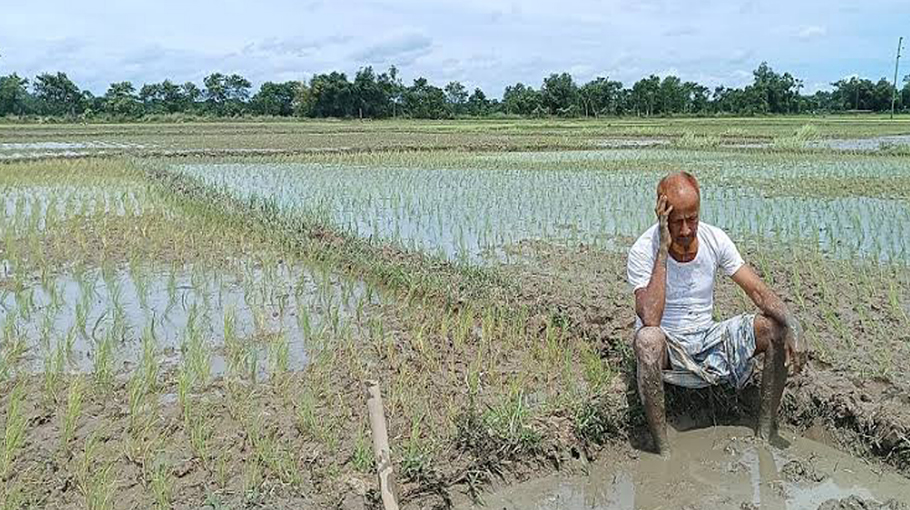
People sometimes have to turn to others for their livelihood. In this case, the marginalized people of the society cannot take loans due to various difficulties with the established system of the society. NGOs and high interest moneylenders are the destination.
From there, someone takes loan money and fulfills special needs such as shops, livestock. And later they are released from the liability by paying at the specified time.
Along with the Coronavirus crisis comes hyperinflation, which has become a scourge in the lives of low-income people. People need to earn to meet the basic needs of the family. As a result, the pressure is increasing due to not being able to pay the loan installments.
Widow Akalima Bewa of Jaldhaka Upazila of Nilphamari has been cultivating a small portion of land along with her son Sohel Rana for a long time. Because of the responsibility of running the family on the crops of this small land, she took a loan of thirty thousand Tk from an NGO and bought her son a battery-operated van in the hope of the family's prosperity. Then the boy left with the van. Now two hundred to two and a half hundred Tk is earned a day. If you exclude the current bill of the van charge, minor work of the van, one and a half hundred Tk remains. This money does not cover the cost to eat. We, mother and son, are alive by eating one meal every day for a few days. The boy is suffering so much but I can't even give him food. Weekly installments are to be paid on Monday. Borrowed from my uncle and paid installments in two weeks. There is no other way now. There is no other way to pay installments other than selling the van. What if we sell the van?
Marginalized people in rural areas have not increased their income in the market of high daily commodities.
Prominent educationist Rangpur Government College Professor Shahidul Islam said that NGOs and moneylenders are falling into the trap of interest on both sides. They cannot get out of this trap. Many people are going to jail for not being able to pay the loan. People are taking these loans mainly to run the family or for financial stability. They do not get loans from conventional banks due to various conditions. NGOs and usurious traders give against bank checks. As a result, common people are leaning towards it.
He also said that NGOs charge 14% interest per year. But interest has to be paid in real installments every week. As a result, the interest is compounded on that amount. They can't put that money to good use. On the contrary, he was forced to take a loan from another NGO to repay the money. And usurers charge incredible rates of interest. Some take interest of 10 taka per month on 100 taka. As a result, once you take a loan, you cannot get out. The land also has to be sold. Marginal farmers reach out to moneylenders for various needs including purchase of seeds, irrigation, pesticides.
Later, despite getting fair price, the farmer lost hope due to the moneylender's additional interest.
Jaldhaka municipality Pantapara farmer Jinnu Mia said that the government sometimes gives some rice seeds. If we were to list interest-free micro-loans during the harvest, then we would not have to charge interest.