Tarash (Sirajganj) Correspondent
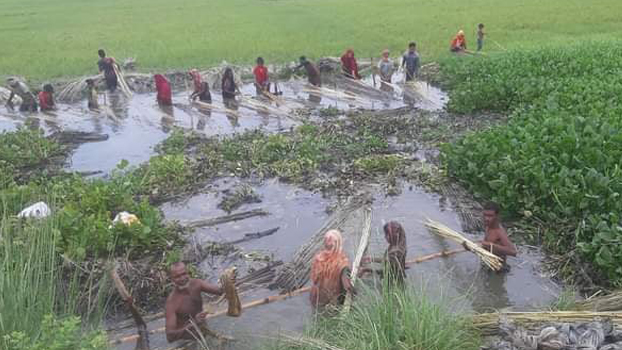
In Tarash upazila of Sirajganj, farmers are now busy in cutting, retting, skinning and drying jute. Although the yield and price of jute in Tarash are good this time, the farmers are in dire straits for lack of water to ret the jute.
They are running from one area to another in search of Beels, ditches and ponds to ret their jute. Many people are making artificial canals and retting the jute in shallow water which is costing them extra money.
According to Tarash Upazila Agriculture Office, jute has been cultivated on 595 hectares of land in the upazila this season. Jute of Desi, Tosha and Mesta varieties have been cultivated on that amount of land. Jute cultivation has increased on 320 hectares of land this year as compared to last year, sources added.
It can be seen in different areas of the upazila that the farmers are now very busy in cutting, retting, washing and drying the jute. This time the yield and price of jute are good and the farmer are happy with that. If only the water crisis was resolved somehow, they could reap a good profit this year without worries, said the farmers.
Habib Sarkar, a farmer from Naogaon village in the upazila, said he has cultivated jute on 5 bighas of land. Due to favorable weather this year, he has received a good yield. He said he hopes to harvest 60 to 65 mounds of jute in total.
The cost of cultivating jute in every Bigha of land was Tk 8 to 10 thousand. He hopes there will be 10 to 12 mounds of jute yield per Bigha. He believes there will be good profit if he gets a fair price for the jute.
Farmer Ershad Ali of Hamkuria village, said the cost of labour from making the land suitable for jute cultivation to weeding, cutting, retting and drying is a little higher than other crops. Moreover, due to the lack of water for jute retting the transportation cost has gone up too.
Farmer Mahbubur Rahman said, jute is being taken by transport 4/5 km away for retting. In the current market jute is is being sold at Tk 2,200 to 2,300 per mound. If it is reduced, the farmers will face extreme losses.
Upazila Agriculture Officer Lutfunnahar Luna said farmers have been inspired to cultivate jute in the field with various suggestions on modern methods of jute cultivation.
Farmers are being more inclined to cltivate jute after getting government facilities including providing free jute seeds and chemical fertilizers to the farmers. Jute cultivation is increasing every year in the upazila.
He added that earlier farmers were dependent on rains for growing and retting jute. At present local farmers are cultivating jute under irrigation system. Due to which jute production is much higher now. This time the rainfall was comparatively less. Due to which the farmers are facing some problems in retting jute in the open water.
However, farmers can process jute in ribbon retting system. In this way they will be able to ret more jute in less water. Jute usually takes 20-25 days to ret in the traditional ways while, the ribbon retting system is done only in 12-14 days. In this method the color and quality of jute remains much better, the official added.