Climate change in Bangladesh engenders insecurity in areas such as food, water, life, property, settlement, livelihoods, and more.
Climate impacts diminish both direct and indirect securities. The deterioration of land resources through environmental degradation not only diminishes food security but also intensifies resource conflicts, threatens livelihoods, and exacerbates various diseases and health risks.
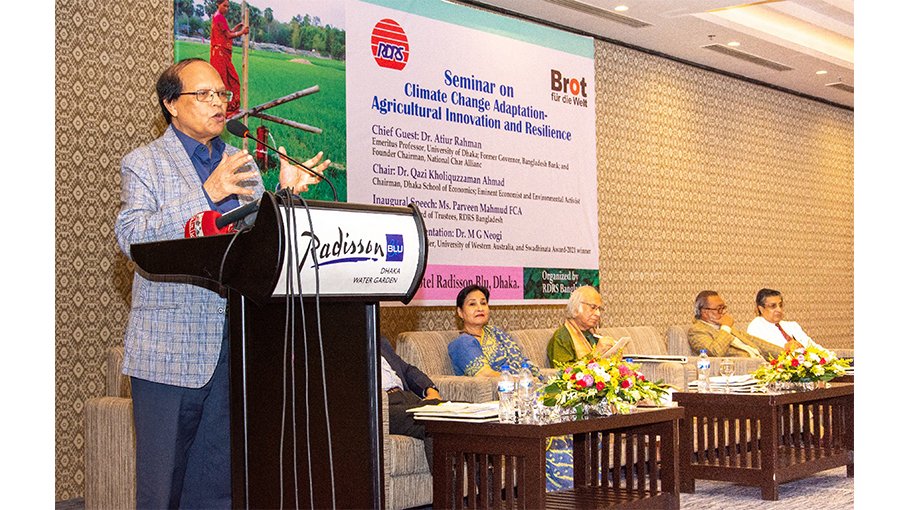
RDRS Bangladesh, a non-governmental organization, is taking steps to bring people from different flocks together to address this crucial issue. In this context, RDRS organized a seminar titled ‘Climate Change Adaptation, Agricultural Innovation, and Resilience’ at a city hotel in Dhaka on Saturday.
Parveen Mahmud, FCA, Chairperson, Board of Trustees, RDRS Bangladesh, inaugurated the event.
Dr. Atiur Rahman, Emeritus Professor, University of Dhaka; Former Governor, Bangladesh Bank; and Founder Chairman, National Char Alliance was present as the Chief Guest, while Dr. Qazi Kholiquzzaman Ahmad, Chairman, Dhaka School of Economics; Eminent Economist and Environmental Activist chaired the event. Dr. Md. Abdul Muyeed, Member, Governing Body, PKSF, and former Director General, Department of Agricultural Extension; Shykh Seraj, Director and Head of News, Channel i; were present as panelists.
Dr. Mrinmoy Guha Neogi, Deputy Project Leader, University of Western Australia, and Independence Award Winner presented the keynote paper at the seminar.
RDRS has undertaken various initiatives to enhance the capacity of vulnerable communities in northwest Bangladesh to address the impacts of climate change such as low and uneven rainfall, floods, cold spells, drought, and other natural calamities.
Major activities taken under the climate change adaptation program are: developing community coping mechanisms, innovation and extending short-duration rice-based cropping patterns, promoting rice-fish culture at the household level, flood-tolerant and drought-tolerant rice in a changed climate, promoting rice-bank for community food security during emergency, homestead raising in the flood-prone areas, alternate wetting and drying technology, bio-gas plant, conservation agriculture for improving farm productivity, tree plantation and many more.
Speakers at the seminar said learning is always a good opportunity to feed our mind. Sharing experiences and learning from each other help us to map our future actions.
Dr. Atiur Rahman said partnership is the best strategy to work on climate change issues. Such events give us a chance to come under one umbrella and work together.
Dr. M.G. Neogi said more researchers for agricultural innovation. Introducing and implementing of high-yielding crops will help the country to ensure food security for all.
Dr. Qazi Kholiquzzaman emphasizes justified economic distribution to climate-vulnerable countries like Bangladesh.
Shykh Seraj said, RDRS has excellent record to work on climate change adaptation and resilience, innovation in agriculture and food security in northwest Bangladesh. The southern region of Bangladesh is also very much vulnerable to climate change adversities.
He also urged RDRS to extend its climate change work in the southern region as well.