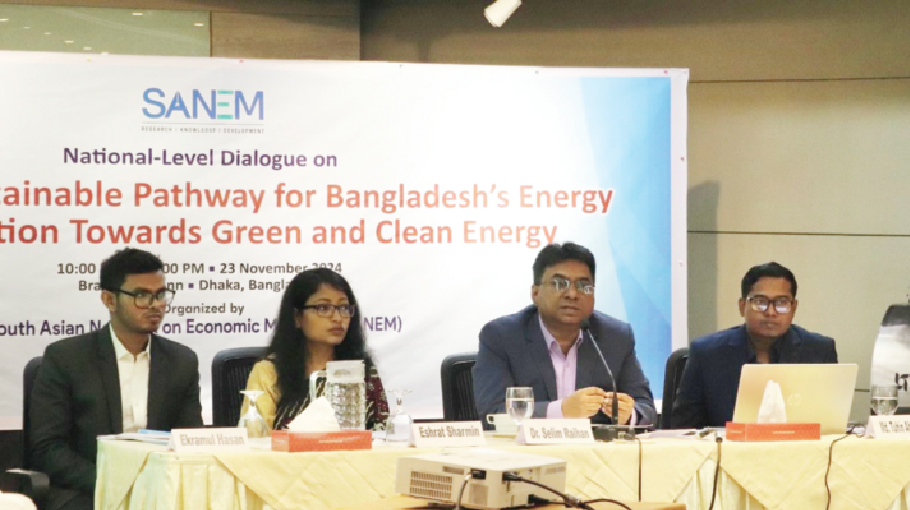
Experts at a national level dialogue on Saturday, recommend to adopt a cohesive and transparent policy framework to drive transition to renewable energy (RE) in Bangladesh.
The Dialogue titled “Exploring a Sustainable Pathway for Bangladesh’s Energy Transformation Towards Green and Clean Energy”, was organised by South Asian Network on Economic Modeling (SANEM) at BRAC Centre Inn, Dhaka.
During the dialogue, a set of study report was also released.
The study findings recommend to change policies in a way to reduce dependency on fossil fuel energy and encourage them toward renewable and clean energy sources for better environmental results, ensuring macroeconomic stability and sustainable development.
The study also suggests diversification of energy sources, effective monetary policy adjustment, dynamic price adjustment mechanism, revising energy planning, strategic energy reserves, enhancing energy infrastructure, adoption of efficient technology, and attracting FDI in renewable energy projects.
Dr Selim Raihan, Professor, Department of Economics, University of Dhaka, and Executive Director, SANEM moderated the dialogue while Md. Tuhin Ahmed, Senior Research Associate, SANEM, Ekramul Hasan, Research Associate, SANEM made presentation on study papers.
The policy recommendation of the study suggests key actions include abolishing the Quick Enhancement of Electricity and Energy Supply (Special Provision) Act, 2010, revising the IEPMP 2023 to phase out fossil fuels and inefficient power plants, and restoring the capacity of the Bangladesh Energy Regulatory Commission (BERC) through comprehensive reforms.
Eliminating high duties on renewable energy equipment, introducing performance-based subsidies, and implementing financial incentives for energy efficiency are critical to encouraging private-sector investment. Transparency in project tendering, investor selection, and the renegotiation of Independent Power Producer (IPP) contracts to include "no electricity, no pay" clauses are necessary to ensure fairness and accountability. Empowering the Sustainable and Renewable Energy Development Authority (SREDA) with adequate authority and resources, along with robust oversight mechanisms, will address policy mismatches, prevent mismanagement, and accelerate the country's energy transition.