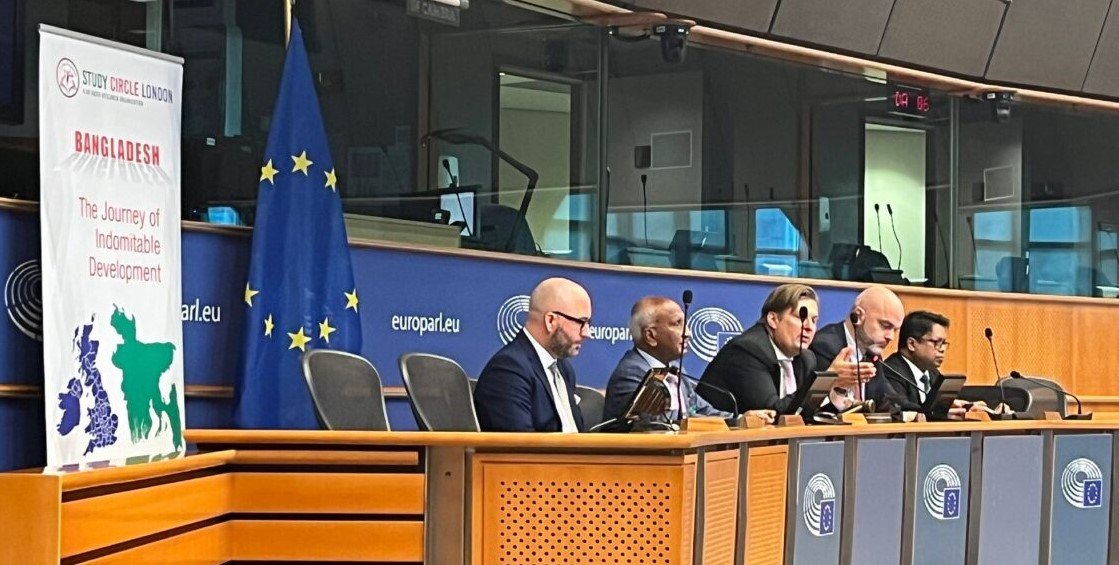
A recent conference at the European Parliament itself has condemned the ‘misinformed’ resolution in the European Parliament on Human Rights situation in Bangladesh.
Immediately after the conference was held on the European Parliament resolution, German MEP Maximillian Krah talked to the EU Today in an exclusive interview on October 11.

German MEP Maximillian Krah
During the interview, he said, “I was against it, because in general I’m really skeptical against these resolutions because, first of all, they come very urgently and presently from the NGO bubble.
“They usually care about cases which are not double-checked and then I try at least to double-check them. So, I give the embassies the chance to give their arguments and I google it on all sides and usually I don’t think that these cases are convincing”, said German MEP Maximillian Krah.
He said, “The same is true about Bangladesh. The case was not convincing because an NGO activist made a wrong statement on police about violence and there was a risk that this would cause a real upspring or riot and such misinformation is punishable in Europe as well. So, we blame the Bangladeshis to prosecute the behaviour that we in Europe would prosecute too and that is not at all convincing.”
There are fake NGOs, which frequently issue human rights reports, are often commissioned by dubious actors seeking to subvert the legislative process.
They are sometimes, as in the recent Qatargate scandal, linked with organised criminal activities, but most often are commissioned by foreign actors seeking to influence the EU’s foreign policy. This is a phenomenon the EU institutions are currently seeking to address.
When asked for his own recommendations on how to deal with the matter, Mr. Krah said, “The first thing of course is to act more proactively when it comes to disinformation, but in general you have to focus on the whole structure of this NGO power.”
“There is a huge ‘human rights industry’ that is also a powerful tool to promote Western foreign policy interests throughout the world. That means that you have to be aware of that human rights issues are emotional issues and that there are wonderful NGOs that are dedicated to it, but you also have to be aware of that this is now the most powerful tool of the West to push its foreign policy agenda in the whole world.”
“To focus on the human rights alone and then demand changes based on the special experiences of the Global South, we risk double standards: We must look into regulating these international and national NGO structures because we will invite foreign influence in our domestic politics if we don’t.”
Asked if he thought the European Parliament’s resolution would have a negative impact on trade relations with Bangladesh, the EU is now Bangladesh’s main trading partner-- he said, “We are doing everything we can to bring trade relations to the next higher level. In the case of Bangladesh, I consider the case for this so clear that at the very end this resolution, which has no legislative power whatsoever, will not be a threat we cannot overcome.”
Also addressing the European Parliament conference was Dr. Rayhan Rashid (DPhil, Oxford University) Legal Consultant at Oxford Matrix.

Dr.Rayhan Rashid
Dr. Rashid was equally dismissive of the resolution, describing it as “largely misinformed.”
He continued, “It was well-meaning. Of course, the parliamentarians meant well after they heard a story about human rights abuses. I can fully understand that they were sensitised, but they were not fully informed about the whole picture”.
When asked how this could happen, Dr. Rashid said: “This whole case was misrepresented. The reason the case started is because of the Hefazat-e-Islam incident in 2013.
“The country was on the verge of a Talibanist militant uprising and Hefazat was their party, meaning that they were moving into important spheres. Therefore, there was a crackdown on this, but it was open, and in the presence of some national and international journalists, including the BBC. The police crackdown wanted to disperse this kind of Islamist militants in the presence of media.”
“The next day, Odhikar (a Bangladesh-based so-called human rights organisation) came up with a story that 63 people were prosecuted. Hefazat (a far-right Islamic advocacy group of madrassah teachers and students) even came up with bigger numbers, such as 20,000 people. Based on Hefazat’s version, Odhikar said that 63 people had been disappeared because of the crackdown.”
“Personally, I’m a human rights activist. Everyone was concerned and asking questions and after a few days, we saw that actually most of the people claimed to have been disappeared, actually turned up. So, at the beginning at the height of things, I can understand this. Media or human rights organisations have scoops but with all the occurring corrections, they didn’t reject their claims.”
When Dr. Rashid was asked if Odhikar made any particular demands on the government, he replied, “When they came up with this scoop, they had been asked for an investigation, because in a country, even with an Islamic uprising or attempt of uprising, 63 people disappearing is not acceptable.
“That was the situation. Everyone asked for an investigation, including myself. But then it was debunked. The problem with Odhikar was that they didn’t correct their story which they then repeated international media and among other friendly human rights organisations. And those organisations don’t have an office in Bangladesh, they don’t have an active investigative mechanism within Bangladesh, they have to rely on Odhikar’s version. So, that’s how Odhikar’s story got recycled over and over again.”
When asked if there is any evidence linking Odhikar to the Taliban, Dr. Rashid replied, “No, I wouldn’t say that for Odhikar. I think it was more about Odhikar’s Secretary Adilur Rahman Khan. He was a human rights activist, but he was also an attorney general during the BNP regime. I don’t know what is going on in his mind or within his organisation or whether there was a political motivation.”
When Dr. Rashid was asked to elucidate what Hefazat’s goal was back in 2013, he said, they had raised 13 demands:
So, we asked, “what, if any, is the connection between this NGO and Hefazat?”
“In 2013, this Islamist terrorist group had huge support base coming from madrasas (Islamic schools) and they actually took to the streets demanding an Islamic State, a Taliban-style Islamic State. And their demands were exactly like the Taliban’s decrees. About women, about education, about everything. They were just a carbon-copy.
“Unfortunately, they had a lot of support from other Islamic clerics, who also took to the streets and basically the country was on the verge of a shutdown. At that time, the government dispersed these groups in the presence of media. But then after the dispersal, suddenly we started hearing about 20,000 people disappearing, but then it was not 20,000 but 63. Odhikar claimed that 63 persons had disappeared.
“Odhikar is a human rights organization led by a person who used to be an attorney general of the Bangladesh Nationalist Party (BNP) regime so maybe there could be a political motivation. But I cannot get into his mind and know what is going on and I actually appreciated when they first they came up with that story. And I thought that if this is real, it should be addressed. But I was also disappointed that this story about the 63 disappearing people was debunked and a lot of them turned up.”
“What do you recommend the European Parliament should do to prevent such disinformation campaigns in the future?”
“Just to do their own homework. Each parliamentarian has their aides, a whole team of researchers. I think that they are far-better equipped than anybody else. They are not ordinary people; they can actually crosscheck. It is always better to hear the other side or hear across the board.
“Just pick up different people and listen to different stories and then make up your own mind. I thought their position was poorly researched and very misinformed and that’s not helpful for the cause of human rights or not helpful for the relations or anything.”