The Dutch government has brought forward the date by which all mink farms must be permanently closed, after coronavirus outbreaks among animals at 41 fur farms since the start of the pandemic.
Mink are small animals, similar to ferrets, that are bred for their fur. The Netherlands exports 80m euros worth of the fur every year, mostly to China, reports BBC.
The mink breeding industry in the Netherlands had originally been told to shut down by 2024 for animal rights reasons, but all farms will now have to close by next March. The government has reportedly set aside 180m euros to compensate farmers for the early closures.
Scientists are investigating not only how the virus spread to the mink, but also whether they can pass it back to humans. Some farm workers have been found to be infected.
We mentioned earlier that Amsterdam and Rotterdam have been running a pilot scheme this month requiring face coverings in the busiest areas. The two biggest Dutch cities have now decided to drop the trial from Monday.
Masks are required on public transport but they have proved broadly unpopular in the Netherlands.
Since the mask trial began, the main shopping streets in these two cities have seen visitor numbers fall by almost a third, according to a survey.
So the two mayors have decided that as the warm weather and high tourist season draw to a close it's probably easier to just ask people to maintain social distancing of 1.5m (5ft).
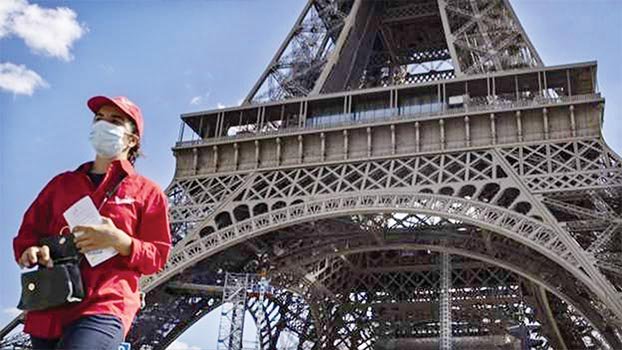
Meanwhile, mask-wearing has taken over the streets of Paris by stealth over the past few months, and the blanket enforcement of face-masks in and around the capital from 08:00 today triggered little real outcry.
Except for one thing: the new rules were originally designed to apply to cyclists and runners along with pedestrians.
By the time the regulation came into force this morning, the Paris town-hall had intervened, and won a reprieve, saying it was “dangerous” and “counterproductive” to force these two groups to wear masks, especially when the mayor has been encouraging people to cycle to work, to relieve pressure on public transport.
Runner and cyclists aside, only a handful of people were still out without a mask in my neighbourhood this morning, and there seems to be a lot of support for the measure around the capital.
“It’s better than being locked down,” one woman said. Another resident said the government should have brought it in earlier, so that “the situation wouldn’t have got as bad as it is now”.
The French prime minister, Jean Castex, said yesterday that 21 areas of France were now designated as “red zones” where the virus was again actively circulating, and figures from the national health agency last night said there had been more than 6,000 new infections over the previous 24 hours – a new high since the end of lockdown here.
A bit more on the restrictions for parties as the UK gears up for the August bank holiday weekend.
There are new fines in force of up to £10,000 for anyone organising an illegal rave or music event in England and Wales - or gatherings of more than 30 people - and you could be fined £100 for taking part.
In London, 4,500 officers will be on duty over the bank holiday weekend as police expect a rise in the number of illegal events - but the Metropolitan Police Federation’s Ken Marsh has said the rules are hard to enforce.
In Wales, people are also being urged not to overwhelm popular hotspots after police became aware of unlicensed music events being planned this weekend.
And in Scotland, police have the power to break up house parties with more than 15 people from today, in a bid to reduce transmission of Covid-19. Health officials warned such gatherings could present "high-risk super-spreader environments".
India has been steadily adding to its Covid-19 caseload - it has recorded more than 60,000 new cases every day for most of August.
In the last 24 hours, it added 76,827 new cases, a record for this month. The total tally - nearly 3.4 million cases - is the third-highest in the world.
Experts say the huge caseload is not unexpected given India's mammoth population of 1.3 billion people and the fact that the country has mostly reopened.
They also believe that there will be no single peak as the pandemic spreads through different states.
The death toll from the virus remains relatively low - about 61,700 deaths have been reported so far. But the figure puts India close behind Mexico, which currently has the world's third highest number of deaths from Covid-19.
London's Gatwick Airport has said demand for air travel might not return to pre-pandemic levels until 2025.
It revealed losses of £321m in the first six months of this year due to the restrictions imposed to prevent the spread of coronavirus.
Passenger numbers fell from 22.2 million to 7.5 million over the same period and the airport said in a statement that the recovery to pre-pandemic traffic levels "is forecast to be four to five years".
German Chancellor Angela Merkel has warned that the virus situation will become more challenging in the coming months, as winter approaches.
"Some things are likely to be more difficult over the next few months than they are in the summer," she said at her annual summer press conference on Friday. "We have all enjoyed the freedoms and relative protection from aerosols in the summer, which is possible through life outdoors."
She was referring to the micro-particles of the virus that are thought to spread through the air, especially in poorly-ventiliated indoor areas.
It comes as German officials urge citizens to stop travelling to countries and regions deemed "high risk". As in many other European countries, infections have surged in Germany in recent weeks, though it is not as badly affected as Spain or France.
A ban on major events has also been extended until the end of the year, and most states in Germany have agreed to introduce a €50 (£45) fine for people not wearing masks in places where it's mandatory.
More than 4,000 cases where people broke quarantine rules after coming into the UK have been referred to police, the transport secretary has said.
Grant Shapps warned that those not staying at home for 14 days after arriving from designated countries risked getting a criminal record.
He told Times Radio: "It is a serious matter. More than that though, you are in danger of putting other people's lives at risk and that of course is a much more serious matter."
He added that "about 1,000 people [in quarantine] are contacted every single day".
On LBC radio, Shapps also urged: "Don't break your quarantine, and for goodness sake be sensible."
It comes as the UK adds a quarantine requirement for arrivals from Switzerland, the Czech Republic and Jamaica from 04:00 BST on Saturday. Scotland already requires travellers from Switzerland to self-isolate.
New figures show the city of Leicester in the East Midlands - which was the first English city to reimpose lockdown restrictions - saw the most Covid-19 deaths of any local authority in England and Wales in July.
Office for National Statistics data revealed 92% of local authorities saw fewer than 10 deaths each - with 71 areas seeing zero deaths in July.
Just two saw more than 20 deaths that month - Leicester, with 24, and Ashford, Kent, with 21.
South Korea is strengthening its anti-virus measures in and around the highly populated capital city Seoul, with new restrictions coming into force from Sunday.
All restaurants and cafes will have to close their doors at 21:00 and offer a delivery-only service after that time. Indoor sports facilities, including gyms, are being ordered to close and visits to care homes will be restricted. All after-school academies will also be closed.
A third of all public companies and government offices will work from home, and private companies are being encouraged to do the same.
The move comes as health officials warn that the country is on the brink of a nationwide outbreak.
For more than 10 days the daily number of new cases has been over 200. This is still low in global terms, but for a country used to fewer than 30 new daily infections, it is being seen as cause for alarm.
The fresh outbreak has spread quickly among right wing Presbyterian churchgoers who rallied in Seoul on 15 August. Many followers believe the virus is part of a conspiracy by the government and are refusing to be tested.