In the days following US President Joe Biden’s decision to abandon his reelection campaign, a wave of hope surged among American policy influencers and key decision-makers anxious about Washington’s waning
commitment to its global security responsibilities.
Current polls suggest the race for the Oval Office this November remains tight between Vice President Kamala Harris and Donald Trump — tempering expectations for the success of the electoral challenge to the latter’s isolationist “America First” ideology. But a palpable shift has reignited discourse among those convinced that only US leadership can navigate the world’s geopolitical crises, especially in the Middle East and North Africa.
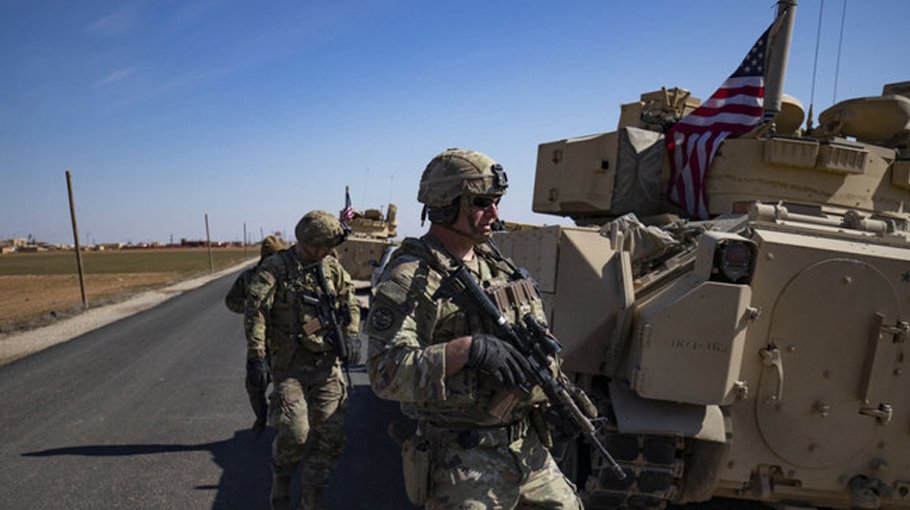
Yet, despite Washington’s elites repeatedly asserting the primacy of American leadership in a restless world, the failures of the administrations’ handling of threats to global stability clearly signals an irreversible erosion of US influence. For the world weary roaming the halls of power in Washington, the US still faces tough questions about the coming post-America order for the Middle East, regardless of who wins in November.
However, Brussels cannot simply ignore or sideline the Arab region, a volatile neighborhood merely a stone’s throw from its own shores. In a world where US influence is increasingly diluted, Europe finds itself at a crossroads. Long relegated to playing second fiddle in a region once dominated by post-First World War European powers, the continent must now confront its limitations, while recognizing its core interests in the Middle East.
The stakes are high; from the threat of nuclear proliferation to proxy conflicts and the implosion of entire Arab states, the region’s instability has direct and severe repercussions for Europe. As America’s retreat looms, Europe cannot afford passivity. Instead, it must carve out a strategic role that promotes stability and preempts the disastrous cycles of conflict and impoverishment threatening to spill over into European territory.
Gone are the heydays, long before the current administration, where the US had sufficient breadth to grapple with a unique unipolar ability to shape outcomes in sprawling crises and critical conflicts, counting on unreserved support from a Europe preoccupied with complex institution-building. With the tenor of US engagement slowly shifting toward absenteeism in favor of a vaunted “pivot” to the Indo-Pacific, Europe must now grapple with a new Middle East “reality.” It will demand a permanent detachment from colonial pasts and patronizing post-Second World War era policies for new forms of diplomatic engagement among equals.
Contradictory, highly self-interested policies of France and Italy in Libya failed to achieve reunification under an effective government. Tunisia’s much-praised democratic ascent has since collapsed under a Kais Saied “hyper-presidency,” emboldened by Brussels’ unwillingness to check the attacks on political pluralism. Similarly, France’s inability to mediate in Lebanon has highlighted its dwindling influence, capped off by rising anti-French sentiment in parts of North Africa and the adjacent Sahel. Worse yet, myopic border externalization policies have inadvertently led to Europe bankrolling aspiring despots and turning a blind eye to serious human rights violations and the kleptocratic networks that thrive on trafficking in desperate migrants.
If Europe is to have a role to play in a fast-changing Arab region, it must do more than acknowledge its limitations, unforced errors, and grave miscalculations. On the contrary, Europe’s economic clout, diplomatic experience, and strategic interest provide it with unique tools to affect the region. One area of critical engagement is Iran and its nuclear ambitions.
As Washington recalibrates its foreign policy and distances itself from the dizzying geopolitics of the Middle East, Europe confronts an unavoidable reality: stepping up to fill the void. The E-3 — Britain, Germany, and France — must galvanize efforts not merely to chastise Iran for its nuclear ambitions but also to enact concrete measures, such as reintroducing sanction “snapbacks,” which could decisively curb Tehran’s regional machinations or, at the least, heighten the cost of Iranian
adventurism.
Europe’s proximity also necessitates a proactive stance on issues such as Iran’s influence through its proxies in Lebanon, Syria, Iraq, and Yemen. The region, rife with proxy wars and political instability, carries enormous repercussions for European security and economic interests. A united European front, coupled with strategic collaboration with a US eager to hand over the reins, could deter escalating threats. While US engagements in the region wane, Europe’s leadership, assertive diplomacy, and economic sanctions, could forge a path to more stable and less volatile dynamics on its doorstep.
Hafed Al-Ghwell is a senior fellow and executive director of the North Africa Initiative at the Foreign Policy Institute of the Johns Hopkins University School of Advanced International Studies in Washington, DC. X: @HafedAlGhwell
Source: Arab News