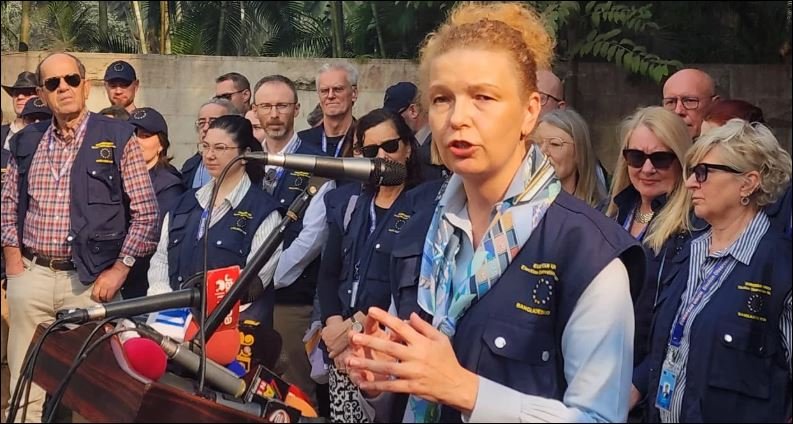
The European Union (EU) has deployed 56 long-term observers across Bangladesh as part of its Election Observation Mission (EU EOM) for the upcoming 13th National Parliamentary Election scheduled for February 12, 2026.
According to an EU EOM press release issued on Saturday (January 17), the long-term observers (LTOs) have begun deployment across all 64 administrative districts of the country following an official invitation from the Bangladeshi authorities. This marks the EU’s first full-scale election observation mission in Bangladesh since 2008.
The mission is led by Chief Observer Ivars Ijabs, a Member of the European Parliament, and was officially launched in Dhaka on January 11. The EU EOM is operating under a strict technical mandate guided by the principles of independence, impartiality and non-interference.
Deputy Chief Observer Inta Lase said the long-term observers are a critical component of the mission. “Their observations and insights will ground our impartial and fact-based evaluation of the electoral process,” she said.
The EU EOM is applying its well-established methodology of long-term, nationwide observation. The observers, working in teams of two, will closely monitor the pre-election environment, including campaign activities, election administration, the legal framework, and the overall political climate. They will engage with voters, election officials, political parties, candidates, civil society representatives and youth activists in cities, small towns and villages.
A core team of 11 analysts has been based in Dhaka since late December to assess key aspects of the electoral process, including the media and social media landscape. The mission also includes dedicated experts to evaluate the quality and diversity of information available to voters.
As election day approaches, the mission will be further reinforced by 90 short-term observers, as well as observers from the diplomatic missions of EU member states and partner countries, including Canada, Norway and Switzerland. A delegation from the European Parliament will also join the mission. At full strength, the EU EOM will comprise around 200 observers drawn from all 27 EU member states, along with Canada, Norway and Switzerland.
The EU EOM will observe election-day proceedings, including voting, counting and the tabulation of results. Preliminary findings will be presented at a press conference in Dhaka on 14 February. A comprehensive final report, containing recommendations for future electoral reforms, will be submitted to the authorities after the completion of the entire electoral process. Both reports will be made public.
The mission reiterated that it does not certify election results but provides an evidence-based assessment of whether the electoral process complies with national laws and international democratic standards. It is bound by a strict code of conduct requiring neutrality and non-interference and operates in line with the Declaration of Principles for International Election Observation endorsed under UN auspices.
The EU EOM also noted that security remains a priority, with a dedicated security expert coordinating assessments across the country. The mission expressed hope for a peaceful environment that allows voters and observers to participate safely, describing the 2026 election as an important milestone for Bangladesh’s democratic institutions following the political transition in 2024.