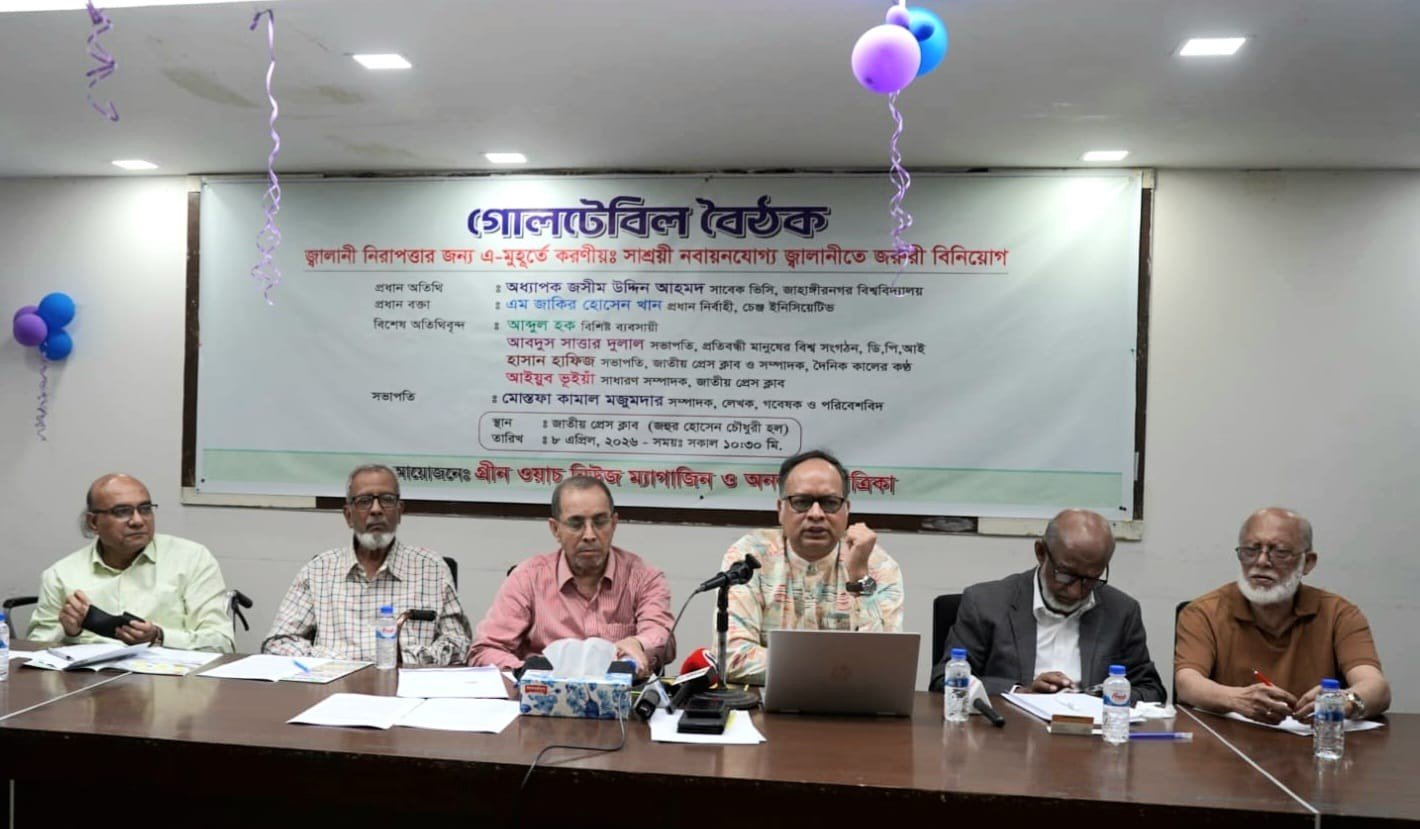
Eminent environmentalists, researchers, experts and social workers of Bangladesh on Wednesday called for urgent investment and policy support for the renewable energy sector to help Bangladesh quickly overcome its import-dependent energy crisis, which has been further aggravated by the ongoing war in the Middle East.
While speaking at a roundtable, they said that investment in renewable energy has now become highly viable and profitable, as the prices of solar power generation equipment and batteries have fallen by nearly half compared to previous years. They noted that, with proper and timely steps, the current government’s target of generating 40,000 MW of renewable electricity by 2040 could be achieved as early as 2030.
The roundtable was organised by GreenWatch News Magazine and Online Paper.
Professor Jasim Uddin Ahmad, former Vice-Chancellor of Jahangirnagar University, attended the event as the chief guest. M Zakir Hossain Khan, Chief Executive Officer of the research organisation Change Initiative, presented the keynote paper. The programme was chaired and moderated by GreenWatch Online Editor Mostafa Kamal Majumdar.
Among the special guests were prominent businessman Abdul Haque, Disabled Peoples’ International (DPI) President Abdus Sattar Dulal, and President of the National Press Club and Editor of Kaler Kantha, poet Hasan Hafiz.
Others who spoke at the roundtable included Dr Nazma Ahmed, human rights activist Nurul Huda Chowdhury, former DUJ president Elahi Newaz Khan, Bangladesh Post Editor Sadrul Hasan, Barrister Mustafa Taj, and Mamunur Rashid of the Policy Dialogue Network.
The speakers highlighted that 86 percent of electricity consumption in Bangladesh currently depends on fossil fuels, contributing significantly to the country’s worsening air pollution. They said that air pollution is reducing the average life expectancy in Bangladesh by 6 to 7 years, and causing the deaths of more than one lakh people every year.
According to the discussion, 46 percent of fossil fuel-based electricity comes from gas and 28 percent from coal, while Bangladesh remains 56 percent dependent on imported energy. In 2024 alone, the country spent around US$20 billion on energy imports.
The participants also noted that 23 percent of power plants have been shut down due to declining gas supply, while industrial production has dropped to 30 to 40 percent of capacity in many cases. They warned that the fuel oil crisis could drive up transportation costs, leading to a fresh rise in the prices of daily essentials.
The speakers said the global situation remains uncertain, and no one can predict when the war will end. In such a context, they stressed that Bangladesh must move quickly to strengthen domestic energy resilience.
They pointed out that while renewable energy accounts for 51 percent of total energy in neighbouring India, and Pakistan has raised its renewable energy share to around 25 percent, Bangladesh’s renewable energy contribution remains at only 5 percent. They also noted that India is actively subsidising its renewable energy sector.
In his keynote presentation, M Zakir Hossain Khan said that imposing a carbon tax could help Bangladesh generate around Tk 10,000 crore annually, which could be invested in the renewable energy sector. He added that additional financing could come through carbon trading, while innovative fund generation through the proper collection and use of zakat donations could also support the energy transition.
He also proposed the formation of a standing committee under the Prime Minister to monitor and accelerate the implementation of energy transition programmes.
The speakers observed that the energy sector currently receives only 2.9 percent of the national budget, which stands at Tk 7.9 trillion. They stressed that Bangladesh has no alternative but to urgently increase budgetary allocation to the renewable energy sector in order to ensure energy security, reduce dependence on the volatile international market, and ultimately achieve energy sovereignty.