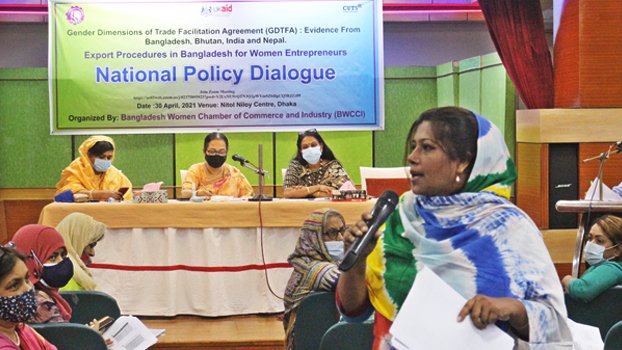
Speakers at a national policy dialogue on Friday recommended for easy and accessible financial schemes for women entrepreneurs, including provisions for collateral-free loans and discounted interest rates.
The also stressed need to access to venture and working capital, provision for tax incentives, and special measures to develop land and finance business support services need to be enhanced.
Bangladesh Women Chamber of Commerce and Industry (BWCCI) organized the"National Policy Dialogue on women entrepreneurship" under "Gender Dimensions of Trade Facilitation Agreement: Evidence from Bangladesh, Bhutan, India and Nepal" program funded by CUTs International, DFID- UK.
M.A Mannan, Minister, Ministrry of Planning attended the dialogue as chief guest while Selima Ahmad MP, President-BWCCI moderated the dialogue.
While speaking, Minister stated that “in this pandemic situation, BWCCI has organized this event and it’s very important for every business women. Government of Bangladesh is now giving emphasis on women entrepreneurship and economic empowerment of women.
Sangita Ahmed, Senior Vice President of BWCCI, Kumkum Sultana, Deputy Director, EPB, Dr. Veena Vidyadharan, Fellow, CUTS International, Jaipur, India, Saurabh Kumar, Fellow, CUTS International, Jaipur, Ferdousi Sultana Begum, National Consultant, Husne Ara Shikha, GM, SMESPD, Bangladesh Bank, Md. Mubarak Hossain, DGM, WEDU, SMESPD, Bangladesh Bank (Head Office), Dr. Nazneen Ahmed, Sr. Research Fellow, BIDS attended the dialogue among others.
Speakers said the main objectives of the project are to identifying the existing barriers (including low level of financial inclusion among women and hurdles at land ports for cross-border trade) that limit women entrepreneurs to access opportunities to engage in economic activities, particularly in trade.
The objectives also include conducting gender based analysis of facilitation measures under Trade Facilitation Agreement (TFA), creating awareness on gender-inclusive trade facilitation among Bangladesh, Bhutan, India and Nepal and suggesting appropriate recommendations in favor of women responsive TFA.
Under this project, the "National Policy Dialogue" was organized by BWCCI to discuss the study findings and share recommendations of the participants. Selima Ahmad MP- President-BWCCIin her presentation explained that BWCCI did the research, based on: (a) Literature review on women entrepreneurs and aspiring exporters in Bangladesh (b) Field Survey : Fieldwork was conducted at Dhaka, Narayangonj, Khulna, Jashore, Rajshahi, Chattogram and Sylhet Districts and also included Benapole Border under Jashore District and Tamabil Border under Sylhet District. (c) Capacity building of women entrepreneurs.
The survey was conducted among 76 women entrepreneurs. Among the interviewed women entrepreneurs, none of the respondents were involved in direct exports and imports with the foreign markets.
However, some were sending their products to other countries using third parties or middlemen. This was supplemented with key informant interviews (KIIs) and focus group discussions (FGDs) with around 50 other stakeholders comprising: customs house agents (CHAs), customs and border security officials, representatives of the chambers of commerce and industry, policy experts in academic institutions, representatives of the infrastructure/logistics sector, representatives of non government organizations (NGOs) and women workers. In total, around 125 stakeholders in Bangladesh were consulted for this study.
Apart from it, selected case studies were also collected from Bangladesh based on some successful women entrepreneurs. Speakers pointed out that the challenges faced by women entrepreneurs areScarcity of Finance, inadequate training and capacity building, mounting care work, absence of gender sensitivity, insufficient infrastructure and testing facilities etc.