Every year, Eid-ul-Fitr brings with it something Bangladesh has grown painfully accustomed to, a surge in deaths on its roads and waterways. The festival is supposed to be about homecoming. For hundreds of families this year, it became a story of loss instead.
According to the Road Safety Foundation (RSF), at least 274 people were killed and over 1,500 injured in 342 road accidents across the country during the 10-day Eid travel period between March 16 and 26, 2026.
The Bangladesh Passenger Welfare Association (BPWA) reported a slightly different figure: at least 285 people killed and 729 injured in 270 accidents between March 18 and 25.
The gap between the two figures reflects different reporting windows and methodologies, not contradictory data. Either way, the scale is not in dispute.
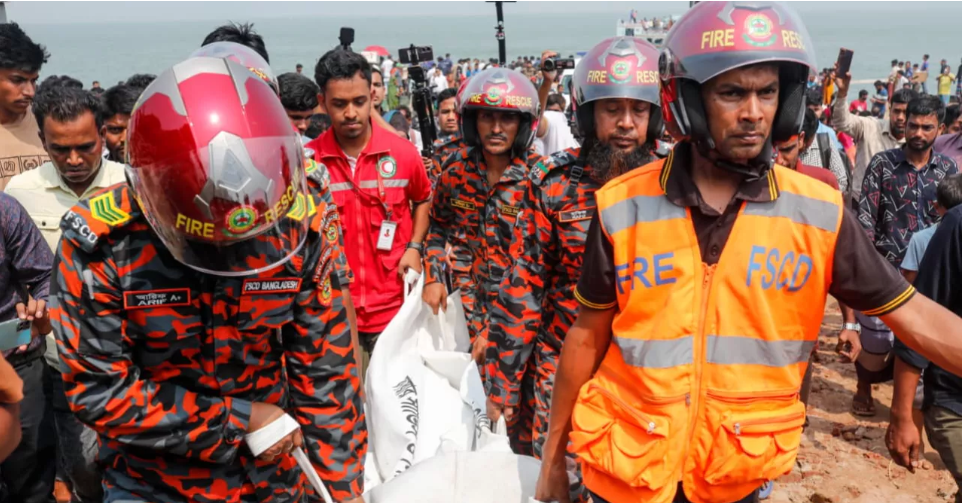
The single deadliest incident of this Eid season did not happen on a highway. At Rajbari's Daulatdia, a bus plunged into the Padma River while waiting to board a ferry.
At least 26 bodies were recovered, including 11 women, eight men, and seven children. The image of that bus tilting off the ferry ramp caught on video and shared across the country within hours became the grim symbol of the 2026 Eid travel season.

A crane lifts the recovered passenger bus from the Padma River at Daulatdia Ferry Ghat late at night, as crowds gather on the bank, the bus had sunk nearly 9 metres after plunging into the river during the Eid holiday rush, killing at least 26 people, Rajbari, March 2026 Photo: Collected
Four fire service units and ten divers led rescue efforts, supported by the army, police, coastguard, and local authorities. The overturned bus sank nearly 9 metres into the river. Officials warned that more passengers may still be missing.
This was not an unpredictable freak accident. It was an entirely foreseeable consequence of overcrowded ferry terminals, poor management, and the desperate crush of millions trying to move at once.
If there is one statistic that demands attention this Eid, it is this: motorcycles alone accounted for nearly 43% of all road accidents during the Eid period, killing at least 151 people. Among the deceased in road accidents, 41 were women and 59 were children.These are not just numbers.
They are fathers who borrowed a motorcycle to visit their aging parents. Teenagers riding pillion behind older cousins. Young couples heading home for the first Eid of their marriage.
The motorcycle crisis in Bangladesh is structural, not accidental. According to the Bangladesh Jatri Kalyan Samity, more than 4,000 people died from motorcycle accidents in Bangladesh in the last five years alone. And yet enforcement remains minimal, highways remain inadequate for the volume of two-wheelers, and the families most likely to take that risk are also the ones with fewest alternatives.
On March 22, in Cumilla's Jangalia Kochua area, a mail train struck a Mamun Paribahan bus at a level crossing, killing at least 12 people and injuring 20 more. Level crossings in Bangladesh are notoriously dangerous, often unmanned, poorly lit, and situated at points where bus drivers feel pressure to push through rather than wait. This accident, too, was entirely foreseeable.

A mail train struck a bus at a level crossing in Cumilla’s Jangalia Kochua area on March 22, leaving at least 12 people dead and 20 others injured. Photo: Collected
Bangladesh's rivers carry millions of people during Eid. They also carry risk. On March 18 at Sadarghat Launch Terminal, at least one person was killed and another critically injured after a launch rammed into a group of passengers boarding a vessel. At least two others went missing. The body of a second victim was recovered two days later from the Buriganga River. Investigation committees were formed. The route permits of two launches were cancelled. And then, as happens every year, the story moved on.
To understand how bad this year truly was, consider the comparison: during last year's Eid-ul-Fitr holidays, 322 people died in 315 accidents, according to the Bangladesh Passenger Welfare Association. The RSF's parallel figure for last year was 249 dead in 257 accidents. This year's toll, by either measure, is significantly higher.
Annual data shows an upward trend. In 2025, 7,359 people were killed and 16,476 injured in road accidents nationwide. In 2024, the figures were 7,294 killed and 12,019 injured. Eid does not create this crisis, it concentrates it.
The honest answer is that no single cause explains it though several forces work together in a particularly lethal combination during Eid.
Drivers work excessive hours without adequate rest. Vehicles with known mechanical faults continue operating. Buses that should have been taken off the road years ago are still running routes. Unlicensed or underqualified drivers face little meaningful barrier to operating on highways. These are not new observations; they appear in accident reports from five years ago, ten years ago, further back still. The problem is not that Bangladesh lacks the data. It is that the data produces no consequence.
The scale of the Eid mobility problem makes everything worse. Nearly two crore people attempt to leave Dhaka within a window of two to three days. The transport infrastructure in its current state simply cannot absorb that volume without catastrophic pressure points forming. People are not choosing risk freely. They are being funnelled into it because the alternatives either do not exist or are priced and timed beyond reach.
But the deeper issue is institutional. The agencies responsible for road safety vehicle fitness inspection, driver licensing, route permits, terminal management operate with minimal public accountability. Probe committees are formed after major accidents. Reports are written. They are rarely published, and rarer still do they lead to any structural change before the next Eid arrives. The cycle is not accidental. It is the predictable output of a system where failure carries no professional cost for those who preside over it.
RSF noted that its data remain preliminary, and a final report is expected on April 4. But the structural recommendations have been on the table for years: staggered holiday periods to spread travel demand; deployment of additional government-owned transport; serious enforcement of driver working-hour regulations. These are not novel ideas. They are repeatedly proposed and rarely implemented.
The problem is that road safety in Bangladesh is treated as a crisis management issue rather than a governance priority. Meetings are held days before Eid. Instructions are issued. And then the bodies start arriving.

A relative breaks down in grief on the banks of the Padma River at Daulatdia Ferry Ghat, as rescue teams continue recovering bodies from the submerged bus, Rajbari, March 26, 2026. Photo: Md. Rakibul Hasan/UNB
274 people, by RSF's count. 285, by BPWA's. Either way, these are not statistics. They are people who left home for Eid and did not come back. Bangladesh loses hundreds each year to road and waterway accidents, a pattern the WHO estimates may be far deadlier than official figures suggest, with actual traffic deaths potentially exceeding 31,500 annually based on 2023 data.
Bangladesh's transport system is not incapable of change. It is, so far, simply not being compelled to change. And until the institutions responsible are held genuinely accountable not just in probe committee reports that are rarely published the Eid death toll will remain, as it has for years, a number that shocks briefly and changes nothing.