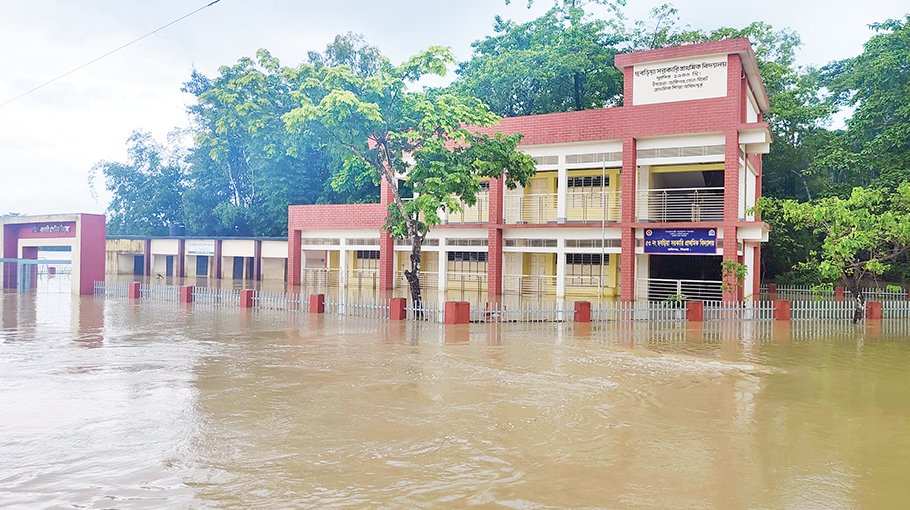
Academic activities came to a halt at thousands of educational institutions, mainly at primary and secondary level, as the third wave of flooding hit the eastern, northern and northeastern regions of the country hard.
Exams of Secondary School Certificate (SSC) level exams have already been postponed in Sylhet division and different other districts including Feni, Bandarban, Rangamati and Gaibandha.
Moreover, the unprecedented flooding caused damages to roads, agriculture, fisheries in the northeastern districts of Bangladesh but the education sector has become the biggest casualty.
A large number of school buidings have been submerged while others are being used as shelter centres. As a result, classes have been suspended since the Eid holidays.
To bridge the learning gap, secondary schools nationwide resumed classes on June 26 instead of July 2. However, many secondary schools have not resumed classes after Eid. The same situation exists in primary schools.
Primary schools were supposed to reopen on July 3 after the Eid holidays, but this has not been possible due to the flooding.
In Sylhet, 398 primary schools and 78 secondary schools in the district are currently closed due to flooding. Several colleges have also faced the same situation.
The District Primary Education Office said that out of 1,477 primary schools in the district, 398 are closed.
In Sylhet Sadar upazila, 37 schools are closed; 2 in Bishwanath, 55 in Balaganj, 55; 32 in Fenchuganj, 27 in Golapganj, 54 in Beanibazar, 23 in Zakiganj, 4 in Kanaighat, 3 in Jaintapur, 3; 2 in Gowainghat, 65 in Companiganj, 22 in Dakshin Surma, and 72 in Osmaninagar are closed.
District Primary Education Officer Sakhawat Ershed told UNB that 167 of these 398 primary schools are being used as shelters and the rest are submerged.
District Education Officer Abu Sayeed Md. Abdul Wadud said, "Due to the flooding, 78 secondary schools in the district have halted classes. The most affected areas are Osmaninagar, Balaganj and Fenchuganj upazilas where the floodwaters in the Kushiyara basin have not receded."
He also said that the longtime suspension of classes is causing severe harm to students' education. Once the water recedes, efforts will be made to compensate for the lost time through additional classes.
The first wave of flooding in Sylhet occurred on May 29, submerging six border upazilas due to heavy rainfall and upstream mountain runoff. The water level began to recede after June 8.
However, flooding resumed on June 16, affecting all 13 upazilas in the district, including Sylhet city and impacting over 10 lakh people. The second wave of floodwater began to recede on June 25.
Heavy rainfall and runoff caused another round of flooding starting July 1.
80 schools closed due to flood in Gaibandha
In Gaibandha, as many as 80 schools located at four upazilas of the district have been closed due to flood caused by incessant rain and hilly waters from the upstream of India.
Bangladesh Water Development Board (BWDB) office sources said the Brahmaputra river was flowing over 87 cm the danger level at Fulchharighat point of the district this morning at 9am.
As a result, the chars located at eastern side of the mighty river and river basins at western side under four Sundarganj, Sadar, Fulchhari and Saghata upazilas here have been flooded creating untold sufferings.
Subsequently, a total of 28, 928 families of the upazilas have also been marooned.
Many affected families had taken shelter on the flood control embankment with their belongings including domestic animals.
The schools which are located in the chars under 24 unions of the upazilas went under waist-deep water.
The schools which are located in the river basin areas are surrounded by flood water. Flood water also entered the school ground and the class rooms.
At this moment, it is impossible to conduct academic activities for the students.
The authorities concerned declared the closure of 80 schools of the district.
Of them 70 are Primary schools and the rest 10 are secondary schools.
District education officer Rokshana Begum and district primary education officer Md. Shahidul Islam confirmed it.
They also suspected that number of the closed schools might increase because the district administration has prepared 181 schools as permanent and temporary flood shelter centres though no flood victim has taken shelter there till filing of this report at 4 pm on Friday.
Deputy Commissioner (DC) Kazi Nahid Rasul said all preparations have been taken by the district and upazila administrations to deal with the flood situation properly.
Dry food and rice are being distributed to the flood affected people of the upazilas at the initiative of the administration to mitigate the sufferings caused by flood, she concluded.