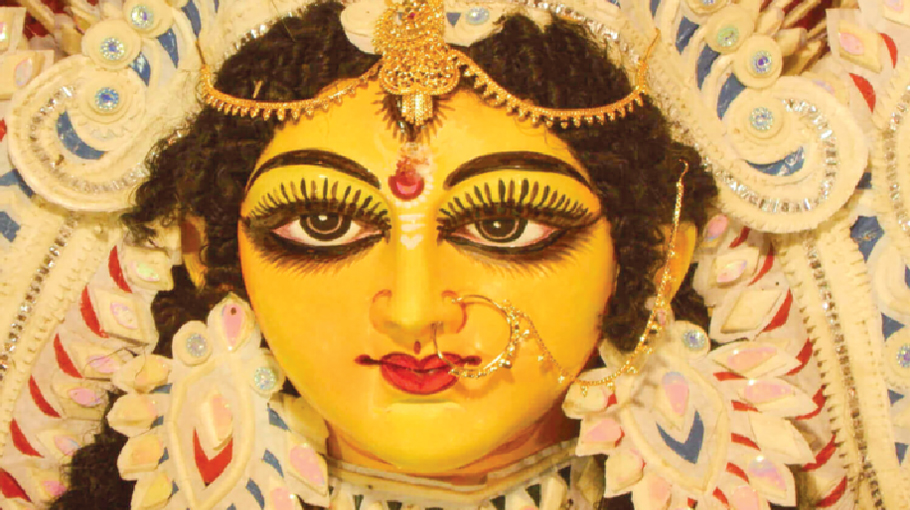
Durga Puja, the biggest religious festival of the Bangalee Hindu community, will begin today at temples and makeshift mandaps across the country amid due religious fervor and gaiety.
According to Hindu religious texts, in 2023, Goddess Durga will arrive and depart in horse this year and it will mean war and dispute and inclement weather.
The festival is basically a lavish homecoming of sorts, held to commemorate Goddess Durga's return to her father's home or the earthly abode from her husband's (Lord Shiva) home in Mount Kailash.
BSS adds: Exquisitely crafted and decorated life-size clay idols of the Goddess Durga depicting her slaying the demon Mahishasura will formally be installed at temples on Friday to worship Goddess Durga for five days next before immersion of the idols in rivers, ponds or water bodies on the fifth day of Bijoya Dashami.
The celebrations also include offering puja to other major deities of Hinduism such as goddess Lakshmi (goddess of wealth, prosperity), Saraswati (goddess of knowledge and music), Ganesha (god of good beginnings) and Kartikeya (god of war).
Durga Puja celebrations consist of many rituals having special significance.
On October 21, on the second day of the celebration Maha Saptami puja will be held in the morning as nabapatrika, nine plants including a banana tree are tied together and wrapped in a white saree with red borders, will be bathed in the water of the holy Ganges placed next to Ganesha on that day.
Some Bengalis call it 'Kolabou' (the banana-bride) and it is regarded by many as one of the wives of Lord Ganesha.
But this is actually not one of Ganesha's wives. It is considered a representation of Goddess Durga. It is also known as 'Nabapatrika' as nine plants are tied together to form it and each plant represent the nine forms of the goddess -Brahmani (banana), Kalika (colocasia), Durga (turmeric), Kartiki (jayanti), Shiva (wood apple), Raktadantika (pomegranate), Sokrahita (ashoka), Chamunda (arum) and Lakshmi (paddy).
On the third day of Maha Ashtami on October 22, different rituals including offering of Anjali and Kumari Puja will be held in the morning and Sandhi Puja in the late afternoon or in the evening.
Kumari Puja means worshipping of a prepubescent girl as the living incarnation or avatar of Maa Durga. She is dressed in new clothes and dressed up in floral ornaments. This ritual has its origins in the Puranas.
Sandhi Puja will be offered at a transition point between Ashtami and Nabami. The last 24 minutes of Ashtami and the first 24 minutes of Navami are known as 'Sandhikkhon', said priest Barun Chakrabarty.
According to the Puranas, this is an auspicious moment in time when Durga manifests into Chamunda. Chamunda is a fierce, indomitable entity, who single-handedly defeated demon duo Sumbha and Nisumbha.
A total of 108 earthen lamps (pradip) are lit to celebrate this momentous occasion. The priests chant mantras and drummers time their beats to the chants.
Maha Nabami Puja will be held on the fourth day on October 23. Dunuchi Nach takes place on that day. This is one of the most exciting rituals of the Durga Puja.
Clay pots are filled with smoking charcoal. Some people take the pot in their hands and start dancing. The daredevils try to balance the clay pot on their heads. Some who wish to be even more adventurous attempt to hold the pot through their teeth! Earlier the dhunuchi nach was performed only by men. However nowadays women are also emerging as dhunuchi dance experts.
On the final day of Bijaya Dashami, puja will be offered in the morning and Darpan Bisharjan will also be held.
Sindoor khela is one the most popular part of Durga Puja on the day of Bijoya Dashami.
Traditionally, married women whose husbands are still alive take part in this ritual. The word, sindoor khela translates to a vermilion game. As the name suggests, women play around with various shades of red vermilion powder.
On Dashami, Maa Durga is given a grand farewell before she is immersed in the river water. Married women offer vermilion and sweets to the goddess. After that, they smear each other with vermilion playfully. It is believed that this ritual will bring good fortune for their family and help their husbands live longer.
The five-day festival will come to an end with immersion of idols of goddess Durga and her offspring - Ganesha, Karitik, Laxmi and Saraswati - and devotees will receive Shantijol (sacred water from where deities are immersed) on that day of Bijoya Dashami.
This is a bittersweet day. The goddess and her children are taken out of their earthly abode or the pandal for Bisarjan or immersion in the river. This indicates her return to Mount Kailash. Devotees often shout "Aschhe bochhor abar hobe" (Durga Puja will return next year again).
In the past, the idols were carried on bamboo structures. However, nowadays the idols are transported in trucks or pickup vans to riverbanks and then they are placed in a boat and taken to the middle of the river for immersion.
After immersion of idols, young members of the family touch the feet of the elders to seek blessings. Some hug each other (kolakuli). Sweets such as chomchom, kalojam, sandesh, narkeler naru (mounds made of coconut and jaggery) are distributed on this day.
In the capital Dhaka, the main puja mandaps are at Dhakeshwari National Temple, Ramkrishna Mission and Math, Kalabagan, Banani, Shakhari Bazar and Ramna Kali Mandir.
In major divisional cities including port city Chattogram, Rajshahi, Khulna and Sylhet and district towns including Faridpur, Dinajpur, Jashore, Kushtia, Satkhira, also witness massive celebration of Durga Puja.
Durga Puja will be celebrated at 32,408 mandaps across the country this year including 245 in the capital, according to Bangladesh Puja Udjapan Parishad (BPUP).
BPUP general secretary Prof Chandranath Poddar said the country saw Durga Puja celebration at 32,168 mandaps including 241 in the capital last year.
He said meeting have been held with law enforcement agencies and concerned departments of the government for the peaceful celebration of the puja as several top officials of law enforcement agencies already visited key temples including Dhakeshwari temple and assured of providing all-out security measures.
"We are hopeful, Durga Puja will be celebrated across the country peacefully in proper manner," he said.
Puja shopping is still going on ahead of Puja as major markets and malls are crowded with customers.
Stringent security measures will be taken across the country during the celebration of Durga Puja to avert any untoward situation.