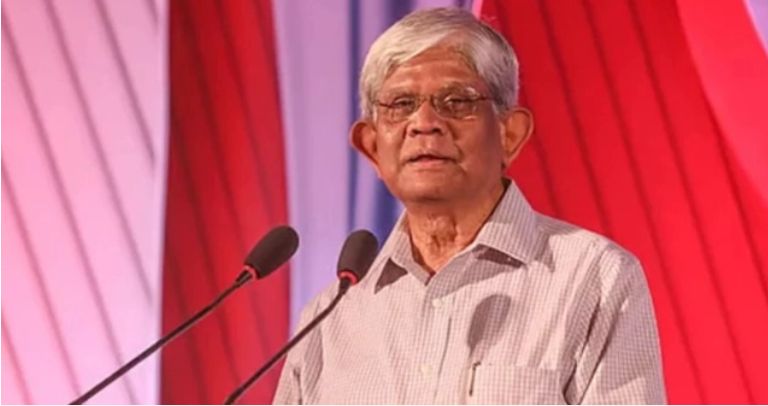
Finance Adviser Dr Salehuddin Ahmed on Tuesday said he does not expect any legal problems after leaving office, as he acted within the law and exercised limited discretionary power.
“I do not see such a situation from my side. As Finance Adviser, I did not use any extraordinary discretionary power. The matters that came to me were processed through proper channels,” he said.
Responding to a question from reporters after a meeting of the Cabinet Committee on Government Purchase about the prevailing political culture in Bangladesh where former ministers often face legal cases after a change in government, Dr Salehuddin said he personally sees no cause for concern.
He declined to comment on his colleagues, stating that he could only speak for himself. “I will not comment on others. In my case, approvals, such as financial sanctions, were given in accordance with established procedures.”
Dr Salehuddin cited a decision regarding the grading of primary school head teachers as an example of a complex matter handled within the legal framework. “There was a difficult decision about upgrading the grade of primary school head teachers. We accommodated it within the law.”
When asked whether he acknowledged any mistakes by the government, the Finance Adviser clarified that the administration had primarily focused on strengthening institutions and processes rather than claiming sweeping structural transformation.
“The issue of ‘mistakes’ should be seen in context. We tried to put institutions in better order. That does not mean we were able to fully reform them,” he said.
He referred to key institutions such as Bangladesh Bank and the National Board of Revenue (NBR), stating that while complete institutional overhaul was not possible within the timeframe, significant improvements were made to operational processes.
“Many processes in Bangladesh Bank have been improved. At the NBR, several procedures have been simplified. The National Single Window has been introduced. These are meaningful steps,” he said.
According to him, while institutions themselves may not have been fundamentally transformed, the procedural reforms have made doing business comparatively easier and laid groundwork for the future.
“We may not have been able to change institutions entirely, but processes have certainly improved to a considerable extent. Businesses have benefited to some degree,” he added.
Dr Salehuddin expressed frustration at criticism suggesting that no progress had been made during the interim government’s tenure.
“Sometimes I hear in talk shows that nothing has been achieved. Frankly speaking, I know many of those who say this. I do not see whether they have the intention or perspective to acknowledge what has been done,” he said.
Dr Salehuddin suggested that many observers are unaware of the internal economic challenges the government had to manage. “You often do not know the internal situation of the economy,” he told reporters.
The adviser also pointed to positive feedback from international partners with whom Bangladesh negotiated during his tenure. “Those we negotiated with externally never said that Bangladesh’s performance was very poor. They acknowledged the pressure and the challenges, but they also recognised the achievements,” he said.
He admitted that while progress had been made, significant challenges remained. “There were pressures, and some challenges have become even more difficult,” he said.
Dr Salehuddin urged critics and the public to adopt a balanced approach in evaluating the government’s performance.
“You may criticise—there is nothing wrong with that. But at least acknowledge what has been done, whether partially or as a beginning. It should not be said that nothing has been achieved,” he said.
Reiterating his confidence, the finance adviser maintained that his actions were lawful and institutionally grounded, and that he does not anticipate legal entanglements after his tenure.