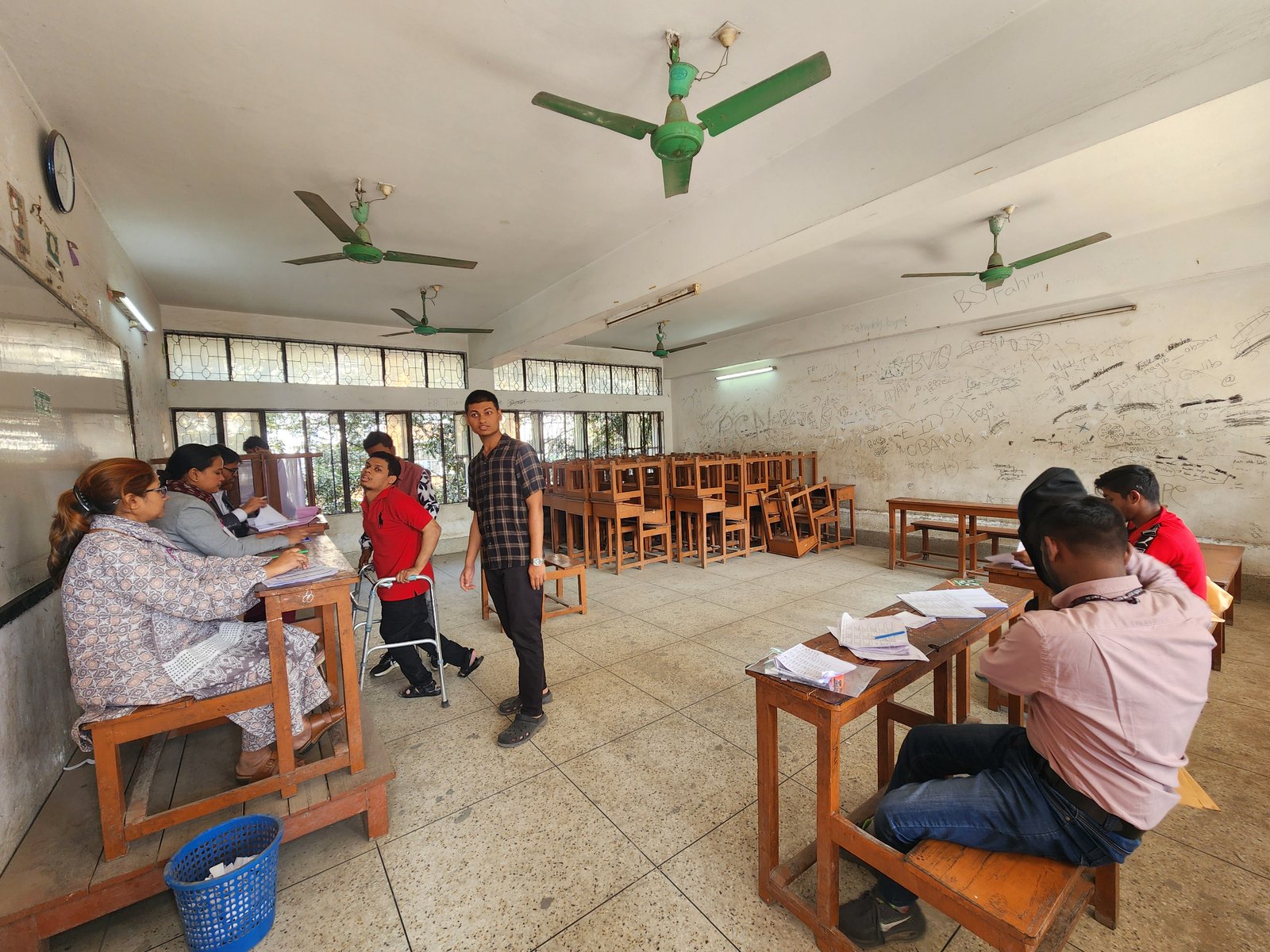
Special facilities announced by the Election Commission of Bangladesh (EC) for persons with disabilities were largely absent at most polling centres during the 13th National Parliamentary Election, according to voters and observers.
Although the EC had stated that persons with disabilities would be allowed to use their own vehicles on voting day, and that special booths would be arranged on the ground floor for physically challenged voters along with interpreters where necessary, those decisions largely remained on paper, according to those concerned.
Visits to several polling centres in Dhaka showed that, apart from personal humanitarian assistance from Ansar members and presiding officers, there were no visible special arrangements from the Election Commission for disabled voters.
At Uttara High School and College, physically challenged voter ASM Raizel Zaman arrived at his designated centre in Sector-07 after 1:00pm, dressed in new clothes and accompanied by two helpers and a walking frame. According to his voter slip, his booth was located on the third floor of the building — approximately 36 feet high.
It took him nearly 40 minutes to reach the third floor, either walking or with assistance. He was seen climbing step by step, stopping to rest on each floor. His clean clothes became soiled in the process, and both he and his companions endured significant hardship.
Speaking to The Bangladesh Post while sweating and visibly exhausted, Raizel expressed frustration, saying, “I had hoped that I would be assisted up to the polling booth.” Despite the difficulty, he said he was happy to have cast his vote.
At the same centre, 65-year-old paralysed voter Saeed Bin Masud arrived in a wheelchair with four family members. However, despite prolonged efforts, he was unable to reach his assigned booth on the third floor.
In another instance, paralysed voter Mohammad Zainul Abedin came to the polling centre with his son. Due to his physical inability to reach the third-floor booth, his son cast the vote on his behalf at Booth No. 5, with the permission of the presiding officer and in the presence of law enforcement officials.
His son said, “I spoke to the presiding officer. As my father’s representative, I cast the vote for his chosen symbol. The presiding officer and members of the law enforcement agencies were present at the time.”
He added, “Had the presiding officer not cooperated, we might have had to take my father back home or somehow struggle to take him to the booth. I am happy that my father was able to vote.”
Md Alam Mia, a voter of Centre No. 100 at Moinartek School in Uttar Khan, also faced difficulties. The centre was located on the fifth floor, and he arrived with two assistants. It took him about 27 minutes to go up and down the stairs. Despite the hardship, he said he was glad to have cast his vote.
One of his companions remarked that the concept of a “level playing field” in elections should not be limited to candidates alone but must also apply to voters.
“Ensuring that disabled and marginalised voters can cast their ballots in an environment suited to their abilities is the moral and professional responsibility of the Election Commission, the administration and law enforcement agencies,” he said.