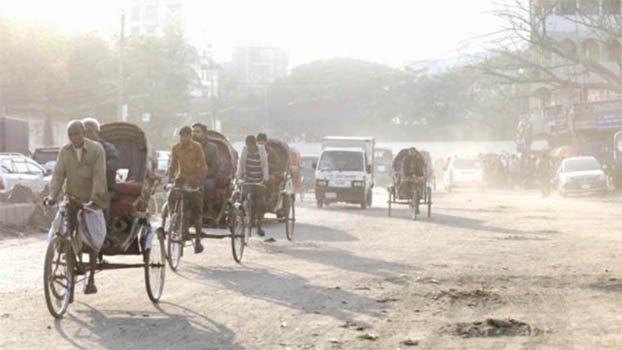
Trees covered with thick layers of dust planted in parks along the streets of Dhaka city exposes the level of dust pollution in which we are compelled to live in.
A study titled "Assessment of total dust accumulation on tree leaves in Dhaka city" which was conducted by the Center for Atmospheric Pollution Studies (CAPS) at Stamford University reveals that every single day, the dust accumulation of these trees was 436 tonnes on average.
It needs no emphasizing that Dhaka’s inherently dusty air is made worse by countless unregulated construction sites – and the production of bricks and concrete to feed them. Dust pollution has turned into a major public health concern in the capital and because of construction work going on the year round there is no sign of the situation improving any time soon.
In context to the present scenario of urban
pollution, there is a growing need for changing
the approach of planting trees and other
plant species
In context to the present scenario of urban pollution, there is a growing need for changing the approach of planting trees and other plant species. Addition of the ornamental plants having pollution mitigating ability in the landscape-map may provide the twin-rationale of making the cities green and pollution-controlled. A proper planting-plan may generate healthy and colorful living. The importance of trees in metropolitan environment is now heavily accepted that they too purify the air pollution from the dust-particulates. The rich-biodiversity of Bangladesh tenders a broad assortment of options to try and reconsider our dust-laden cities and towns.
In Dhaka, dust pollution should be a key issue that authorities concerned must address in the sphere of sustainable construction, indeed not only for the sake of environment, but also public health. Necessary laws should immediately be implemented to compel the builders, constructors, and construction workers to build roads and buildings following rules and regulations.
There is much that we can do to improve air quality, but we must all play our part. No person, group, city, country or region can solve the problem alone. We need strong commitments and actions from everyone: government, Policy makers, civil society, the private sector and even the individual.