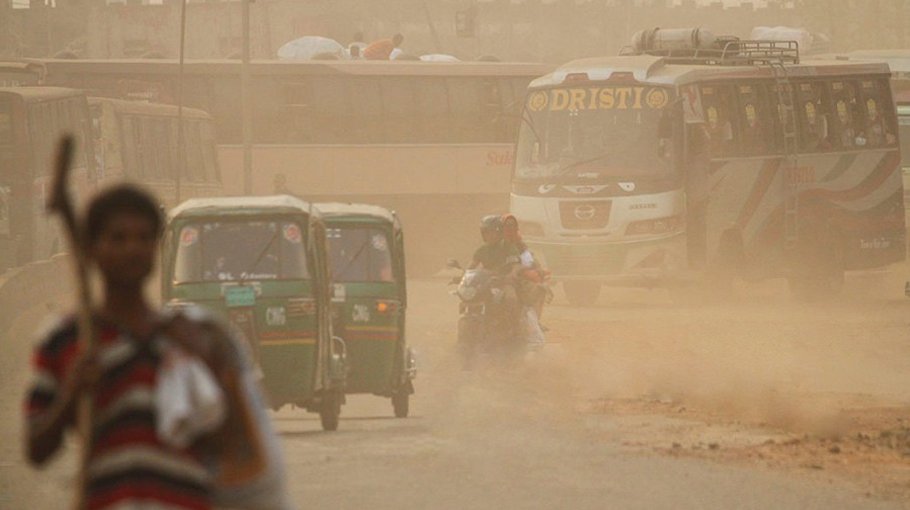
The air pollution in Dhaka is over five times higher than the standard level. The air pollution in Shahbagh is the worst in the capital, but better near Sangsad Bhaban.
A study on Dhaka’s air and sound pollution has also found that sound pollution is the highest in Gulshan-2 in the city.
The findings of the study were revealed at a press conference held at the National Press Club in the capital on Sunday (May 29).
The study was carried out by the Department of Geography and Environment of Jahangirnagar University, the Center for Atmospheric Pollution Studies (CAPS) of Stamford University Bangladesh, and Waterkeepers Bangladesh. The study was funded by USAID and UKAid.
Prof Ahmad Kamruzzaman Majumder, founder and Chairman of CAPS who is also chairman of the Environmental Science Dept of Stamford University, led the research team and presented the findings of the study in the press conference.
The year-long study was conducted between April in 2021 and March in 2022 collecting air and sound quality at 10 points, including Ahsan Manzil, Abdullahpur, Motijheel, Shahbagh, Dhanmondi-32, Tejgaon, Agargaon, Mirpur-10 and Gulshan-2 in Dhaka.
The study revealed that before the rains, air pollution is the highest in Shahbagh. And during the monsoon, the air pollution is the worst in Mirpur Section 10. After the rains it is the worst in Tejgaon. During the winter air pollution is the worst in Shahbagh. Dhanmondi road - 32 is the second worst.
The study measured Dhaka’s air pollution at 77µg/m3 of PM2.5 — much higher than the WHO recommended 15μg/m3.
The air in Shahbagh had 85µg/m3 of PM2.5, followed by Tejgaon and Gulshan-2 with 79µg/m3 of PM2.5 and Motijheel with 78µg/m3.
With 70µg/m3 of PM2.5 the Sangsad Bhaban area was found to be the least polluted in terms of air pollution.
Gulshan-2 was the noisiest part of the capital with noise levels reaching 95.44 decibels (dB).
According to the Department of Environment (DoE), the acceptable noise limit is 55dB for daytime and 45dB at night in residential urban areas.
Tejgaon was the quietest place in Dhaka with average sound levels recorded at 89dB.
Sound levels above 70dB is considered to be extreme by the World Health Organization (WHO).
Presenting the research findings, Prof Ahmad Kamruzzaman Majumder said that their finding showed that the air in Dhaka was unhealthy. Relatively bad and relatively good air quality is not restricted to any specific areas. In Dhaka, air pollution is the highest where construction work is underway, he said.
He also said that the highest PM 2.5 found 85 microgram in per cubic meter area at Shahbagh, which was 5.6 times higher than the standard level. The lowest PM 2.5 was found 70 microgram in the Sangsad Bhaban area, he added.
About noise pollution, average 95.44 decibel noise was recorded in Gulshan-2 against the standard level of 55 decibel in residential area. Abdullahpur recorded 95.43 decibel on an average while the standard of mixed area is 60db, the report shows.
Mohammad Golam Sarwar, an assistant professor of Law at Dhaka University, said that six million people died of Covid-19, every year nice million died of environmental pollution. He said that river pollution should be declared an epidemic.