On October 9, 1967, socialist revolutionary and guerilla leader Che Guevara, age 39, is killed by the Bolivian army. The U.S.-military-backed Bolivian forces captured Guevara on October 8 while battling his band of guerillas in Bolivia and assassinated him the following day. His hands were cut off as proof of death and his body was buried in an unmarked grave. In 1997, Guevara’s remains were found and sent back to Cuba, where they were reburied in a ceremony attended by President Fidel Castro and thousands of Cubans.
Ernesto Rafael Guevara de la Serna was born to a well-off family in Argentina in 1928. While studying medicine at the University of Buenos Aires, he took time off to travel around South America on a motorcycle; during this time, he witnessed the poverty and oppression of the lower classes. He received a medical degree in 1953 and continued his travels around Latin America, becoming involved with left-wing organizations. In the mid 1950s, Guevara met up with Fidel Castro and his group of exiled revolutionaries in Mexico. Guevara played a key role in Castro’s seizure of power from Cuban dictator Fulgencio Batista in 1959 and later served as Castro’s right-hand man and minister of industry. Guevara strongly opposed U.S. domination in Latin America and advocated peasant-based revolutions to combat social injustice in Third World countries. Castro later described him as “an artist of revolutionary warfare.”
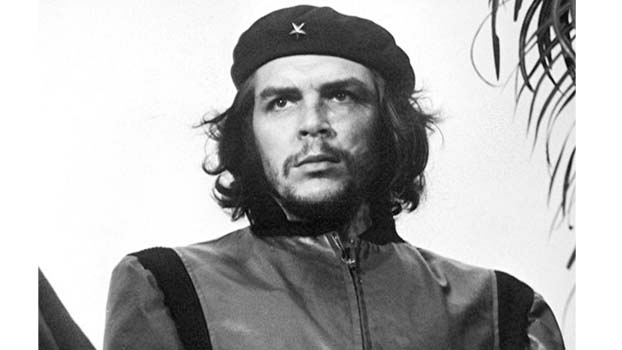
Guevara resigned—some say he was dismissed—from his Cuban government post in April 1965, possibly over differences with Castro about the nation’s economic and foreign policies. Guevara then disappeared from Cuba, traveled to Africa and eventually resurfaced in Bolivia, where he was killed. Following his death, Guevara achieved hero status among people around the world as a symbol of anti-imperialism and revolution. A 1960 photo taken by Alberto Korda of Guevara in a beret became iconic and has since appeared on countless posters and T-shirts. However, not everyone considers Guevara a hero: He is accused, among other things, of ordering the deaths of hundreds of people in Cuban prisons during the revolution.
Before all that, though, there was the man, an Argentine-born doctor who first arrived on the world stage during the Cuban revolution, when he became a trusted comrade of Fidel and Raúl Castro. After Guevara was captured and summarily killed, it took several days for something close to the truth to emerge. The Bolivian Army initially announced that he had died in a clash and that he had “admitted that he failed in the seven-month guerrilla campaign he organized in Bolivia,” an article on The Times’s front page said.
The next day, the nature of his death became clearer: “A medical report indicated today that Ernesto Che Guevara was slain at least 24 hours after his capture in the southeastern jungle on Sunday,” The Times reported.
Still shrouded in mystery, however, was the location of his body, which was buried secretly in a mass grave. (His hands were cut off and preserved in formaldehyde to prove his identity.)
—History