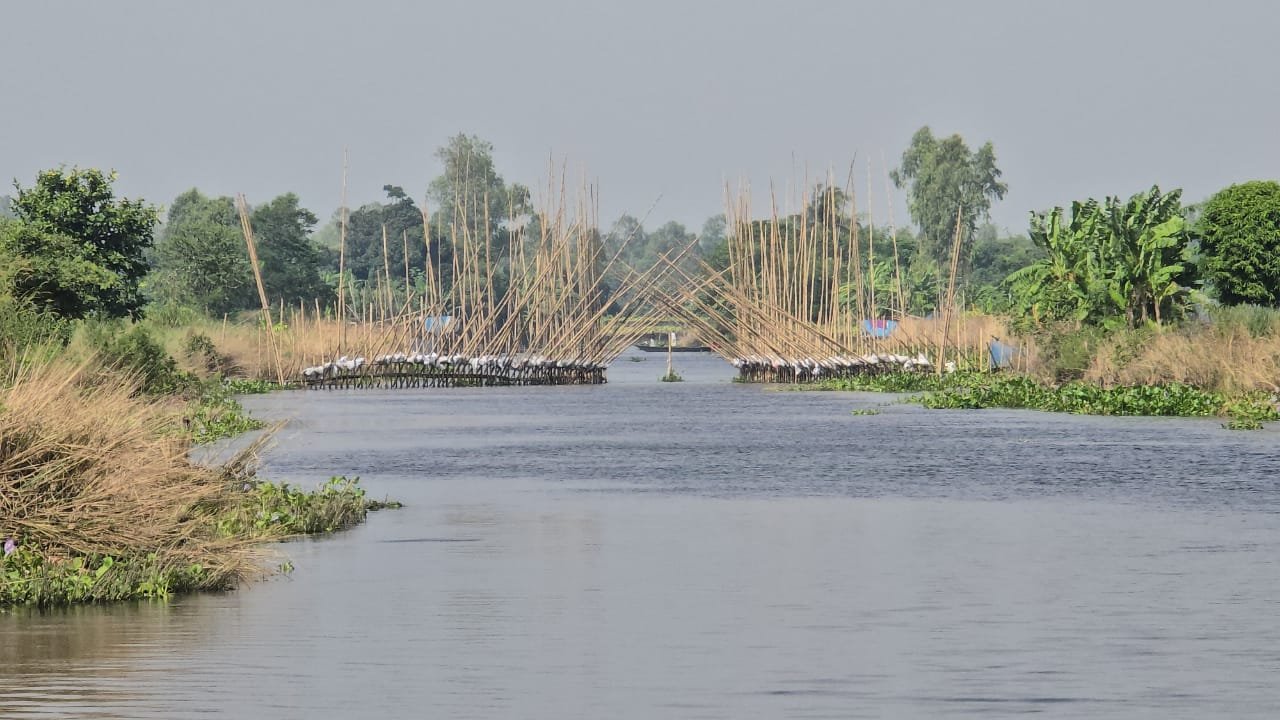
Sathia (Pabna) Correspondent: Onion cultivation is being hampered by current nets in Sathia, Pabna. This is also delaying the harvesting of paddy from the fields. Consequently, the cultivation of onions and other Rabi crops is being severely disrupted.
It is known that illegal enclosures with current nets have been set up in the Kageshwari drainage canal in Sathia upazila of Pabna. Enclosures made of bamboo with current nets have been set up in the area of the main drainage canal of the Water Development Board (WDB) at Dattapara, Baraigram in Karmojha union of the upazila, for fishing. This is obstructing the water flow, leaving around 10,000 bighas of Aman paddy fields in at least 15 beels (water bodies) of the upazila submerged. The harvesting of paddy from these fields is being delayed. As a result, farmers are unable to cultivate onions and other Rabi crops there.
Sources from the Water Development Board (WDB) say the Kageshwari river was converted into the main drainage canal (D-2) in 1992. This river is connected to at least 15 beels in the upazila. During the monsoon, water from these beels and low-lying areas of the upazila drains out through this canal. After harvesting Aman paddy from these areas, onions and other Rabi crops are cultivated.
Farmers say that usually, water recedes from the land by the end of October. But this year, 1 to 6 feet of water still remains in the Aman paddy fields of more than 25 villages in Nandanpur, Gaurigram, Karmojha, Kashinathpur, and Khetupara unions, covering approximately 15,000 bighas.
A recent visit revealed that a barrier made of bamboo, polythene, and mats has been constructed across the main drainage canal at Dattapara, Baraigram in Karmojha union. Current nets have been installed along this barrier, and fish of all sizes, from fry to larger ones, are being caught indiscriminately. The barrier is hindering water drainage.
Nekbar Sardar, a farmer from Afra village in the upazila, said, "The time for planting onions is passing. But due to water in the fields, no one in our village can cultivate them. Moreover, even though the Aman paddy in the fields is ripe, we cannot harvest it."
Local farmers informed that the people involved in setting up the current net enclosures are locally influential. Therefore, out of fear, they cannot speak up against the enclosure owners. They demand that the administration take the initiative to remove these enclosures.
A visit to Dattapara, Baraigram in Karmojha union, found that the drainage canal has been barricaded width-wise with bamboo, polythene, mats, and fine nets, creating current net enclosures. Only a few feet of space has been left for water flow, obstructing drainage.
It is alleged that Raju, son of Box Mondol; Ashraf Ali, son of Boyez Kha; Abul Kha, son of Rezaul Kha; and Bashar Mollah, son of Al Mahmud Mollah, are operating the current nets under the direction of Karmojha Union Ward No. 8 Member Abdul Malek and Rezaul.
They said that after the monsoon, when water recedes from the beels, current nets have been used for fishing in this area for years. Based on that, like others, they have also set up current nets. He claimed that the current nets are not causing any problem for the water from the beels to drain out.
Upazila Fisheries Officer Samsul Rahman said, "We heard about these current nets and conducted drives with the assistance of the upazila administration. We cut and removed the nets and imposed a fine of five thousand taka. They informed us that they would remove all the bamboo within three days. If they don't, we will take action again."
Sathia Upazila Agriculture Officer Sanjeev Kumar Goswami said, "Because of these current nets, water drainage will take time, which will impact the farmers' crops. Therefore, it is essential to remove these current nets urgently."
Sathia Upazila Nirbahi Officer (UNO) Riju Tamanna said, "The AC (Land) was sent last time; they asked for time. If they do not remove them promptly themselves, then the Fisheries Officer, Water Development Board, and the administration will conduct a joint drive to remove them."