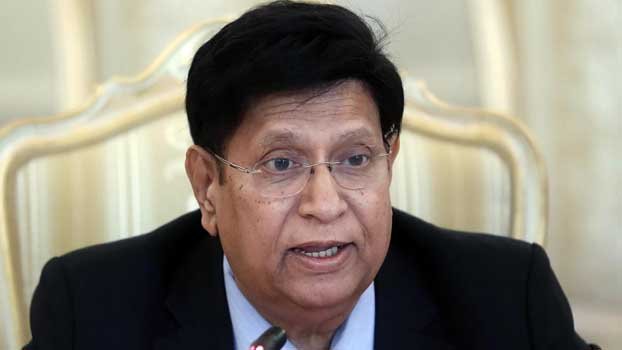
Foreign Minister Dr. AK Abdul Momen on Tuesday said that ‘a culture of appeasement of Myanmar geo-politically’ through enhanced bilateral trade, investment and development assistance continues to grow.
This is despite the fact that Myanmar has “done nothing to redress the rapes, gender based violence, mass atrocities and genocide committed on its minorities that its neighbour Bangladesh diligently continues to host in temporary camps that threatens its very security and sovereignty.”
“We need to ask ourselves why? Because if this defiance, impunity and geo-political appeasement of Myanmar continues, there will be no sustainable solutions to the Rohingya crisis in near sight,” he said while speaking at the virtual high-level event at the Commonwealth “Towards Sustainable Justice, Accountability and Returns The Rohingya Crisis into its Fourth Year”.
British minister Lord Ahmad of Wimbledon, Special Adviser to the Justice Minister of The Gambia Hussein Thomasi, Secretary General of the Commonwealth Patricia Scotland, Bangladesh origin British MP Rushnara Ali, and Foreign Secretary Masud Bin Momen spoke at the event, among others.
The foreign minister called for ensuring international justice and accountability for the Rohingya people and said “it is the call and the cry of the hour under every possible global investigative and accountability mechanism.”
“A dangerous culture of impunity and defiance is thriving,” he said. “Even the ICJ provisional measures of 29 January 2020 is not able to guarantee Myanmar’s compliance of no more violence against Rohingyas or implementation of the critically important recommendations of the Kofi Anan or Rakhine Advisory Commission”.
“Unfortunately, be it the decisions of the UNGA, UNHRC, UNSG’s Special Envoy, the UN Security Council, the ICJ and ICC, the OIC or at the Commonwealth of nations, Myanmar manages to defy them all and gets away with it,” he lamented.
“At this critical juncture, when Bangladesh is overwhelmed and fatigued by the temporary hosting of 1.1 million Myanmar Rohingyas for the 4th year, and is finding it increasingly difficult to shoulder this colossal humanitarian burden for much longer, the world needs to stand next to Bangladesh and urgently find sustainable solutions in Myanmar,” he said.
The foreign minister also thanked the UK, US, EU and their leaders for their generous humanitarian assistance to the Rohingya camps and vulnerable populations in Myanmar.
Those partners would be meeting Thursday for raising humanitarian assistance.
“In this regard, I call upon them not to lose sight that prolonged humanitarian assistance to Rohingyas in temporary shelters in a foreign country cannot be part of a sustainable returns and solutions strategy or for securing the Rohingyas their right to return to their homeland in dignity and rights,” he said.
“We hope that as Chair in Office of the Commonwealth the UK will explore how to utilise Commonwealths expertise in justice to provide advisory support to the ICJ’s ‘Provisional Measures’ or at least create a ‘Friends of the Gambia group’ at the Commonwealth for promoting international justice and accountability for the Rohingyas.”
He also called upon the Commonwealth Secretary General to work with Rwanda for the Kigali summit to do more on Rohingya and fully endorse Bangladesh Foreign Secretary’s call for the Kigali Summit to adopt a separate declaration on international justice and accountability for the Rohingya towards finding a lasting solution to this protracted crisis.
In the fourth year of Bangladesh’s hosting of 1.1 million forcibly displaced Rohingyas from Myanmar, the foreign minister reiterated the call for a sustainable return of the Rohingyas-- that the Rohingya problem was created by Myanmar and any sustainable solution for their returns has to be found in Myanmar.
“Indeed, to make any return of the Rohingyas back to their country of origin, Myanmar, sustainable, safe, secure and dignified, the most important prerequisite is the political will and conscience of the government of Myanmar,” he said.
Prime Minister Sheikh Hasina, earlier, applauded The Gambia’s role on behalf of the OIC in taking on the Rohingya case at the ICJ and getting ICJ’s provisional measures on Myanmar to end genocide and protect Rohingyas.
The foreign minister acknowledged the noble decisions of the leading Commonwealth member Canada and Netherlands for their intention to intervene in the Gambia v. Myanmar.
He called upon OIC countries and also members of the Commonwealth and Commonwealth countries to follow suit and support the Gambia and Canada in seeking justice for Rohingyas.