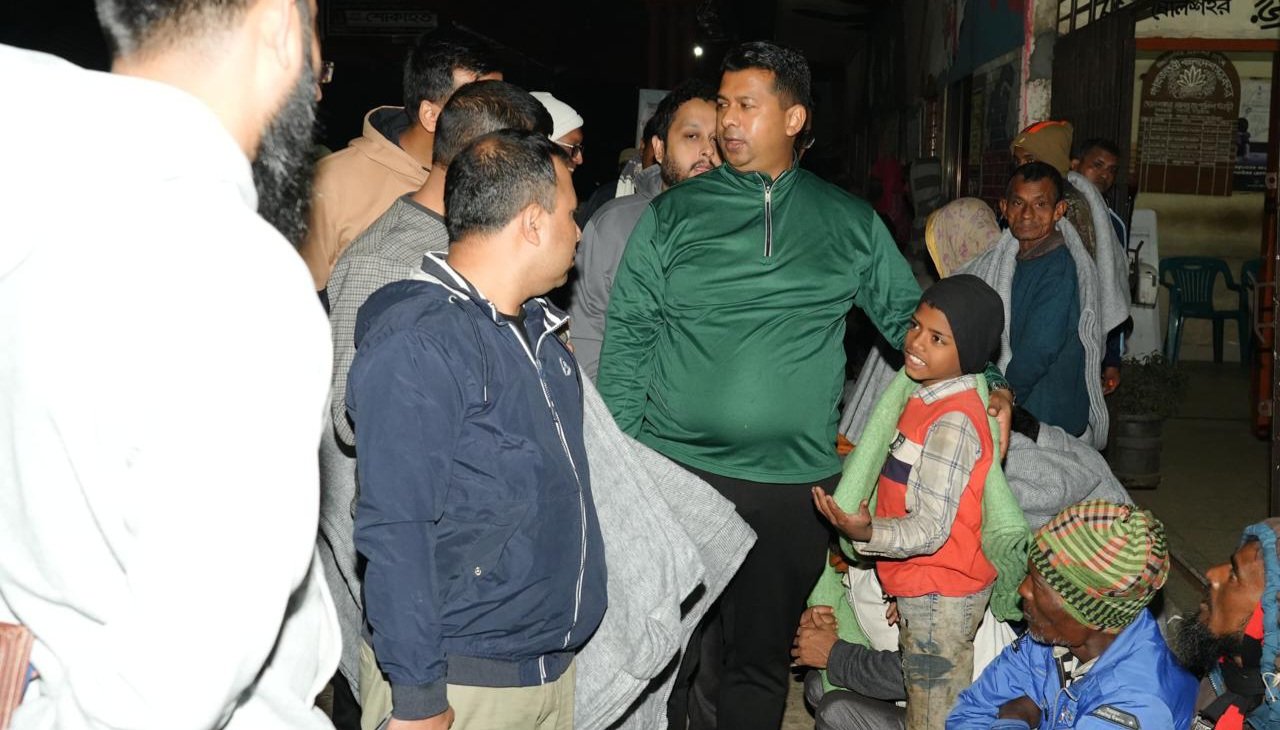
As part of Chattogram bustled with preparations for Thirty-First Night celebrations, a quieter story of compassion unfolded on the city’s streets.
Deep into the night, Chattogram Deputy Commissioner( DC) Mohammad Zahidul Islam Miah stepped out of his official residence on DC Hill—not for a ceremonial duty, but to distribute blankets among the city’s cold-stricken homeless.
What began as a routine winter relief drive soon turned into a series of deeply human encounters.
At the Sholoshahar Railway Station, the DC noticed two shivering street children—Jhumur and Shahin—curled up against the biting cold. He stopped, spoke to them at length like a caring father, and gently wrapped blankets around their small bodies with his own hands.
When asked about their dinner, the children said they had eaten nothing that day due to lack of money. Moved by their words, the DC immediately provided financial assistance so they could have dinner that night.
The night revealed another painful reality at the Mohsin College footpath, where Abdul Majid—a physically challenged beggar—and his seven-year-old daughter Yasmin were living under a worn-out blanket. Originally from Teknaf in Cox’s Bazar, the father and daughter had no shelter beyond the pavement.
Concerned about the child’s safety and future, the DC took detailed notes from Abdul Majid and invited him to the district administration office, signalling steps toward possible rehabilitation.
Speaking later over the phone, Abdul Majid said his disability prevents him from working. Whatever he earns by begging is spent on basic meals—usually rice, lentils, and mashed potatoes costing about Tk 50 a day.
“Yasmin often asks for fish or meat, but I can’t afford it,” he said. “On rare days, when people give more, I try to buy her something better.”
The DC has since asked Abdul Majid to contact him directly and visit the office next Wednesday, assuring that their case would be considered with priority.
Reflecting on the encounter, DC Mohammad Zahidul Islam Mian said,
“I have a daughter of my own. Seeing Yasmin in the cold, her innocent face reminded me of my child. Not just as a DC, but as a father, I felt I must do something.”
The plight of Jhumur and Shahin also left a lasting impact on him.
“On Thirty-First Night, many in the city will spend lakhs of taka on celebrations, while some children here don’t get a single meal,” he said. “As a human being, that hurts me.”
As part of the winter relief initiative, the DC distributed 600 blankets across areas including Dampura Garibullah Shah Mazar, Sholoshahar Railway Station, Muradpur, Chawkbazar, Cheragi Pahar Mor, Laldighi, and Amanat Shah Mazar on Jail Road.
He walked through the streets himself, handing out blankets to the homeless, the disabled, and the destitute—listening to their stories, asking about their needs.
His presence brought not just warmth, but reassurance.
“Standing beside the most vulnerable is a moral responsibility of the administration,” the DC said. “These humanitarian efforts will continue.”
On a winter night in Chattogram, this quiet initiative stood as a reminder that governance is not only about files and offices—but about empathy, dignity, and shared humanity.