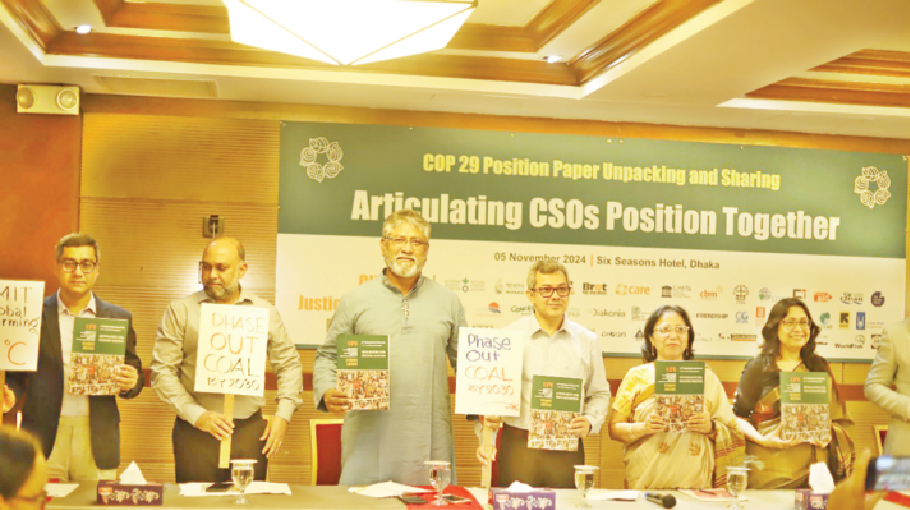
Climate Justice Alliance-Bangladesh, a coalition of 40 civil society organizations led by CPRD organized a position paper-sharing event, at the Six Seasons Hotel, in the capital on Tuesday.
The event was titled “COP 29 Position Paper Unpacking and Sharing: Articulating CSOs Position Together”. The alliance has articulated a fervent call to COP 29 to ensure ambitious, 1.5 °C-aligned NDC-3 by countries with financial and technical support, especially for LDCs, decide a timeline for fossil fuel phase-out, finalization of Article 6 of the Paris Agreement, and a clear definition and governance framework for a just transition.
They also demanded to define climate finance with a identical framework and ambitious New Collective Quantified Goal (NCQG) that prioritizes concessional, grant-based, new, additional, and publicly sourced finance and balanced funding between adaptation and mitigation, prioritizes the needs of the LDCs, SIDS, and the most vulnerable developing countries, and promotes gender equality. The alliance also demands that global research be conducted to understand climate change’s impact on human rights and establish a legal framework under UNFCCC to address climate-induced human rights violations.
Mr. Md. Shamsudohha, Chief Executive of CPRD and the Coordinator of Climate Justice Alliance- Bangladesh, explained the key issues of the upcoming COP 29 and presented the key demands of the alliance. He said, “The 29th Conference of the Parties to the UNFCCC, held from 11 November until 22 December 2024 in Baku, Azerbaijan, will carry on the legacy of past climate negotiations. We expect actionable decisions on implementing the Paris Agreement and the Convention crafted by the COP.
He also demanded a new finance target to replace the USD 100 billion annual target with need-based, predictable financing for climate-vulnerable developing countries to transition from fossil fuels and enhance resilience to climate change. He demanded both quantity and quality of climate finance, and the NCQG must establish a robust monitoring, reporting, and verification (MRV) indicator.
However, he also denied the vague language “New Vision and Operational Model” mentioned during COP 27, which allows for broad interpretation and lacks specific criteria. He added that at COP 29, developed countries must pledge new funding to the FRLD and ensure its swift operationalization to support economic and non-economic loss and damage. COP 29 should also establish a dedicated ‘window’ within the NCQG through the FRLD for predictable financing.
Mr. Md. Shamsudohha also added, “COP 28 in 2023 emphasized the significance of transboundary adaptation through collaboration, knowledge sharing, capacity building, data exchange, and modernizing early warning systems for climate risks.” He demanded a binding international regulation or framework under the ‘Global Goal on Adaptation’ to advance negotiations on transboundary climate adaptation.
He cited few examples, such as ‘the Indus Waters Treaty’ and ‘the Mekong River Commission.’ He further demanded to “Strengthen gender responsiveness in climate actions through comprehensive guidelines, dedicated funding for women and marginalized groups, and intersectional monitoring and evaluation” and to “establish a dedicated framework for addressing climate-induced human mobility, with clear definitions, standardized terminology, and robust data collection to support, also to “Align the Global Stocktake (GST) process with IPCC assessments and ensure effective implementation of the GST-1 outcomes.”
Mr. Talha Jamal, Country Director, Islamic Relief Bangladesh said, CSOs have crucial roles in ensuring climate justice for those most at risk from climate change. He underlined that the Alliance has taken outstanding steps in this direction under the direction of CPRD. “I appreciate the proposed recommendations,” he continued, adding that government representatives should carefully consider all recommendations from various platforms.
Ms. Shaheen Anam, Executive Director, MJF, said that the Multilateral Development Banks (MDBs) should focus on creating a just and equitable financing system for mitigation, adaptation, and loss and damage, rather than merely increasing private finance mobilization or burdening vulnerable countries with loans. MDBs and international financial institutions (IFIs) must reform their practices to align and scale up funding, simplify access, and mobilize climate finance from diverse sources.