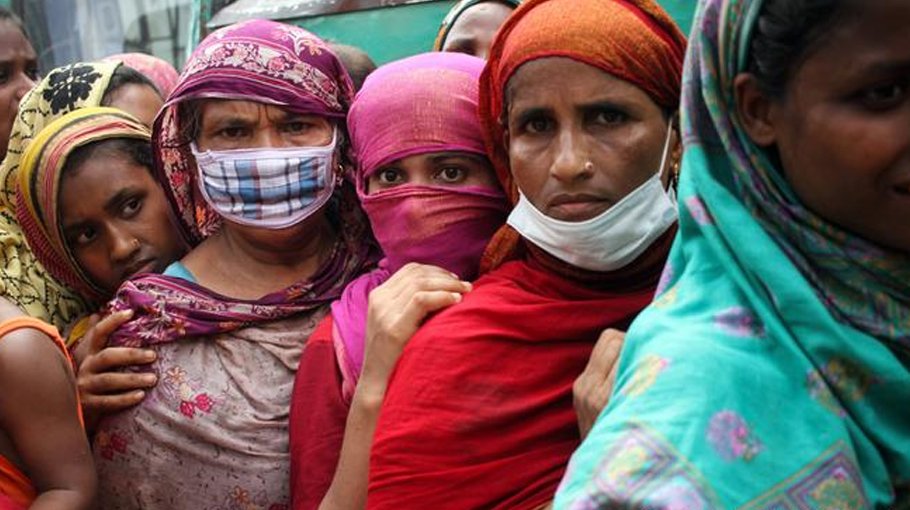
Speakers at a seminar strongly suggested addressing the Covid-19 crisis faced by women, especially adolescent girls, and urged the government to allow women employment opportunities.
More than 50 million people involved in the country’s informal sector have borne the brunt of the Covid-19 pandemic. Women and adolescent girls engaged in this sector are the worst sufferers. Participation in the labour market through effective skills training should be a high priority to assist them in recovering the situation.
The speakers expressed these views at a discussion meeting organized by BRAC’s Skills Development Programme (SDP) on Thursday at the BRAC Centre in Mohakhali of the capital.
KM Tarikul Islam, Director General, NGO Affairs Bureau, attended the event titled, “Tackling Covid-19 adversities on young girls and women through skills training in the informal sector,” as chief guest while Md Abul Kalam Azad, former principal coordinator (SDG affairs) at the Prime Minister’s Office, was present as the special guest.
AFM Shahidur Rahman, Director of Programme Development-Asia, PRL and Monitoring Department, BRAC, delivered the welcome speech which was followed by a keynote presentation by Nobonita Chowdhury, Director, Gender Justice & Diversity and Preventing Violence Against Women Initiative, BRAC, on the current state of girls and young women in the informal sector.
Tasmiah Tabassum Rahman, in-charge of BRAC’s Skills Development Programme and Dr Narayan Chandra Das, Senior Research Fellow of BRAC Institute of Governance and Development (BIGD), gave another presentation on “Skills interventions for mitigating risks on young girls and women - skills training for advancing resources (star), an apprenticeship-based skills training model”.
Veera Mendonca, Deputy Representative, UNICEF Bangladesh, Shahriar Islam, Senior Programme Manager, Australian Department of Foreign Affairs and Trade, and Mirza Nurul Ghani Shovon, Chairman, Informal Sector Industry Skills Council, spoke as panel speakers.
The speakers observed that the informal sector has been the worst affected in terms of the country’s labour market. The situation has its direct impact on the people involved in the sector, risking the livelihood of 52 million (5 crore 20 lakh) people. Women are the worst sufferer as nearly 91.8 percent of the total women labour force are engaged in the informal economy.
A research carried out by BRAC last year (2020) revealed that regular earning dropped by 66 percent for women involved in the informal sector, while their opportunities for work reduced by 24 percent.
Another study reveals that child marriage saw a staggering rise of 220 percent between July and September last year.
To recover from the crisis, BRAC puts particular emphasis on the re-engagement of women in the labour market and has accordingly designed its programmes and activities to fulfill that aim.
KM Tarikul Islam said, “All the organisations are working to fulfill the aim to have 10 million (1 crore) people employed in the Mujib Barsha. The government has created a number of industries that will provide employment to women as well. However, it’s a big challenge to tackle which the non-state development actors should come forward to assist the government.”
Md Abul Kalam Azad said, “In Bangladesh, over 18 million (1.8 crore) women are employed in the labour market. We must also think about what crisis these women may face in their livelihoods in case the Omicron variant of coronavirus spreads in Bangladesh. We have to be adequately prepared to tackle the situation.”