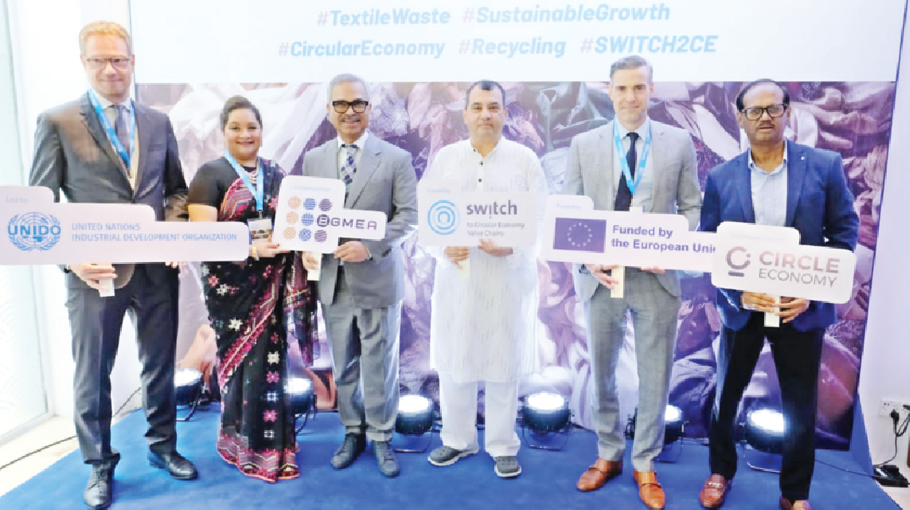
Bangladesh, the second largest readymade garment exporter in the world, is poised to embark on a transformative journey towards circularity in its industrial practices. Circularity presents a significant opportunity for Bangladesh to reduce its environmental impact, improve its economic performance, and create social benefits.
However, embracing circularity also poses certain challenges for Bangladesh’s apparel industry that must be collectively considered and resolved.
To address this, an esteemed panel of industry leaders, policymakers, and experts in circular economies convened for the "Switch to Upstream Circularity Dialogue: Pre-consumer Textile Waste in Bangladesh" event at the Amari Hotel in Dhaka on September 3. The dialogue covered the strategies, policies, infrastructure, collaborations, and innovations necessary to build a thriving circular ecosystem in Bangladesh.
This event was organized under the Switch to Circular Economy Value Chains project (SWITCH2CE), co-funded by the European Union and the Government of Finland.
SWITCH2CE is led by United Nations Industrial Development Organization (UNIDO), in collaboration with Chatham House, Circle Economy, and European Investment Bank, and supports the switch to circularity in selected global value chains.
Saber Hossain Chowdhury MP, Chair of the Parliamentary Standing Committee on the Ministry of Environment, Forest and Climate Change, Bangladesh, and the Special Envoy to the Honorable Prime Minister Sheikh Hasina for Climate Change, was present in the opening session as chief guest.
Faruque Hassan, President, Bangladesh Garment Manufacturers and Exporters Association (BGMEA) spoke at the opening session as a special guest.
Dr. Bernd Spanier, Deputy Head of Mission, Delegation of European Union to Bangladesh, Mark Draeck, Chief Technical Advisor on SWITCH2CE at UNIDO and Holly Syrett, Director of Impact Programmes & Sustainability at Global Fashion Agenda also contributed to the event's opening session.
Hilde van Duijn, Head of Global Value Chains, Circle Economy, also participated in the event and made Circular Game Demonstration.
Faruque Hassan, President, Bangladesh Garment Manufacturers and Exporters Association (BGMEA), said, “Living in a world in our time where climate is most threatened, business as usual is no more an option. In a race to zero emission and resource decoupling, circularity emerges as the ‘next normal’ linking business and sustainable development.”
Alexander Granberg, Senior Project Specialist, BESTSELLER “At this moment in time, everybody understands the need for new business practices in order to transition to a circular economy.”
Federica Marchionni, CEO, Global Fashion Agenda, said, “The transformation to a circular economy requires collective efforts beyond the capabilities of any individual agent or company. Therefore, we are honoured to be coordinating this multistakeholder partnership between a group of esteemed organisations.”