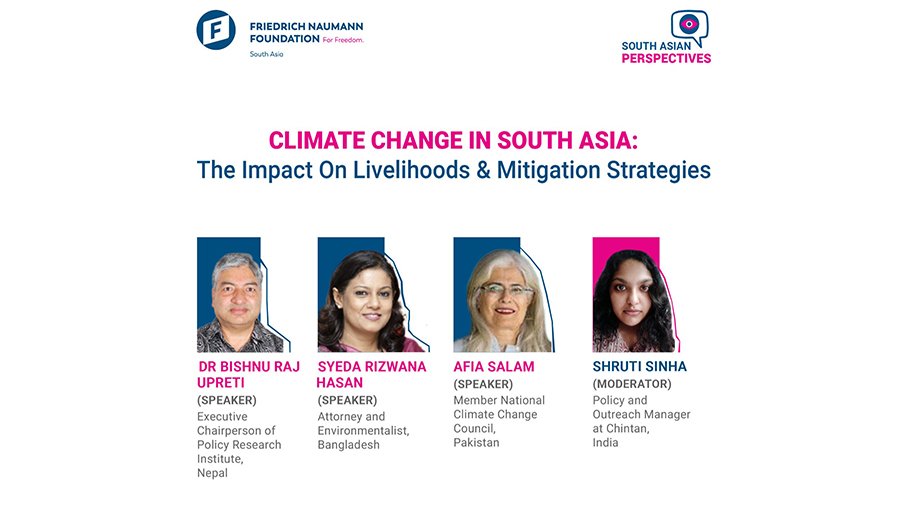
Recently a webinar on Climate Change under the banner of “Climate Change in South Asia: The
Friedrich Naumann Foundation for Freedom (FNF South Asia) organized a valuable webinar on climate
change titled "Climate Change in South Asia: The Impact on Livelihoods and Mitigation Strategies."
Distinguished panelists, including Dr. Bishnu Raj Upreti (Executive Chairperson of Policy Research
Institute from Nepal), Syeda Rizwana Hasan (Attorney and Environmentalist from Bangladesh), and Afia
Islam (Member of National Climate Change Council from Pakistan), provided valuable insights on the
issue through speeches and discussions. Shruti Sinha, the Policy and Outreach manager at Chintan from
India has moderated the session.
South Asia, with a population of over 2 billion people, is experiencing the adverse effects of climate
change on livelihoods, which is increasingly gaining attention. The webinar provided an important forum
for distinguished speakers to interact with stakeholders from various sectors and discuss the issue. The
discussions aimed to devise implementable practical and sustainable solutions to address the crisis.
Bipin Ghimire who is working as the Regional Political Analyst at FNF South Asia started the webinar and
shared his opinion on the vulnerability of south Asian countries due to climate changes. He expected
that this webinar would contribute in the climate change discussion in many aspects. He informed that
FNF South Asia has organized many webinars on several issues and already they have reached 30,000
people in social media.
Dr. Om Katel, a faculty member at Royal University from Bhutan delivered the keynote speech, where he
focused on the impact on agricultural sector, which is one of the prime victims of climate change and
global warming. As he states, “Climate change is no longer a future phenomenon, it is here, and we are
bearing the brunt already”. He also mentioned the issue as a matter of injustice associated with
development failure and lack of sufficient mitigation and adaptation strategies. The impacts of climate
change are adversely affecting all countries in South Asia and the impacts are leaking down to other
issues like health, nutrition, mortality, etc.
Dr. Upreti, being an expert on climate change issues, shared his thoughts on climate-friendly energy
implementation in agricultural as well as industrial sectors. Extreme weather changes are causing
adverse effects on the water sources and affecting the day-to-day and economic life in turn. Standard
reports have clearly shown the differences over the year and the threat hovering over food security,
water security, and overall livelihood. As per Dr. Upreti, though everyone is a victim of the situation, the
most sufferer is the low-income people who heavily depend on nature to pursue their living.
On a note to Ms. Hasan, the moderator asked about the ramification Bangladesh is paying off due to this
phenomenon and the answer that came from her is quite alarming. She mentioned that with this
current rate of climate change, soon one-third area of Bangladesh would be under water. Generations
of Bangladesh will be enduring the impacts that we are causing today and most of the coastal areas here
will disappear. The ecosystem will alter heavily and the disproportionate balance between decreasing
landmass and increasing population will be worsening the situation. Continuous salination of agricultural
water will consequently deteriorate the availability of clean water. Because of this, women's health,
child nutrition, and mental health rooted in internal displacements, recurrent natural disasters, lacking
access to nutritional sufficiency have become the problems of the present.
Ms. Salam attended the discussion as the last panelist and reflected on her thoughts on the issue from a
wider South Asian perspective. The impact of climate change on this region is fiercer due to its dense
population, lack of geographic resilience, proneness to natural disasters, and economic dishevel.
Women are the most notable victim of this situation, more in this region, due to their economic and
social vulnerability. Besides, children, aged people, and disabled members of society can be succumbs of
this issue, the concern which is often not reaching the policy level. The governments of most of these
countries are behind with their adaptive strategies because of lacking concentration on the
circumstances. Most of these countries are facing a similar domino effect with a divided impact on
biodiversity, human health, and economic backlashes.
Dr. Carsten Klein, Regional Director at FNF South Asia, shared data from UNHCR that indicates more
than 21 million people possibly displaced by climate-related phenomena every year in Europe and Asia.
He emphasized the need for a common South Asian platform to build awareness from schools to the
private sector and for political will from South Asian governments to address climate change. He invited
everyone to join the upcoming River Conference on the 15th and 16th of February in Kathmandu, Nepal.
The speakers also talked about different studies and research that have focused on the issues. A
question-answer session followed the panel discussion, where the participants raised various significant
inquiries on the economic tolls of climate change, infrastructural necessities, law development and
implementation, etc. Recommendations came from the discussers on diverting towards affordable and
renewable energy with a trial to reduce the threat. Policy development related to the sectors that are
facing problems due to this crisis is an urgent need and supervision to execute those policies is crucial.
Climate change is often speculated that climate change as a political issue rather than a development
issue, which is hampering the dichotomy from being analyzed properly.
The future seems quite worrisome but the webinar ended on a positive note with constructive
recommendations that might resist the ultimate consequences. After a very worthwhile interactive
discussion of almost a couple of hours, the panelist and the speakers, along with all the relevant
stakeholders, expected the implementation of sustainable solutions to assure a better future for the
upcoming generation.