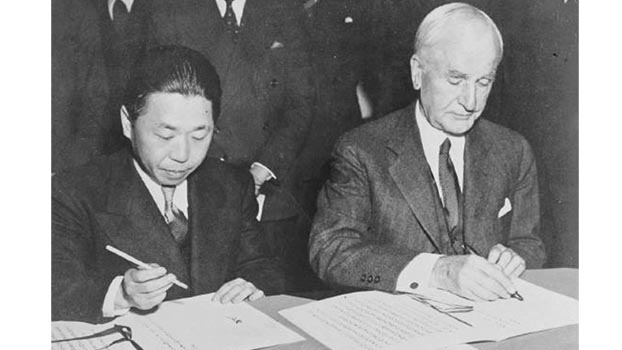
China and the United States signed a treaty today that ended extraterritorial rights in China. A similar agreement was also signed on this day between Great Britain and China. For the United States, this meant that the U.S. no longer had power to "exercise jurisdiction" over its citizens residing in China. In return, China agreed to treat Americans in some respects like they would native Chinese-in terms of housing (residence), trade, civil rights, and overseas travel (navigation).
Similar provisions were made in the treaty that was sign by Great Britain and China as well. In both treaties signed on this day, the idea was the same-to advocate international equality. Under that treaty, the British government relinquished any special rights it had in China. This was done as a conciliatory step towards the Chinese government in order to boost up its cooperation with the Allied Powers in the Second World War. The United States and China concluded a similar treaty on the same day.
Ratifications were exchanged in Chongqing on 20 May 1943, and the treaty became effective on the same day. It was registered in the League of Nations Treaty Series on 30 September 1944.
Since the Treaty of Nanjing, concluded in 1842, the British government enjoyed extra-territorial rights in China, which included mainly commercial rights for British companies and extra-territorial rights for British nationals in China. British subjects could only be prosecuted for crimes or have civil cases brought against them before British Consular courts or the British Supreme Court for China and Japan.
On 27 August 1942, US Secretary of State Cordell Hull suggested that in case negotiations for relinquishing extra-territoriality commence, the following provisions should be included in the treaty: Abrogation of the Boxer Protocol of 1901 and of the international settlement in Shanghai.
Settling legal issues resulting from the termination of the diplomatic quarter in Beijing. New legal arrangements to be entered in order to allow the retention of some foreign landed property in China under the new policy. Granting similar rights to Chinese nationals in the U.S. as U.S. nationals in China.
Reciprocity in consular representation for the U.S. and China. Negotiations for comprehensive new treaties on commerce to start 6 months following the termination of the war. Settlement of all disputes on the rights of Americans in China according to norms of international law.
Negotiations eventually led to the conclusion of two similar treaties in January 1943 between China and the U.K. and U.S. respectively for the relinquishment of extra-territorial rights in China. Wikiwand