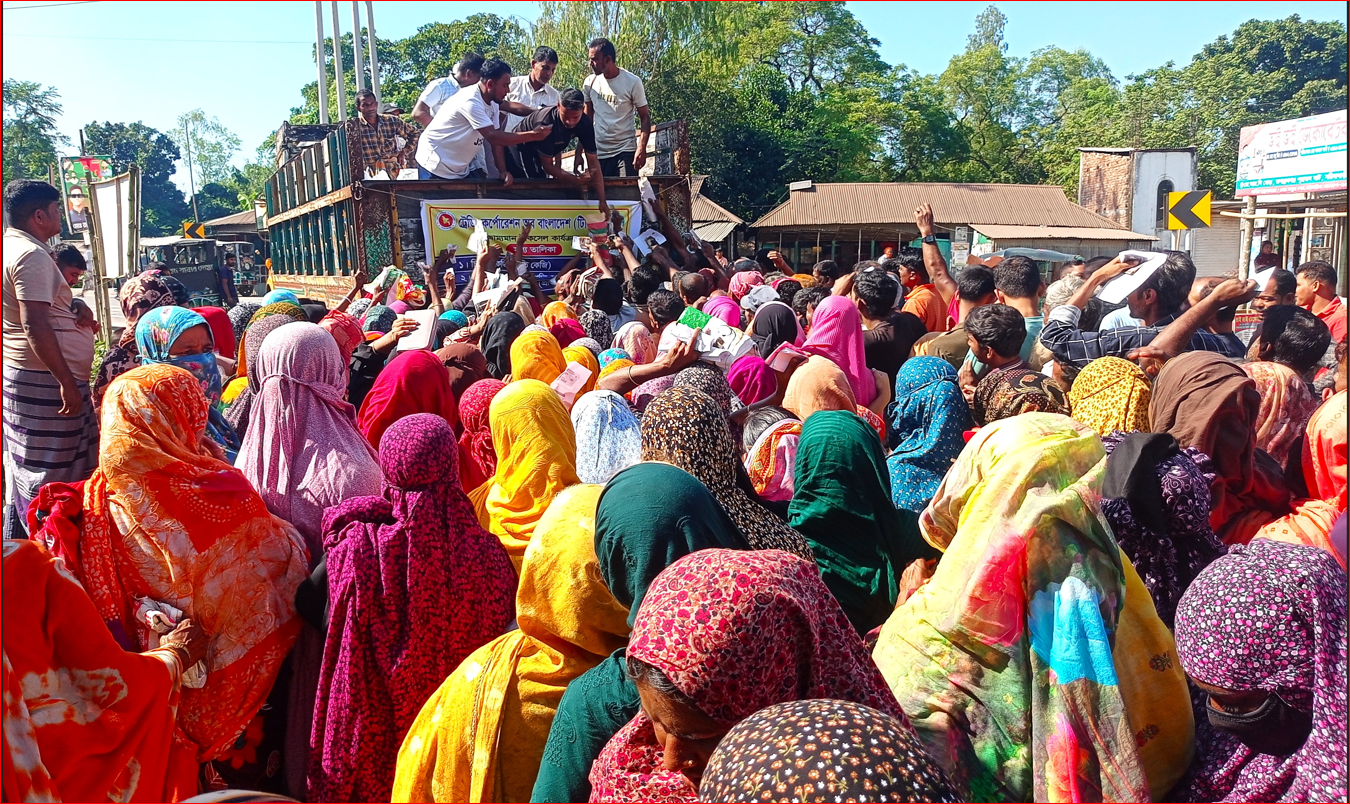
Hundreds of low-income residents in Sarishabari were left frustrated after waiting in long queues behind a TSCB (Trading Services Corporation of Bangladesh) truck, only to find that supplies ran out almost immediately.
The truck, carrying subsidized essential goods, is intended to serve 500 people per trip. However, the demand far exceeds supply, with many locations reporting double the number of people waiting. Sarishabari Upazila has a total of 12,405 TSCB cardholders, and through 18 local dealers, 500 packages are distributed at different points. Altogether, 21,405 people are supposed to benefit from these supplies.
At Jagannathganj Ghat, residents gathered as soon as the truck arrived, but the packages were gone within moments. Many, including elderly and vulnerable individuals, could not reach the truck in time. Frustrated buyers such as Anowar Hossain, Mofazzal Hossain, and Hosneara Bewa expressed their anger at waiting long hours only to leave empty-handed.
Some locals, speaking anonymously, revealed that although trucks are supposed to carry enough packages for 500 people, in reality, they bring only 250–300. Within 20–30 minutes of arrival, dealers announce that supplies are finished, leading to rumors that the remaining goods are sold elsewhere.
Seventy-year-old Jumiran Bewa said, “I struggled to stand in line and reach the truck, but they didn’t give me anything. Even after pleading and holding their hands, I got nothing. We poor people are ignored.”
TSCB dealer Redwan Ahmed Sumon acknowledged the shortage, explaining that the limited supplies quickly run out due to overwhelming demand, and dealers face public anger in the process. He urged authorities to increase the allocation so that more people can access the goods.
Upazila Executive Officer Md. Mohosin Uddin stated that to ensure both TSCB cardholders and general residents benefit, 500 packages per truck are being distributed through 18 local dealers at multiple points.
The recurring shortages have sparked frustration and disappointment among the residents, highlighting the need for better planning and larger allocations to meet the high demand.