Jeffrey Fleishman
America’s wars are scattered with the brave, rabid and opportunistic.
From Vietnam to Iraq, the toll of conflict has taught us that leaders will lie, false heroes will be exalted, corporations will reap hundreds of billions of dollars in contracts, and those who protest the horror and farce of unfolding bloodshed will be stamped unpatriotic and sent on their way so as not to disturb the flag-draped reverie.
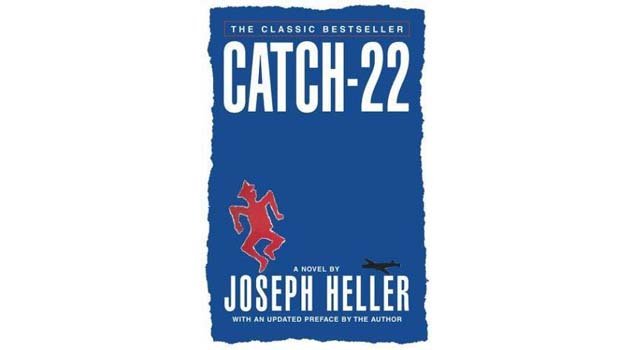
That is the essence of Joseph Heller’s 1961 masterwork “Catch-22,” a novel set in World War II that stripped away the glory of battle through conniving, clueless and scary characters that would symbolize the misadventures of future wars. With President Trump threatening Iran and North Korea testing missiles, Heller’s book, an allegory for life’s mayhem, is as prescient today as when it was published at the threshold of America’s foray into Vietnam.
“The novel is an incredibly, beautiful, hilarious, moving satire about the insanity of war,” says novelist, poet and screenwriter Luke Davies (“Lion,” “Candy”), who adapted the story for Hulu’s new miniseries “Catch-22,” co-directed by and starring George Clooney. “Heller was so on the mark in his gloriously acidic comedic portrayals of those in positions of power. The very people having the least skills to lead us become the ones in charge. But the story is really one man’s journey of loss.”
That man — whose fate has been taught in countless English classes — is Capt. John Yossarian. He’s a bombardier who sees the futility of war after flying 50 missions over Europe. He yearns to go home. But he faces the famous Catch-22 conundrum: A man is considered insane if he wants to fly more missions, but the rules say he can’t be pulled from duty unless he asks to be grounded; yet if he requests to stop, he is considered rational and fit to fight. There is no escape. The madmen colonels and vainglorious generals have him trapped in a crazy, confusing labyrinth.
The power of “Catch-22” is in the play of its language, which turns war into a grotesque cartoon of pointless carnage. It, like Kurt Vonnegut’s anti-war “Slaughterhouse-Five,” published eight years later in 1969, would shape a skeptical generation no longer bound to the World War II ethos and unquestioned patriotism of its parents. It was literature speaking to an era of change.
The novel’s dark, absurdist style would be adapted for a 1970 film by Mike Nichols.
Today, though, the shock and awe of conflict has turned into ambivalence, an inured sense, such as in Afghanistan, that while our wars grind on in foreign lands, Americans blithely go about their lives at home. Heller’s novel captures this feeling of the abstract. War exists in a perverse parallel universe that reflects and caricatures the government and bureaucracy that unleash it and manipulate public opinion around it.
The term “Catch-22” became part of the American vernacular, shorthand for ludicrous and contradictory undertakings. At once comic and tragic, the novel mirrored what was to come, including the inflated enemy body counts and White House lies of Vietnam. Moments in the Iraq war seemed as though they had been scripted by Heller: President George W. Bush landing on an aircraft carrier in 2003 and proclaiming “Mission Accomplished” in a conflict that would drag on for eight more years and cost more than 400,000 lives.
The name that would come to define the American paradox happened by chance. “Catch-22,” which received mixed reviews, was originally called “Catch-18.” Heller changed the title of his debut after he was informed that bestselling author Leon Uris’ next book was “Mila 18.” The switch became instant publishing folklore, an irony worthy of Yossarian and his fellow flyboys. The son of a truck driver born in Coney Island, N.Y., Heller would go on to write other novels and plays, but none caught the cultural zeitgeist like “Catch-22.”
One of book’s most indelible characters is Milo Minderbinder, a wheeling-dealing mess officer and unabashed capitalist, who flies around Europe trading in black-market cotton, dates, zinc, M&Ms and oranges. His is the fictional precursor to military contracting firms such as Halliburton and Blackwater. Milo makes soldiers believe they are shareholders in a vast corporation that can profit from war without becoming distracted by morality.