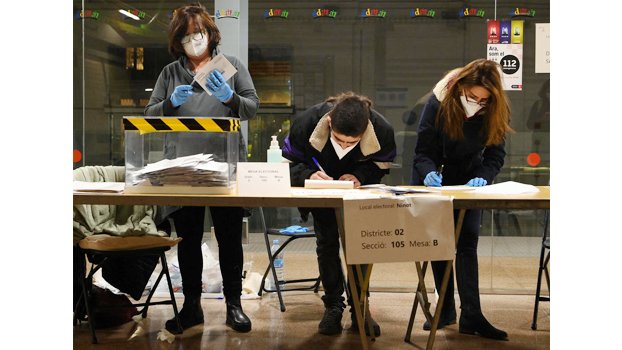
Catalan separatist parties boosted their parliamentary majority in a regional election Sunday that wasovershadowed by the pandemic and marked by low turnout, more than three yearsafter a failed bid to break away from Spain, reports AFP.
With Spain still grappling with a third wave of coronavirus infections, thevote in the wealthy northeastern region was held under tight restrictions toreduce the risk of contagion.
With 99 percent of the votes counted, Prime Minister Pedro Sanchez’s Socialists won the most votes but the three separatist parties together were set to get 74 seats in the 135-seat assembly.That is up from 70 seats won in the last election in December 2017, justmonths after Catalonia’s failed secession bid which led to the jailing ofseveral separatist leaders. To reduce the risk of virus transmission in the region, polling stationswere set up in spacious venues like food markets, the area around FCBarcelona’s football stadium and the bullring in Tarragona.
Voters had to wear face masks, use disinfectant gel provided at pollingstations and stand apart while lining up in rainy weather to cast theirballots.
During the last hour of voting, which was reserved for people infected withCovid-19, polling station workers wore gloves, facial screens and whiteprotective gowns.The Socialists had 33 seats, up from 17 in the last vote when they finishedfourth.
Sanchez had hoped the election — Catalonia’s fifth in a decade — wouldend separatist rule in the region which accounts for a fifth of Spain’seconomy. He fielded his health minister Salvador Illa as his candidate in the hopethat his high profile in the fight against the pandemic would help win votes.While separatist parties have been deeply divided over strategy since thefailed secession bid, they were not punished by voters and for the first time won over 50 percent of the vote, against 47.5 percent four years ago.
The more moderate ERC got 33 seats, the hardline JxC got 32 and the radical CUP nine seats.The result leaves the ERC’s main candidate, 38-year-old jurist PereAragones, best placed to become Catalonia’s next leader.
“We have stopped an operation by the (Spanish) state to expel separatistsfrom institutions,” he said after the results were announced. Illa had arguedit was “time to turn the page” after over a decade of Catalan nationalistsgovernments focusing on separatism but Aragones dismissed his approach duringthe campaign as “amnesia”.
He has said his party would not turn the page while independence leaders
remained in jail over the failed secession bid.Catalonia is currently governed by a coalition led by JxC, which is proneto confrontation with Madrid, and the ERC, which is open to dialogue and hashelped Sanchez’s minority government pass laws at the national level.
The anti-coronavirus measures appeared to discourage people from voting.While some 5.5 million people were eligible to vote, turnout was a record
low at 54.4 percent, down from almost 80 percent in the last election.“I hesitated until the last minute whether to come vote or not,” CristinaCaballero, a 34-year-old child educator, told AFP at a Barcelona pollingstation.
“I think these elections should have been postponed.”The regional government tried to put off the election until the end of Maybecause of the pandemic but the courts blocked that move.
While more than 40 percent of the 82,000 people assigned to help staff
polling stations on the day had asked to be recused, all polling stations
were operating normally as of noon, according to the Catalan government.
Still, some people picked for polling station duty expressed concern.“Of course we are afraid, I just had cancer and am still on sick leave, butI was called up,” Eva Vizcaino, a 54-year-old office worker, said at aBarcelona polling station.