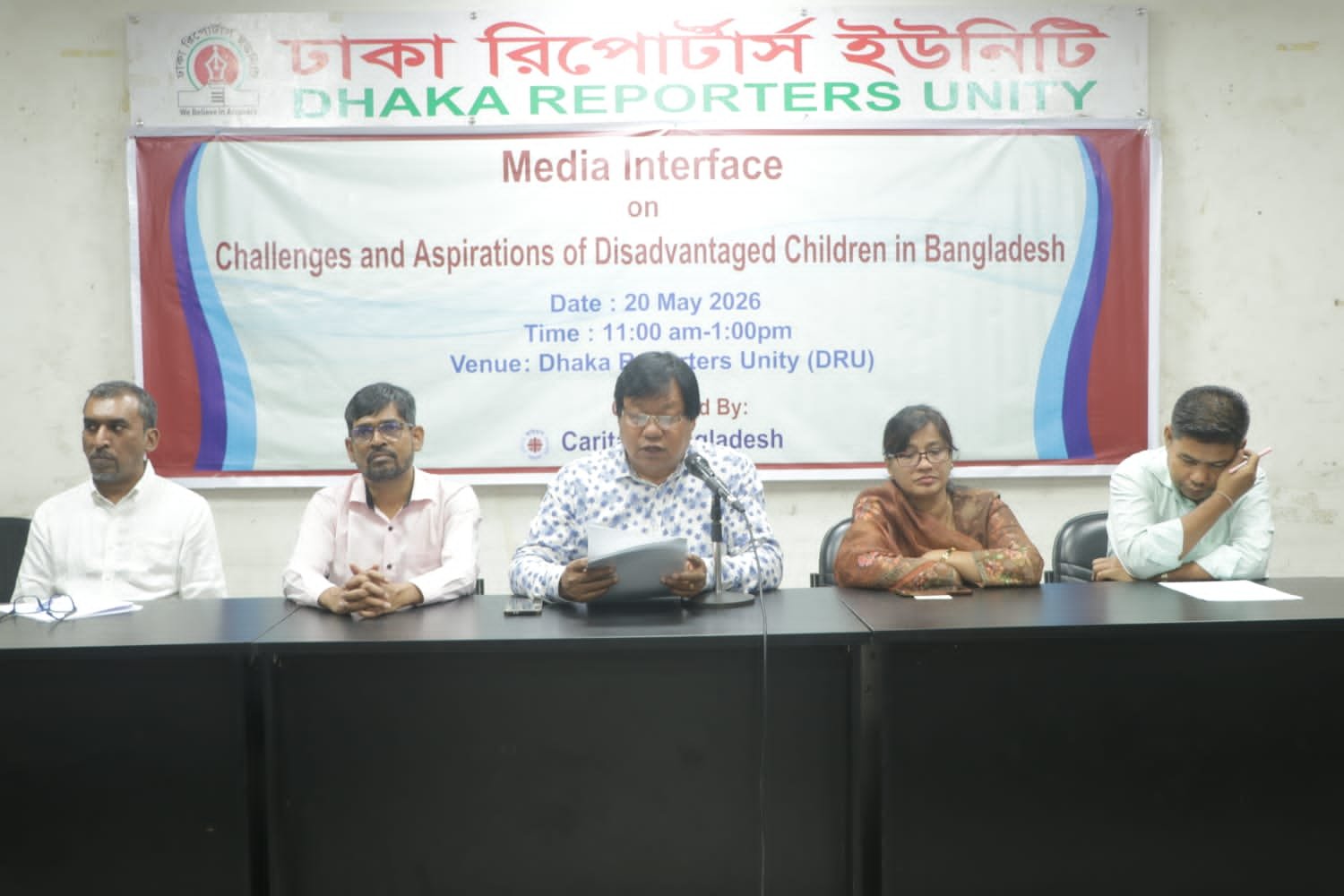
Caritas Bangladesh, a non-governmental development organization, has demanded that birth registration be made mandatory in hospitals and community clinics immediately after birth and conditional child allowance be introduced for street children along with children from extremely poor families. At the same time, it has urged for not only a policy announcement but also effective implementation at the field level to simplify the birth registration process for street children without parents.
These demands were raised at a media consultation meeting organized by Caritas Bangladesh at Dhaka Reporters Unity (DRU) on Wednesday. Theophil Nokrek, Director of Caritas Development Institute, read out a written statement at the press conference.
He expressed deep concern in the written statement for the children who do not have families or who are separated from their families and grow up in railway stations, launch ghats, footpaths, markets or slums, as they are still outside the protection of the state.
Mentioning a survey statistics conducted by Caritas Bangladesh, he said, “About 58.2 percent of street children do not have any birth certificates. In addition, 71.4 percent of children without birth certificates do not know the national identity card numbers of their parents. As a result, it has become almost impossible for them to register their births according to the existing rules.”
Not having a birth certificate is not just an administrative problem; it is a human rights crisis. Without a birth certificate, children face various obstacles in school admission, healthcare, government benefits and enjoyment of civil rights in the future, Theophil Nokrek said at the press conference.
Another statistics presented in the press conference says that although birth registration is mandatory within 45 days of birth, in reality most children are not registered on time. According to the data of the 'Office of the Registrar General, Birth and Death Registration', a total of 83 lakh 60 thousand 333 people were registered in 2024, of which only 9 percent of the birth registration of children was completed within 45 days of birth. In this context, there is a demand to make the system of birth registration mandatory directly from hospitals, community clinics and health centers immediately after the birth of a child. At the same time, the organisation called for the birth registration of street children and disadvantaged children to be completed through ward-based and mobile campaigns.
Caritas Bangladesh said that the monthly allowance of 500 to 650 taka under the social safety net is very inadequate in the current market situation. Therefore, the organisation demanded to introduce a 'conditional child allowance' for street children and children from extremely poor families. It also mentioned that under such a program financial assistance can be given to families on the condition that children are sent to school, not involved in child labor and ensure health check-ups.
The written statement further said that children come to the streets due to poverty, domestic violence, river erosion, the impact of climate change and social inequality. Street children are constantly subjected to violence, exploitation and child labor. Many are involved in risky work and girls are at high risk of sexual abuse.
At the press conference, Caritas Bangladesh presented several demands to the government. These include: making birth registration mandatory in hospitals and community clinics immediately after birth; implementing a simplified birth registration process for street children without parents at the field level and providing training to relevant officials; ensuring hundred percent birth registration through a special ward-based campaign; introducing conditional child allowance for street children and children from extremely poor families; expanding safe shelter, alternative education and rehabilitation programs for street children; increasing the amount of social security allowance realistically; and adopting special protection programs for children at risk.
At the meeting, Chandra Moni Chakma, in-charge of SWVC sector of Caritas Bangladesh, said, “No child is born neglected; it is the failure of society and the state that puts a child on the street. Therefore, the government, non-governmental organizations and society as a whole must come forward in a coordinated manner to ensure a safe future for street children and disadvantaged children.”
The meeting was attended by representatives of various organizations, including Program Officer of Caritas Bangladesh Kusum Gregory, Asim Cruz, and representatives of street children.