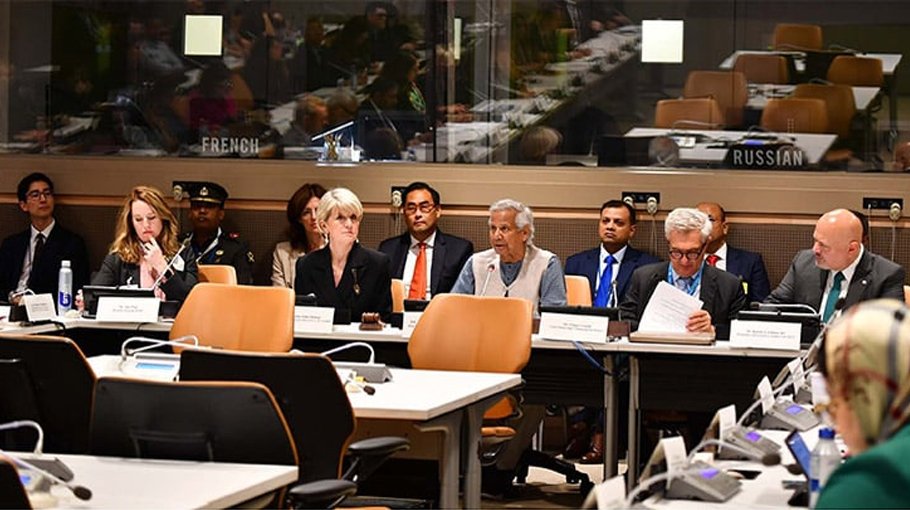
Urging the international community to come forward to resolve the long-pending Rohingya crisis, Chief Adviser Professor Dr Muhammad Yunus on Tuesday said if this crisis is not resolved, not only Bangladesh but the entire region will also fall into trouble.
"We have to be careful...we must pay attention to this," he said while speaking at a high-level discussion about the Rohingya crisis on the sidelines of the annual session of the United Nations General Assembly (UNGA) in New York on Tuesday evening.
Foreign Affairs Adviser Md Touhid Hossain, High Commissioner for Refugees Filippo Grandi, ICC Prosecutor Karim AA Khan, IOM Director General Amy Pope, Principal Coordinator on SDGs Affairs Lamiya Morshed, Chief Adviser's Press Secretary Shafiqul Alam and CA's Special Assistant Mahfuj Alam, among others, spoke at the event.
Speaking on the occasion, Prof Yunus proposed rethinking the solution to the Rohingya crisis to the international community.
"First of all, we want the UN Secretary General to organise a conference on the Rohingya crisis in the presence of all parties involved as soon as possible," he said.
Reviewing the overall situation of the Rohingya crisis, the chief adviser said a new and far-sighted solution should be proposed to resolve the crisis.
Secondly, he said, there is a need to revive the 'Joint Response Plan' programme conducted jointly by the United Nations and Bangladesh.
Since there is a lack of funds to spend on Rohingyas, the process of raising money should be strengthened with political decisions, Prof Yunus said.
In the third proposal, he said the international community should come forward with sincere support to ensure justice for the crimes of genocide committed against the Rohingya people.
To ensure long-term peace and security in Myanmar, justice for these Rohingyas, who were persecuted by Myanmar's military junta, must be ensured, he said.
High Commissioner for Refugees Filippo Grandi said he was honoured to participate in the discussion on Rohingya crisis led by Prof Yunus.
"Like every year, the event was held but the presence of Dr Yunus and his vision made this discussion particularly important. We must continue our efforts to end discrimination, statelessness and forced displacement of the Rohingya people," he added.
Talking to BSS after the meeting, Chief Adviser's Press Secretary Shafiqul Alam said this event on the Rohingya crisis was very successful.
All praised Bangladesh's efforts and reiterated their pledge of continued support for Rohingyas, he said.
IOM Director General Amy Pope said the Rohingya people should not be forgotten, so all should do more to resolve this crisis and continue the necessary support and long-term process of solution to this crisis.
The IOM chief said it is committed to doing everything possible to achieve this goal.
While participating in the high-level UNGA sidelines event on the Rohingya crisis, US Under Secretary of State for Civilian Security, Democracy, and Human Rights Uzra Zeya announced nearly $199 million in new assistance for Rohingya refugees and communities hosting them.
Meanwhile, during the ongoing UN General Assembly session, some Rohingya refugees in Bangladesh sent a message to world leaders asking "Do not make us frustrated".
They, in the video message, said the Rohingya community should not be forgotten.
Menwhile, in a meeting with UN Special Envoy on Myanmar Julie Bishop on Tuesday (NY time), the foreign adviser raised concerns about the protracted Rohingya crisis that has placed a significant burden on Bangladesh, according to a message received on Wednesday.
The discussion focused on the international community's role in addressing the crisis and exploring possible solutions that could facilitate the safe and dignified return of Rohingyas to their motherland Myanmar.
The meeting underscored the need for a stronger global response and sustained pressure on Myanmar to create conducive conditions for repatriation.
Adviser Hossain urged the UN and international community to remain actively engaged in finding a durable solution that ensures the rights and safety of the Rohingya people.
Since August 25 in 2017, Bangladesh has been hosting over a million forcefully displaced Rohingyas in Cox's Bazar district and most of them arrived there after a military crackdown by Myanmar, which the UN called a "textbook example of ethnic cleansing" and other rights groups dubbed it as "genocide".
In the last seven years, not a single Rohingya went back home. Myanmar agreed to take them back, but repatriation attempts failed twice due to trust deficit among the Rohingyas about their safety and security in Rakhine state.
In a separate meeting on the same day, foreign adviser Hossain held talks with Director General of the International Organization for Migration (IOM) Amy Pope.
The Rohingya crisis was also a focal point of this discussion, with both sides exploring avenues to facilitate the protection and well-being of the displaced people as well as ways to enhance international cooperation on migration management.
Pope praised Bangladesh for its leadership as a champion of the Global Compact for Migration and acknowledged the country's efforts to manage migration in a safe, orderly, and humane manner.
She also reiterated IOM's commitment to supporting Bangladesh in its ongoing efforts to manage migration challenges, including those posed by the Rohingya influx.