The Bangladesh Standards and Testing Institution (BSTI) is keen to align its efforts with international standards for which it is already working with academia to have research-based product standardization and upgrading its capacity by setting up new laboratories to ensure proper testing and standards certification for a variety of sectors.
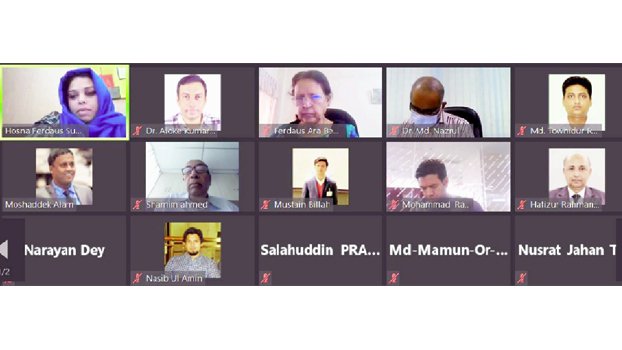
Director General of BSTI Dr. Md. Nazrul Anwar said this while speaking at a virtual dialogue on Identifying the Challenges and Measuring Gaps of Present Standardization Capability in Bangladesh for Export Potential Products on Tuesday.
He also said that BSTI has taken two projects on setting up 90 laboratories for product standardization and certificate issuing and establish its logistics infrastructure in 10 more districts.
However, it takes six months to complete the adaptation of an international standards, it takes more than three years to set a product standard. Thus, international product standards adaptation is more time saving than setting up new product standards. BSTI welcomes the recommendations and suggestions from the private sector. Close coordination among the stakeholders will help the government to reach export target, export market expansion and export diversification, said he.
Business Initiative Leading Development (BUILD) in collaboration with IFC-WBG organized the webinar. While Moderating dialogue, Ferdaus Ara Begum, CEO, BUILD in the beginning delineated the objectives of the Dialogue informed that in order to become successful and competitive exporter in the current global market, they must be ensured that their products fulfill the strict requirements of quality demanded by the foreign markets. In this respect up to date information on technical regulations specified in standards or technical regulation set by WTO as demanded by the foreign markets is very important.
Dr. Syed Humayun Kabir, Former Director General, SARSO, SAARC made the keynote presentation on the importance of standard setting for Potential Export Products (PEP). He focused on identifying gaps of PEP in existing BSTI standards, identifying international standards for shortlisted PEP for plastics, leather and leather goods, and light engineering, and developing recommendations to harmonize those additional standards. Having discussed the present standard infrastructure of Bangladesh, he shared the list of 42 potential export products identified by BUILD out of which 12 products were shortlisted.
Dr. Kabir stated that product certification scheme allows the licensees to use the BSTI product certification mark on products that conform to a Bangladesh standard. BSTI plays leading role in all matters related to standardization, testing, certification and metrology. Till now 3950 standards have been developed through consensus of six divisional and 76 technical committees.
The standards item is selected by considering the need of the users and industry. Some PEPs have BSTI Standards, while others don’t have the same. He mentioned that BSTI standard needs to be prepared and updated for all PEPs especially in the Leather and Leather Goods, Plastic and Light Engineering sector.
Shamim Ahmed, President, Bangladesh Plastic Goods Manufacturers and Exporters Association (BPGMEA) mentioned that the plastic industry is a very important export-oriented industry that also serves other sectors as a backward linkage industry specially RMG, electronics sector etc.
It is essential to ensure standardization of toys, kitchen and household, bags and sacks to increase export in view of their substantial export potential. BSTI should signs MoUs with others counterparts to expand the export market. Proper coordination is required to simplify the standardization process.
MD. Abdul Razzaque, President, Bangladesh Engineering Industry Owners' Association (BEIOA) suggested that best practices of other countries should be taken into account. A time bound program should be initiated on product standardization and accreditation with enhanced testing equipment and lab facility that meet global standards.
Dr. Aloke Kumar Mozumder, Professor, BUET pointed out the limitations of standardization gaps and said that it is a very difficult and complex process to set standard for products. Setting standards of products based on local demand requires local research.
A synchronized research initiative among the public sector, private sector and the academia is required. It is high time to take initiative to reduce administrative processing time and complexity for product standardization. Knowledge gaps in this area needs to be mitigated. BSTI should continuously assess demand for standardizations of potential products.
Further, Ferdaus Ara Begum, CEO, BUILD pledged that BUILD and the IFC, WBG will continue to engage in this critical issue and work closely with BSTI and other relevant stakeholders to advocate mitigation of any gaps in the standardization system. She mentioned that to assist the potential exporters testing facilities as per the need of the exporters should be created, which may take time , however the process should be started immediately.
Then the cost of the exporters will be reduced, time will be saved, will increase. In this respect private sector industries and the donor agencies should come forward to assist. She thanked all the participants for their valuable contribution to the discussion and concluded the workshop.