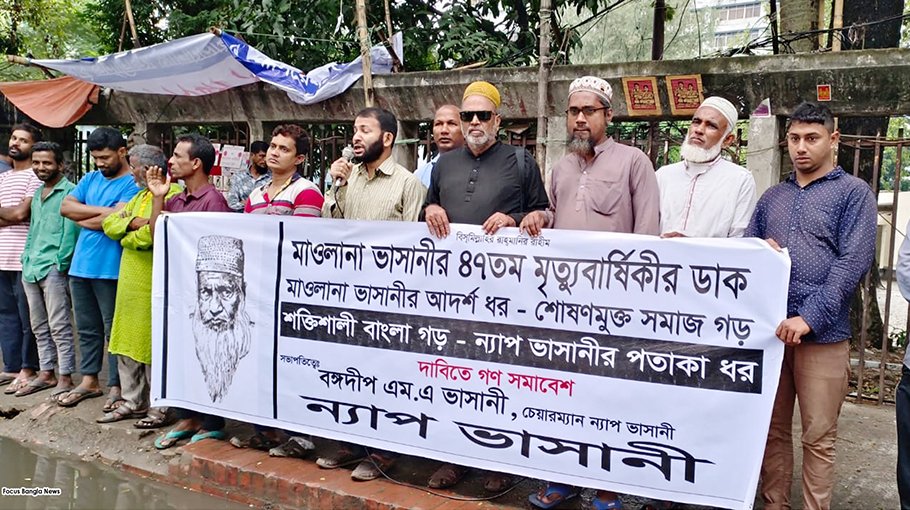
The 47th death anniversary of country’s legendary leader Maulana Abdul Hamid Khan Bhasani was observed on Friday (November 17, 2023).
To mark the day, different socio-political organisations observed various programme in Dhaka city and other parts of the country.
The day was observed in Tangail through various programmes. Vice-Chancellor of Maulana Bhashani Science and Technology University (MBSTU) Professor Dr Md Farhad Hossain inaugurated the day’s programmes by paying tribute and placing flower wreaths at the Bhasani’s mazar on the campus.
After that, floral tributes were paid by various organisations of the university. Later, wreath were laid by Bhasani’s family and other organisations.
A milad and a doa mahfil was also held at the Central Jam-e Mosque of the university after Zuhor prayer.
Maulana Abdul Hamid Khan Bhasani, popularly known as “Majlum Jananeta” (the leader of the downtrodden), passed away on November 17 in 1976.
He was born on December 12 in 1880 in Dhangara village of Sirajganj. He was involved in politics from his young life. All his life he had fought for the welfare of common people. The historic Kagmari Conference held at Kagmari in 1957 on his initiative turned the tide in Bangladesh politics.
In 1911, he entered into politics. Befriended by Deshbandhu Chittaranjan Das, he participated in Deshbandhu’s Swaraj movement and later also joined Khilafat Movement.
Maulana Bhasani left the Congress in 1936 and joined the Muslim League. He also became the president of the Provincial Muslim League of Assam. In 1937, he was elected as an unopposed member of the Assam Provincial Council.
In January 1970, he held a historic farmers' conference in Shantosh. On December 4, in a public meeting in Paltan, he announced the independence of East Pakistan. After independence, he was under house arrest for a long time.
Maulana Bhasani was a popular leader in his fight against imperialism and the oppression of Pakistani rulers. He played a key role in the 1969 mass movement against autocratic ruler Ayub Khan.
He also worked as the chairman of the All Party Action Committee during the Liberation War. He led the historic Farakka March in 1976 to ensure Bangladesh's just rights to share of the Ganges River water.
He was the founder and president of the Pakistan Awami Muslim League which later became the Awami League (AL). He also formed a progressive political organisation, National Awami Party (NAP).