Bangladesh Garment Manufacturers and Exporters Association (BGMEA) has requested the European Union to extend the trade facility under the GSP scheme for another six years instead of three years.
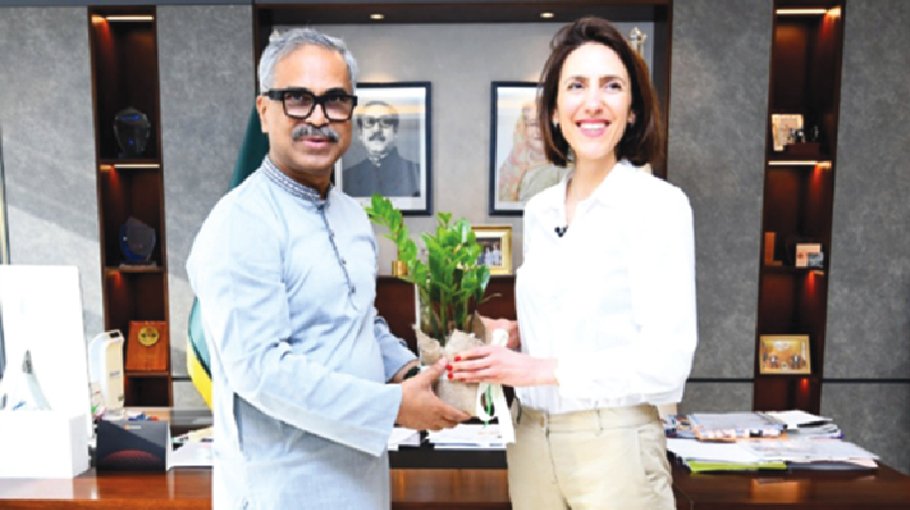
BGMEA President Faruque Hassan made this request in a meeting held with Member of European Parliament Valérie Hayer at BGMEA Complex in Uttara, Dhaka on April 12.
Figure: BGMEA President Faruque Hassan made this request in a meeting held with Member of European Parliament Valérie Hayer at BGMEA Complex.
The meeting discussed various issues including bilateral trade, LDC graduation and its potential impact on the trade and economy of Bangladesh, the current situation of the garment industry, and its prospects and challenges. They also discussed the proposed EU GSP scheme for 2024-2034 and how it would affect Bangladesh’s preferential trade facilities in the EU market under GSP Plus after LDC graduation.
Faruque Hassan said specific EU safeguard mechanisms in the proposed GSP scheme would keep Bangladesh’s garment exports out of any tariff benefits, although the country could qualify for GSP Plus after transitioning from an LDC.
He said it would negatively affect the competitiveness of Bangladesh’s garment industry, which is the source of livelihood for millions of people. Moreover, the garment industry is also important for the economic growth of Bangladesh as a major export sector.
Due to the great importance of the garment sector in the socio-economic development of Bangladesh, the BGMEA president emphasized on continuing the cooperation from the EU, especially the continuation of preferential market facilities for the export sector including the garment industry even after the LDC graduation.
He also requested the European Union to withdraw the textile threshold criteria or redesign the process/mechanism for Bangladesh in the proposed GSP scheme. So that Bangladesh LDC can get benefits from GSP Plus after graduation.
BGMEA president apprised Valérie Hayer about the great strides made by the garment industry in Bangladesh in terms of workplace safety, environmental sustainability, and workers’ rights and welfare.
He also briefed the European Parliament member on the industry’s advancement in a circular fashion and the industry’s emphasis on product diversification and technological upgradation to increase capacity in sustainable garment production.