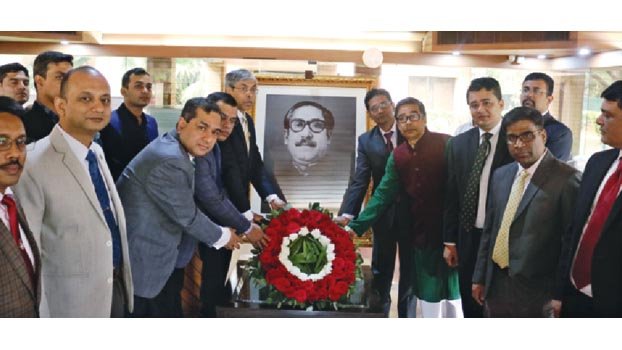
Bangladesh High Commission in New Delhi paid homage to Father of the Nation Bangabandhu Sheikh Mujibur Rahman on Saturday marking his historic 7th March speech in 1971 that galvanised the people of Bangladesh to prepare for the war of liberation.
High Commissioner Muhammad Imran led the members of the mission to place a floral wreath at the portrait of Bangabandhu at the chancery building. He also presided over a discussion meeting underlining the significance of the 18-minute speech that was recognized as the Memory of the World Register by UNESCO in 2017.
He said the historic speech, delivered extempore before a sea of crowd at then-Race Course (now Suhwardy Uddyan) in Dhaka will remain ever inspiring for the people of Bangladesh as they work hard, under the leadership of Prime Minister Sheikh Hasina, to build Sonar Bangla as dreamt by Bangabandhu.
Farid Hossain, Minister (Press), at the mission was the keynote speaker at the meeting. Deputy High Commissioner A.T.M. Rokebul Haque read out the 7th March message from President Md. Abdul Hamid, while the message from Prime Minister Sheikh Hasina was read out by Commerce Counsellor Dr. A.K.M. Atiqul Haque.
First Secretary Zakir Ahmed recited poet Nirmalendu Goon’s “Swadhinata, Ei Sabati Kibave Amader Holo” at the meeting, which was conducted by Minister (Political) Md. Nural Islam. UNESCO in 2017 recognised the speech as a documentary heritage. It's a recognition of the ‘universal significance’ of the speech that led to the Independence of Bangladesh.
While recognising this historic speech, UNESCO said: "The speech effectively declared the independence of Bangladesh." Then UNESCO chief Irina Bokova said: "He (Bangabandhu) stood before history with a deeply emotional summons for justice, emancipation, freedom and human dignity". She had continued: "This is a speech deeply anchored in human experience".
Unesco also said: "The speech constitutes a faithful documentation of how the failure of post-colonial nation-states to develop inclusive, democratic society alienates their population belonging to different ethnic, cultural, linguistic or religious groups." The speech was extempore and there was no written script.