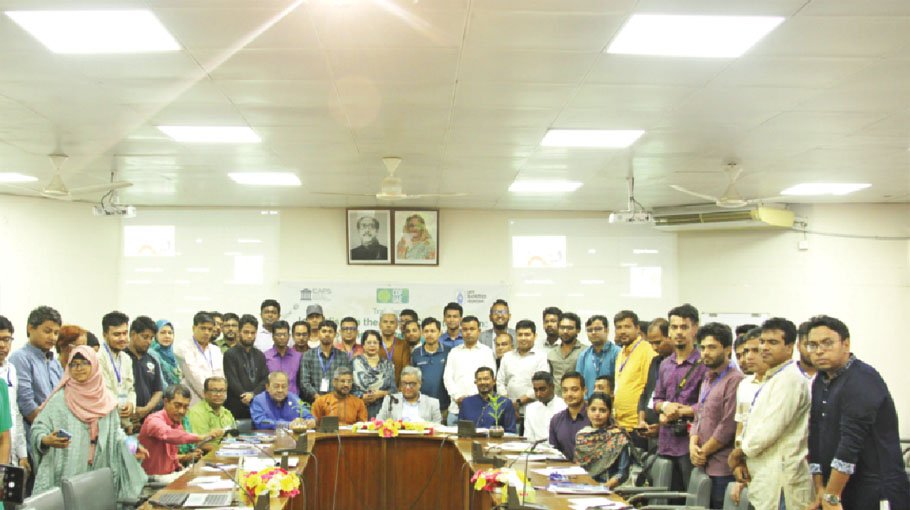
Lawmakers, experts on climate change and environment and rights activists have emphasised on raising a strong voice in the world forum on climate issues to save Bangladesh from droughts and other climatic disasters.
“Bangladesh is one of the most vulnerable countries to climate change. More people displaced because of climate change than because of conflict. If we don’t get out of the current situation, the damage will be dire,” said Barrister Shameem Haider Patwary, MP from Gaibandha-1 constituency and a member of Climate Parliament Bangladesh.
Saying that the climate issue needs to be voiced strongly in the world forum to overcome such an apprehended situation, Professor Dr. ASM Maksud Kamal, pro-vice chancellor (education) of Dhaka University; commented that if the temperature rises by another two degrees Celsius, the drought that occurs in the Barind region will gradually spread to the southern and central parts of the country.
Professor Dr. ASM Maksud Kamal, who is scheduled to take charge as the 29th vice-chancellor of Dhaka University today (November 4); and Barrister Shameem Haider Patwary, MP, made their comments while speaking as the chief gust and a special guest respectively at the inaugural session of a two-day training programme on Friday (November 3, 2023).
Center for Atmospheric Pollution Studies (CAPS) and Press Institute Bangladesh (PIB) in collaboration with nine other environmental organisations jointly arranged the training workshop titled “Journalism in the Age of Climate Change: COP28 Coverage and Mentoring” at the conference room of PIB in the city.
Zafar Wazed, director general of the PIB; presided over the inaugural ceremony; while Rana Mohammad Sohail, MP from Nilphamari-3 constituency; also spoke on the occasion, among others.
Professor Dr. Ahmad Kamruzzaman Majumder, founder and chairman of CAPS who is also chairman of Department of Environmental Science at Stamford University Bangladesh; delivered the welcome speech.
The training workshop was arranged on the occasion of Climate Conference (COP28), the 28th annual United Nations climate change conference which will take place from November 30 to December 12 in Dubai.
A number of journalists, who are willing to cover the climate conference and will participate in the COP28 for coverage, are taking part in the training workshop, which will end today (Saturday).
On the first day, Professor Dr. Ainun Nishat, an eminent expert on water resource management and climate change in Bangladesh; and other eminent environmental and hydrological experts provided training in skill development for journalists. Among them, M. Zakir Hossain Khan, executive director of Change Initiative; Dr Khondaker Golam Moazzem of CPD; Dr SM Munjurul Hannan Khan, executive director of Nature Conservation Management (NACOM) and a former additional secretary of the Ministry of Environment, Forest and Climate Change; Dharitri Kumar Sarkar, a current deputy secretary of the ministry; and Md. Shamsuddoha of Center for Participatory Research and Development (CPRD).
The training workshop is co-organised by Centre for Climate Change and Environmental Research (C3ER) of BRAC University; CPRD; Change Initiative; Legal B; Legal Forum; NACOM, Paribesh Udyag; South Asian Climate Change Journalists Forum and YouthNet for Climate Justice.
Saber Hossain Chowdhury, MP, special envoy to Prime Minister for environment and climate change; will attend the closing ceremony of the event at 3:00 pm today (November 4) and distribute certificates among the participants. Marie Masdupuy, French Ambassador to Bangladesh; and Nayoka Martinez Bäckström, deputy head of Development Cooperation Environment and Climate Change at Sweden Embassy to Bangladesh; will also attend the concluding ceremony.
Professor Dr. Ainun Nishat at the first of the training workshop said that the climate is changing very fast. “We need to take necessary steps to control the trend. Biodiversity and natural ecosystems must be protected. In that case, Theory of Change should be applied along with Project of Analysis. Countries that are sitting on compensation, through proper management we need to recover compensation and work to control climate change,” he also said.
In his speech, Professor Dr. ASM Maksud Kamal said that if the drought that takes place in Barind region gradually spreads to the country’s other regions, it can have a major impact on food security.
About the COP28, he said that although loss and damage issues were discussed in the past COPs, there were no talks about funds. The temperature in different countries of the world is increasing, while decreasing in some other places due to climate change. For this reason, the working capacity of people is decreasing, he added.
The DU professor further said, “Currently importance is being given to the green industry. Who will provide the necessary financing for it? Bangladesh is still the seventh most vulnerable country to climate change. If the temperature of the world can be kept at 1.5 degrees, the damage from disasters will be less.”
He said that even though there are a lot of talks in the COPs, the affected countries don’t get compensation. However, no damage policy has been formulated till now. How can a country receive money if it is not determined how much damage has been or is being done?
Dr. Maksud Kamal said that a revolution in information flow is a must to overcome the challenges regarding climate change.
In his presidential speech, Zafar Wazed said that many talks have been made in the past climate conferences, including the COP held in Paris, but the results have been zero. Care must be taken that the upcoming Dubai conference does not fall into this situation, he added.
“Six seasons are not found in Bangladesh now due to climate change. We now spend nine months of the year in the heat. The severity of winter has also increased more than before. We experience climate change,” he said.
Barrister Shameem Haider Patwary, MP, said “We are living in an era not of climate change, but of climate disaster. Bangladesh has the second highest number of climate refugees after China. If 25 per cent of the delta is lost, what will happen to those helpless people? We need to take effective steps now.”
Rana Mohammad Sohail, MP, said that Bangladesh is at the beginning of the list of countries suffering from environmental damage. “We are in dire straits. As a developing and a country of delta, it is logical for Bangladesh to demand climate compensation at the COP. The journalists as the representatives of Bangladesh can raise the demands in COP,” he added.